



S. Korea allows foreign AI scholars to hold dual professorships at local universities
Nov 10, 2026, 03:34 pm


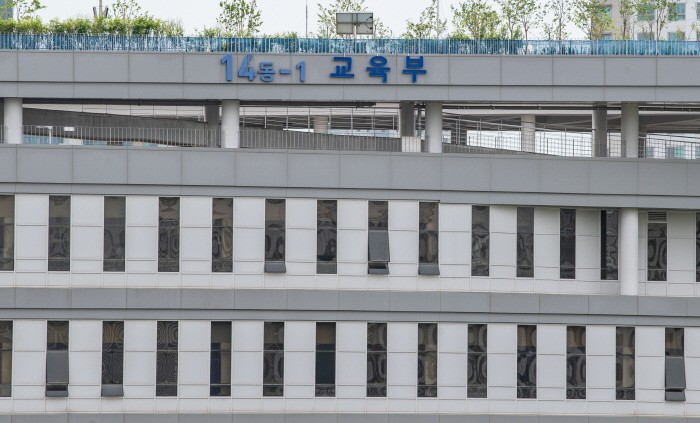 |
| A view of South Korea's Ministry of Education. /Photo by Park Seng-il |
Professors at overseas universities will be allowed to take up full-time faculty positions at South Korean universities while retaining their existing academic appointments abroad.
The measure is aimed at attracting leading international scholars in advanced industries such as artificial intelligence (AI) and big data to South Korean universities.
The Ministry of Education announced Tuesday that the Cabinet had reviewed and approved a partial amendment to the Enforcement Decree on the Appointment of Educational Public Officials.
Previously, restrictions on concurrent employment under the State Public Officials Act and other relevant laws meant that professors at foreign universities had to resign from their existing positions before being appointed as full-time faculty members at South Korean universities.
This requirement had been criticized for making it difficult for domestic universities to recruit leading international scholars.
In response, the Educational Public Officials Act was amended in May to establish a legal basis allowing professors from foreign universities appointed to South Korean universities to retain their overseas positions with the approval of the university president.
The revised enforcement decree, which takes effect on Nov. 20, specifies the fields eligible for concurrent appointments and the procedures for obtaining approval, as delegated by the amended law.
Concurrent appointments will be permitted in advanced industrial fields, including AI and big data, as well as specialized fields designated by individual universities.
University presidents must review applications from faculty members and obtain deliberation by the university personnel committee before granting approval for concurrent appointments.
The committee must comprehensively assess the need for the concurrent appointment, obligations to maintain the confidentiality of official information, plans for managing research outcomes, and the potential impact on student education, academic supervision and research.
The special provisions governing concurrent appointments will apply equally to faculty members at both national and public universities and private universities.
"I hope this measure will encourage more outstanding scholars from overseas to take up positions at Korean universities," Education Minister Choi Kyo-jin said.
"I also expect it to improve the quality of education and research at our universities and expand educational and research exchanges between Korean and overseas institutions."
Kim Nam-hyung
Most Read
-
1
Ukraine halts strikes on Russian oil refineries un..

-
2
China's fifth plenum to conclude amid expectations..

-
3
Southeast Asian auto parts makers hit hard by Chin..

-
4
U.S. links Myanmar peace efforts to rare earth acc..

-
5
Hegseth rejects calls for impeachment over Iran wa..

-
6
Democrats flip U.S. Congress in historic midterm s..

-
7
USFK commander cites interoperability gaps, urges..

PEOPLE






-
Address : In-Young Bldg., 34, Uisadang-daero 1-gil, Yeongdeungpo-gu, Seoul
Copyright by ASIATODAY CO., LTD. All rights resereved