



Southeast Asian auto parts makers hit hard by Chinese EV boom paradox
Nov 02, 2026, 01:15 pm


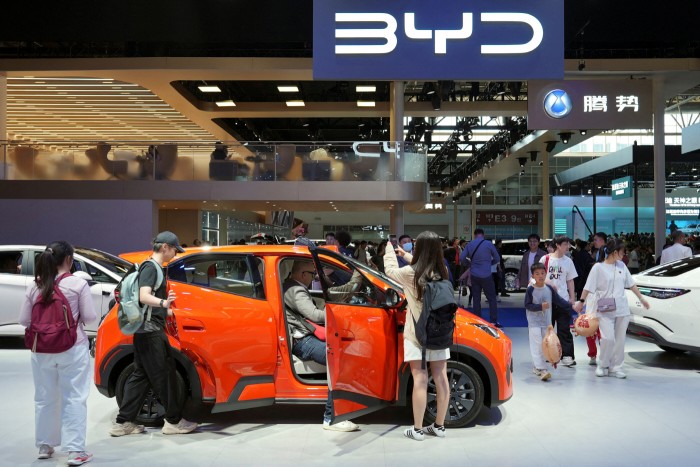 | ||
Visitors look at BYD's Seagull electric vehicle at the Beijing International Automotive Exhibition (Auto China) in April. / Reuters-Yonhap
Chinese electric vehicles are booming in Southeast Asia, but local auto parts manufacturers are struggling with a shortage of orders. Demand for parts used in conventional internal combustion engine vehicles is declining, while Chinese electric vehicle makers rely on imported components and their own suppliers rather than sourcing parts locally.
The South China Morning Post (SCMP) reported on Nov. 2 (local time) that small and medium-sized auto parts manufacturers in Indonesia, Thailand and Malaysia face a double challenge of shrinking demand for internal combustion engine vehicles and high barriers to entering electric vehicle supply chains. Concerns have been raised that the transition to electric vehicles could instead hollow out Southeast Asia's auto parts industry unless government support and connections with Chinese automakers are expanded.
Internal combustion vehicles use up to 70% local parts, EVs just 20%
The spillover benefits of Chinese electric vehicle investment for local industries are far smaller than those generated by conventional vehicle manufacturing. According to reports by Malaysian media outlets in March, locally produced components accounted for just 20% to 30% of electric vehicles assembled in the country, far below the figure of up to 70% for foreign-brand internal combustion engine vehicles.
In the case of Chinese electric vehicle maker BYD, the company disagreed with Malaysia's Ministry of Investment, Trade and Industry (MITI) over conditions including a requirement to export up to 80% of production. It subsequently abandoned plans to establish an assembly plant in Tanjung Malim, Perak, in September and shifted to contract assembly at Malaysian company Inokom's existing plant in Kulim, Kedah, on Oct. 15.
The situation is similar in Thailand, long known as the "Detroit of Southeast Asia," and Indonesia.
In its "Industry Outlook 2026–2028" report, Krungsri Research, a research arm of Thailand's Bank of Ayudhya, found that Chinese automakers import major components or rely on their existing Chinese suppliers, while Thai parts manufacturers struggle to enter their supply chains because they lag behind in both cost competitiveness and advanced proprietary technology.
Chinese companies consider Thai parts suppliers slower and more expensive than their Chinese counterparts. BYD's Thai subsidiary said it had increased its local parts content from 45% to 54%, but local industry officials complain that Chinese brands use far fewer Thai-made components than Japanese brands.
"The supply chains for Japanese cars and Chinese electric vehicles are completely different," said Bhima Yudhistira Adhinegara, director of Indonesia's Center of Economic and Law Studies (CELIOS). "Chinese electric vehicle investment has generated very little business for local parts manufacturers."
He identified financing, technology and access to automakers as three major barriers, adding that small and medium-sized Indonesian parts manufacturers, already struggling with weak domestic demand and rising fuel costs, are surviving by scaling back operations, lowering quality and requesting debt restructuring.
Hybrid vehicles and maintenance market offer alternatives, but government support urgently needed Hybrid vehicles are seen as a practical buffer that parts manufacturers can rely on for now. Krungsri Research noted that hybrid vehicle production in Thailand is supporting demand for both conventional engine components and electrical system parts, while Japanese hybrid vehicle manufacturers source a substantial amount of their components locally. A master plan released on Oct. 13 by the Economic Research Institute for ASEAN and East Asia (ERIA) also proposed a phased strategy of supporting low-emission vehicles and hybrid vehicles in the short term before transitioning to electrification. Somporn Thanadumrongsak, president of the Thai Auto Parts Manufacturers Association, also urged parts manufacturers to turn to non-automotive sectors, including railways, medical devices, aviation and agricultural machinery. Replacement parts for aging internal combustion engine vehicles and the repair and maintenance market are also being considered as alternatives, but technological barriers remain high. Teoh Jiun Ee, co-founder of Southeast Asian used-car platform CARSOME and CEO of CARSOME Academy, explained that Malaysia has a well-established general maintenance ecosystem covering vehicle bodies, tires and suspensions, but that electric vehicle high-voltage systems, battery assessments and model-specific components require specialized expertise. CARSOME itself can inspect electric vehicles but cannot repair or replace individual battery modules, instead referring them to manufacturers. "If individuals have to bear the full cost of retraining technicians, those who most urgently need to upgrade their skills may find it difficult to receive training," Teoh warned. Ultimately, calls are growing for active government industrial policies to support the sector. One example is an initiative undertaken in May last year by the Malaysian Investment Development Authority (MIDA), which connected 23 domestic parts manufacturers with 12 technology suppliers associated with Chinese automaker Chery, resulting in four memorandums of understanding (MOUs) covering parts, technology transfer and joint investment. "There are no transition incentives for small internal combustion engine parts manufacturers," Bhima Yudhistira Adhinegara, director of Indonesia's Center of Economic and Law Studies (CELIOS), said, calling for local sourcing requirements to help these companies enter supply chains. Aiman Abdullah, editor-in-chief of automotive publication Motoring Malaysia, also said that experience with high-voltage systems in hybrid vehicles would help parts manufacturers enter the electric vehicle market. However, he emphasized, "It takes parts manufacturers six to 18 months to prepare for mass production and about 10 years to recoup their investments. The government and automakers must therefore establish clear plans and support funds before investors will open their checkbooks." Jeong Ri-na |
Most Read
-
1
Putin proposes trilateral U.S.-China-Russia summit..

-
2
U.S., Israel plan to resume strikes on Iran after..

-
3
Ukraine halts strikes on Russian oil refineries un..

-
4
China's fifth plenum to conclude amid expectations..

-
5
ASEAN to discuss Myanmar's return next month

-
6
AI-discovered PHP flaw triggers global cybersecuri..

-
7
UK court orders worldwide asset freeze on Vietnam'..

PEOPLE







-
Address : In-Young Bldg., 34, Uisadang-daero 1-gil, Yeongdeungpo-gu, Seoul
Copyright by ASIATODAY CO., LTD. All rights resereved