



Deaths in Democratic Republic of the Congo top 5,000
Nov 02, 2026, 10:41 am


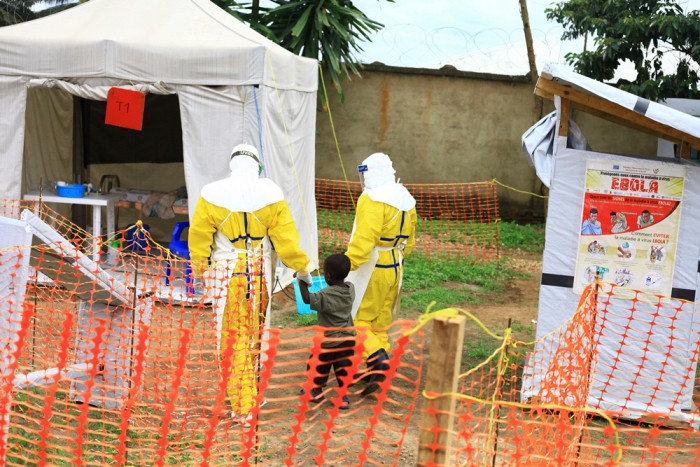 |
| Healthcare workers walk with a child suspected of being infected with the Ebola virus at an Ebola treatment center in Beni, eastern Democratic Republic of the Congo. / AP-Yonhap |
The death toll from an ongoing Ebola outbreak in the Democratic Republic of the Congo (DRC) has exceeded 5,000. Efforts to contain the outbreak have been hampered by the lack of an approved vaccine or treatment for the Bundibugyo virus responsible for the outbreak, along with conflict and poor healthcare conditions.
Reuters reported on Oct. 30 (local time), citing DRC government data, that the cumulative death toll from the current Ebola outbreak had surpassed 5,000. More than 10,000 infections have been reported since the outbreak was declared in May.
An earlier report released by DRC health authorities on Oct. 27 recorded 10,060 confirmed cases and 4,887 deaths as of Oct. 25. DRC figures published by the U.S. Centers for Disease Control and Prevention (CDC) showed 10,274 confirmed cases and 4,992 deaths as of Oct. 28. A subsequent report on Oct. 30 indicated that the death toll had exceeded 5,000.
The current outbreak has surpassed the 2018–2020 Ebola outbreak in the DRC to become the largest in the country's history in terms of infections and deaths. Globally, it is the second-largest outbreak after the 2014–2016 West African outbreak, which killed more than 11,000 people.
The outbreak, first identified in northeastern Ituri Province in May, has spread to North Kivu, Haut-Uélé, Tshopo and other provinces. Eight of the DRC's 26 provinces are currently affected, while related infections have also been reported in Uganda, Kenya and Nigeria.
According to data released by the World Health Organization (WHO) on Oct. 23, the case fatality rate in the DRC stood at 48.3% as of Oct. 20. The WHO explained that there is still no approved vaccine or specific treatment for the Bundibugyo virus responsible for the current outbreak.
Poor healthcare conditions and insecurity are among the factors hampering containment efforts. Patients are not being identified promptly, while shortages of healthcare facilities, testing capacity and protective equipment are disrupting the response. Conflict and threats against healthcare workers are also hindering contact tracing and infection control. The large number of deaths occurring outside treatment facilities also highlights the limitations of early diagnosis and access to treatment.
The WHO and national health authorities are strengthening early case detection, isolation, treatment and contact tracing. The WHO emphasized continued surveillance and cross-border cooperation to control the outbreak, saying that prompt case identification, testing and appropriate treatment can help reduce the death rate.
Lee Se-mi
Most Read
-
1
Putin proposes trilateral U.S.-China-Russia summit..

-
2
U.S., Israel plan to resume strikes on Iran after..

-
3
Ukraine halts strikes on Russian oil refineries un..

-
4
China's fifth plenum to conclude amid expectations..

-
5
ASEAN to discuss Myanmar's return next month

-
6
AI-discovered PHP flaw triggers global cybersecuri..

-
7
UK court orders worldwide asset freeze on Vietnam'..

PEOPLE







-
Address : In-Young Bldg., 34, Uisadang-daero 1-gil, Yeongdeungpo-gu, Seoul
Copyright by ASIATODAY CO., LTD. All rights resereved