



ASEAN to discuss Myanmar's return next month
Oct 26, 2026, 10:08 am


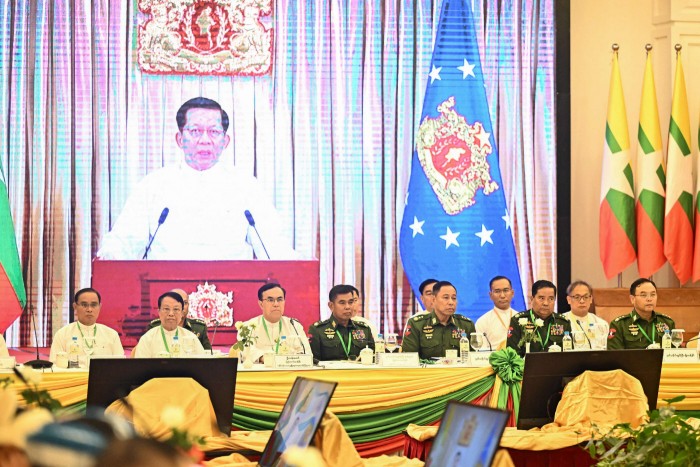 |
| Myanmar's military-backed President Min Aung Hlaing delivers a video address during an event marking the 11th anniversary of the Nationwide Ceasefire Agreement (NCA) in Naypyidaw, Myanmar, on Oct. 15 (local time). / AFP, Yonhap |
Thailand has welcomed the United States' efforts to expand engagement with Myanmar's military-backed government. The Association of Southeast Asian Nations (ASEAN) is also expected to hold substantive discussions at next month's summit on how to deal with Myanmar, whose political leaders have been excluded from high-level meetings since the 2021 coup.
According to Reuters and local media reports on Oct. 25 (local time), Thai Deputy Prime Minister and Foreign Minister Sihasak Phuangketkeow welcomed U.S. engagement with Myanmar in a recent interview with Reuters, saying, "We don't want to see Myanmar isolated, we don't want Myanmar to be an arena for geopolitical rivalry." However, he stressed that such engagement "does not mean legitimizing the regime," explaining that it was intended to encourage a peaceful resolution to the conflict and reconciliation with the opposition.
Signs of a shift in ASEAN's position are also emerging. Sihasak pointed to Myanmar President Min Aung Hlaing's recent visits to Laos, Cambodia, Vietnam, Thailand and Malaysia as evidence of some change in the regional bloc's stance. He predicted that "a very substantive, very extensive, and very in-depth discussion" on Myanmar would take place at next month's ASEAN summit in Manila, the Philippines. However, he added that it remained unclear whether the summit would address restoring Myanmar's full representation, given that ASEAN has barred Min Aung Hlaing from attending its summits over Myanmar's failure to implement the Five-Point Consensus adopted in April 2021.
Thailand's position comes as the United States is accelerating efforts to resume dialogue with Myanmar's military leadership, which Washington had shunned since the coup. According to Reuters, U.S. and Myanmar officials held closed-door talks in Tokyo, Japan, earlier this month. The meeting was their second in a month, following talks between U.S. Assistant Secretary of State for Intelligence and Research Michael Vance and President Min Aung Hlaing in Myanmar's capital, Naypyidaw, on Sept. 15 and 16. Sources said Vance also led the Tokyo talks.
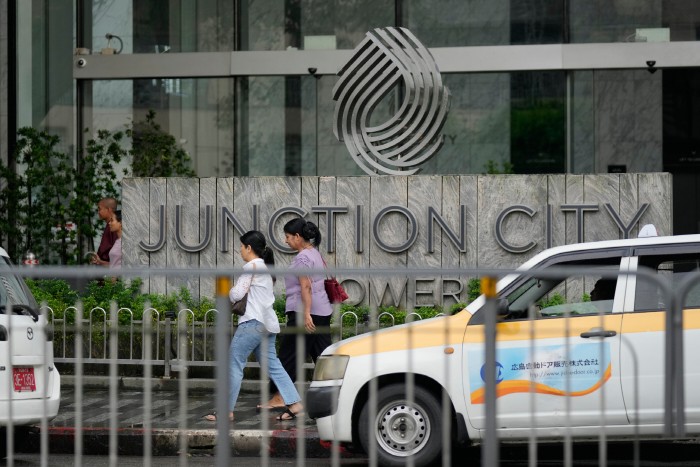 |
| Pedestrians walk past the entrance to Junction City Tower, which houses the American Chamber of Commerce in Myanmar (AMCHAM), in Yangon, Myanmar, on Sept. 15. / AP, Yonhap |
The BBC noted that Vance was the highest-ranking U.S. official to meet Min Aung Hlaing in person since the 2021 coup. The stated purpose of the earlier meeting in Naypyidaw was to secure the release of American citizen Adam Castillo, who had been detained in June following a dispute with the local American Chamber of Commerce. Castillo was indeed released following the meeting. However, Reuters reported, citing current and former officials, that Washington's underlying objective was to crack down on online scam centers targeting Americans and that discussions could eventually expand to cooperation on rare earth minerals.
The BBC reported that signs of a shift in U.S. policy toward Myanmar began emerging in July last year. At the time, as part of his tariff campaign, Trump sent Min Aung Hlaing, then the head of Myanmar's military government, a letter notifying him of a 40% tariff. Unlike leaders of other countries who were taken aback by the announcement, Min Aung Hlaing promptly replied, praising Trump's "strong leadership." The BBC also highlighted Trump's decision to address the internationally isolated leader as "Your Excellency," just as he did other heads of state.
The exchange prompted Myanmar's military government to step up its lobbying efforts in Washington. That same month, the government signed a $3 million (approximately 4 billion won) contract with Washington lobbying firm DCI and subsequently hired Roger Stone, a close Trump ally, for $50,000 (approximately 66.34 million won) a month. Around the same time, Castillo, who had recently stepped down as president of the American Chamber of Commerce in Yangon, was also trying to persuade Vice President JD Vance's team to reengage with Myanmar.
Economic interests also played a role. In April last year, China imposed restrictions on rare earth supplies in response to U.S. tariffs, prompting the Trump administration to seek alternative sources. Myanmar, home to substantial rare earth deposits, emerged as a potential alternative. Currently, all rare earth minerals extracted in Myanmar are mined for China.
The U.S. State Department's instructions to overseas diplomatic missions around the same time to refrain from assessing the fairness or legitimacy of elections in their host countries have also been interpreted as part of this policy shift. Unlike most Western countries, the United States did not criticize Myanmar's general election, held between December last year and January this year. Min Aung Hlaing subsequently assumed the presidency of a nominally civilian government in April this year following the election. Washington's recent removal of some Myanmar business figures from sanctions lists imposed under the Biden administration has further reinforced perceptions of a change in U.S. policy.
However, it remains uncertain whether the United States can secure tangible benefits from its engagement with Myanmar. The BBC pointed out that most of Myanmar's rare earth deposits are located in areas affected by fighting with ethnic armed groups. Moreover, Chinese companies with a longstanding presence in the country extract the minerals and transport them directly across the border, making access difficult for the United States. Cooperation on cracking down on online scam operations is also considered unlikely to produce substantial results. Although some major scam compounds have been shut down, criminal networks have dispersed to smaller, more remote locations, most of which are protected by militias with ties to the military.
Experts have also cautioned against overstating the significance of improving U.S.-Myanmar relations. Richard Horsey, Myanmar adviser at the International Crisis Group (ICG), told the BBC that Min Aung Hlaing remains under sanctions and that "in practice less has changed than the headlines suggest." He noted that the main changes concerned the level and location of diplomatic engagement. Visits by senior U.S. officials to Naypyidaw were exactly what Min Aung Hlaing had wanted, Horsey said, but securing sanctions relief, his next objective, would be considerably more difficult.
Horsey further emphasized that engaging in dialogue with the authorities in Naypyidaw was not inherently wrong, but that the key question was what Washington would demand and what it would offer in return. He argued that the United States should use the new channel of communication to press for expanded humanitarian assistance and an end to airstrikes on civilians. He also recommended maintaining parallel communication with opposition forces and ethnic armed groups that control substantial portions of Myanmar's territory.
Jeong Ri-na
Most Read
-
1
Celltrion nears additional contract with major U.S..

-
2
Putin proposes trilateral U.S.-China-Russia summit..

-
3
U.S. weighs dropping MOAB, world's most powerful n..

-
4
"Aren't those foreigners on welfare?": M..

-
5
Attention centers on APEC for possible Trump-Xi-Pu..

-
6
U.S., Israel plan to resume strikes on Iran after..

-
7
China tightens grip on boosting domestic demand an..

PEOPLE







-
Address : In-Young Bldg., 34, Uisadang-daero 1-gil, Yeongdeungpo-gu, Seoul
Copyright by ASIATODAY CO., LTD. All rights resereved