



China tightens grip on boosting domestic demand and expanding anti-graft drive ahead of fifth plenum
Oct 19, 2026, 10:02 am


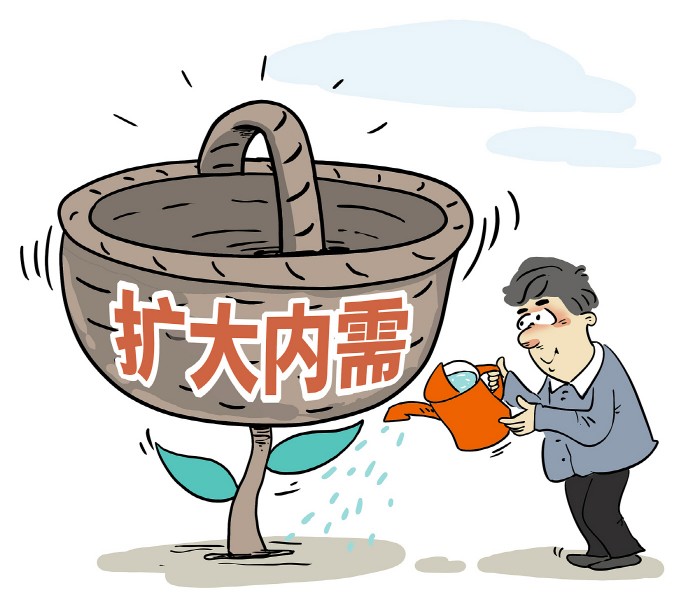 |
| An editorial cartoon from a media outlet illustrating that China's domestic demand has entered a fairly severe phase. Solutions are expected to be discussed at the party's 20th fifth plenum, which will be held for four days starting on the 26th. / Beijing Youth Daily (Beijing Qingnianbao) |
The Fifth Plenary Session of the 20th Central Committee of the Communist Party of China (20th Fifth Plenum), scheduled to be held for four days starting on the 26th, is widely expected to actively declare the formulation of effective measures to kill two birds with one stone: stimulating domestic demand and intensifying an internal anti-corruption purge. If these two goals are not achieved, plans by General Secretary and President Xi Jinping to secure long-term rule extending beyond a fourth term could be disrupted, making the preparation of high-intensity measures virtually a foregone conclusion.
Historically, a party fifth plenum in China focuses on the foundational macroeconomic policies of the party and government as a matter of principle. This meeting, opening in about a week, is no exception. It is certain to address pressing party and state affairs that have emerged as paramount issues. Therefore, it will inevitably engage in heated debates over measures to achieve the targets of the 15th Five-Year Plan (2026–2030), whose outline was established last year.
In this case, the most prominent point to watch is highly likely to be measures aimed at boosting domestic consumption. This is particularly true given that economic activity during the National Day holiday from the 1st to the 7th fell well short of expectations. When delving into specifics, several measures will likely be reviewed. First, a more aggressive push for trade-in subsidies (yijiuhuanxin, a subsidy policy for replacing old goods with new ones) could be raised. Automobiles, home appliances, and smart electronic devices are expected to remain key targets of this policy.
Promoting AI-based consumer spending, providing annual interest subsidies of up to 3,000 yuan (approx. 603,000 won) on personal consumer loans, and continuing the issuance of cultural and tourism consumption vouchers also warrant attention. Because their considerable effects have already been proven in the past, these cards are hard to abandon. This explains why Zou Fuming, an economic commentator in Beijing, lamented the absence of novel initiatives, remarking, "Stimulating domestic demand is essential for economic revitalization. That is why authorities have no choice but to cling to measures that have proven effective in the past."
Judging by recent moves to uncover and punish past wrongdoings even among retired senior party and government officials, tightening internal scrutiny and anti-corruption measures is also certain to be a key agenda item at this fifth plenum. It is by no means an accident that state-run media, including the party's theoretical journal Qiushi, emphasize that a central agenda of the meeting is "comprehensive and strict governance over the party" (zongyan zhidang). The same can be said of the tense and chilling atmosphere expected to prevail leading up to the opening of the meeting as names of high-ranking party and state officials soon to be purged circulate.
In addition, personnel reshuffles are also expected to emerge as a major issue at this meeting. While the exact timing remains uncertain, discussions are anticipated to center on advancing dark-horse figures across the party, government, and military from the so-called "post-70s generation" (those born in the 1970s), who are slated to play leading roles in the post-Xi era. In that event, some members of a successor group to follow President Xi could rapidly emerge. This is precisely why this fifth plenum is drawing more attention than any other plenary session of the Central Committee.
Hong Soon-do
Most Read
-
1
Celltrion nears additional contract with major U.S..

-
2
"Aren't those foreigners on welfare?": M..

-
3
U.S. weighs dropping MOAB, world's most powerful n..

-
4
Houthis launch successive attacks on Saudi airport..

-
5
Saudi Arabia, Iran hold first diplomatic talks to..

-
6
Saudi airport in Riyadh struck again, leaving at l..

-
7
Five ASEAN countries welcome Myanmar coup leader

PEOPLE





HEADLINE NEWS
- Trump's approval rating hits low of 33% as public turns back over soaring inflation
- Trump says Hyundai announced 748.6-billion-won investment in Georgia
- China tightens grip on boosting domestic demand and expanding anti-graft dr..
- Food prices jump 35% over 10 years, fueling massive protests by 800,000 acr..

-
Address : In-Young Bldg., 34, Uisadang-daero 1-gil, Yeongdeungpo-gu, Seoul
Copyright by ASIATODAY CO., LTD. All rights resereved