



Trump's approval rating hits low of 33% as public turns back over soaring inflation
Oct 19, 2026, 09:53 am


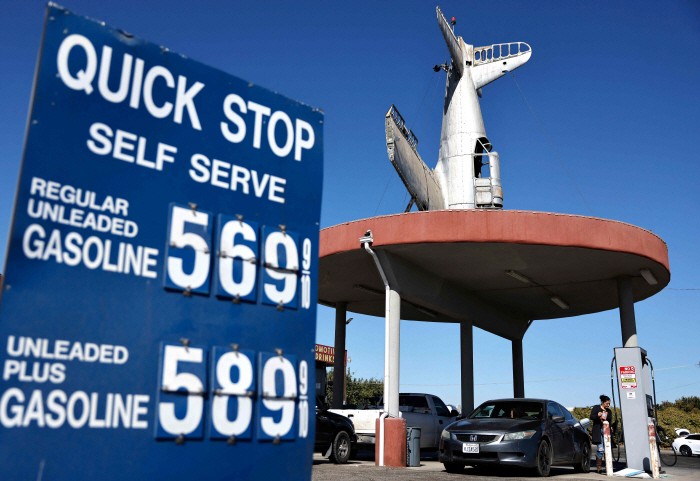 |
| Prices for regular and mid-grade gasoline per gallon (3.785 liters) are displayed at a gas station in California's 22nd Congressional District near Fresno on the 17th (local time). Democratic congressional candidate Randy Villegas is challenging incumbent Republican Representative David Valadao in the newly redrawn 22nd District. Located in the southern Central Valley of California, the district is a battleground where Latino residents make up a majority. With federal cuts to Medicaid, the low-income healthcare program, and food assistance budgets alongside stepped-up enforcement by Immigration and Customs Enforcement (ICE) emerging as local issues, this tight contest could have a significant impact on the outcome of the November midterm elections. / AFP, Yonhap |
[Article Summary]
1. With President Trump's job approval rating hitting a low of 33%, Democrats led Republicans by 8 percentage points in House voting intentions.
2. Economic discontent is mounting among households and rural communities as gasoline prices have surged 38% since his inauguration, and inflation has outpaced wage growth for six consecutive months.
3. Amid assessments that Democrats are likely to retake the House, polling margins of error in battleground Senate states and actual voter turnout among the Republican base remain variables determining the balance of power in Congress.
As U.S. President Donald Trump's job approval rating dropped to 33%, the lowest across his first and second administrations, the Democratic Party led the Republican Party by 8 percentage points in House voting intentions ahead of the November 3 midterm elections, according to a poll released on the 18th (local time) by U.S. daily The Washington Post and ABC News.
With inflation outpacing wage growth for six consecutive months and the burden of gasoline, electricity rates, and groceries mounting, signs of discontent and potential abstention are surfacing even in rural areas, the Republican Party's traditional base of support. While the likelihood of Democrats retaking the House majority is evaluated as high, races in Senate battleground states and voter turnout among the Republican base have emerged as key variables.
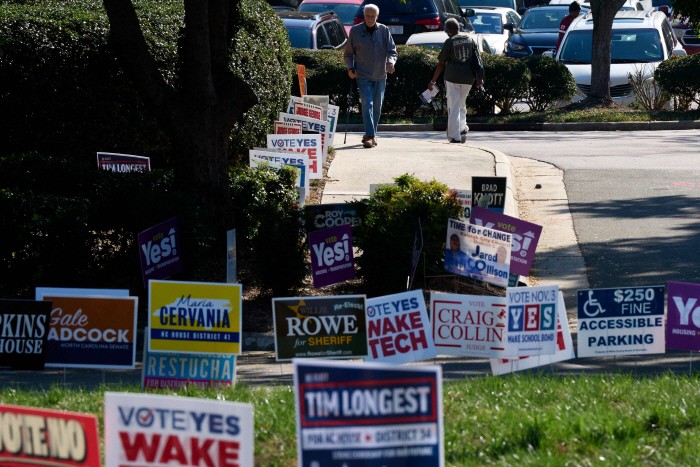 |
| Voters walk past campaign signs to cast their ballots at the Wake County Commons Building in Raleigh, North Carolina, on the 15th (local time). U.S. voters will decide which party controls the federal legislature for the remaining two years of President Donald Trump's term in the November 3 midterm elections. Governors in dozens of states and thousands of state government officials will also be elected in this election. / AFP, Yonhap |
Trump's approval rating hits low of 33% while Democrats hold 8%p lead in House race and outpace in voter enthusiasm
According to a survey of 2,545 U.S. adults conducted by Ipsos commissioned by The Washington Post and ABC News from the 9th to the 13th, President Trump's job approval rating stood at 33%, while disapproval was at 66%. Strong disapproval reached 52%. His approval rating fell by 4 percentage points compared to July and dropped 8 percentage points compared to a year ago.
In a survey released by NBC News on the 18th, his approval rating stood at 34%, while in a Fox News poll released on the 14th, it recorded 36%, each marking historic lows, U.S. online news outlet Axios reported.
In House voting intentions, Democrats led Republicans 52% to 44% among likely voters. Among registered voters, the margin stood at 50% to 42%. In the Fox News and NBC surveys, Democrats also held leads of 9 percentage points and 10 percentage points, respectively. Fifty-eight percent of respondents preferred a Democratic-led Congress to check President Trump, while 39% favored a Republican-controlled Congress. The 19 percentage point gap is roughly double that of a year ago.
Differences also emerged in voter enthusiasm and turnout intentions. While 75% of registered Democratic voters answered that they will definitely vote or had already voted, the figure for Republicans was 67%. While 75% of MAGA (Make America Great Again)-leaning Republicans intended to vote, only 57% of non-MAGA Republicans said the same. The turnout intention among respondents who supported Democratic candidate Kamala Harris in the 2024 presidential election stood at 84%, compared to 71% among Trump supporters.
Notably, 23% of respondents who voted for President Trump in 2024 currently disapproved of his job performance. The share disapproving of his economic management stood at 31%, and disapproval of his handling of inflation reached 38%. These voters broadly favored Republican candidates but displayed relatively lower motivation to vote, the Post reported. This serves as the reason why possibilities of abstention among the Republican base are being raised alongside shifts in support toward the Democratic Party.
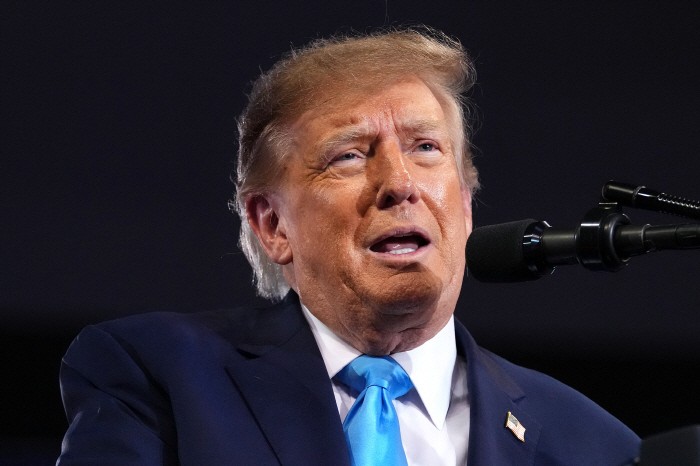 |
| U.S. President Donald Trump speaks at a midterm election campaign rally held at Truist Arena on Northern Kentucky University's campus in Highland Heights, Kentucky, on the 17th (local time). / AFP, Yonhap |
Economic policy approval at 28%; 48% say finances worsened
President Trump's economic policy approval rating stood at 28%, continuing its downward slide from 41% in February and 33% in July. This is 21 percentage points lower than the 49% recorded at the same point in 2018 ahead of the midterm elections of his first term. Disapproval of his economic management reached 70%, while disapproval of his handling of the cost of living stood at 77%. Approval ratings on each were limited to 28% and 21%, respectively.
Forty-eight percent of respondents answered that their financial situation had worsened since President Trump returned to office. This is the highest proportion recorded in the same survey conducted by The Washington Post and ABC News across past presidents since 1986. Among them, 78% favored Democrats in congressional elections. On which party is more trusted on the economy, Democrats led with 40% against Republicans' 33%. This marks the first time Democrats have led on economic trust since 2014.
The war with Iran is also a liability. Sixty-five percent of respondents rated President Trump's military action in Iran as a mistake, and 68% opposed his handling of allies. Sixty-six percent of respondents also said President Trump is using the presidency to enrich himself, up from 56% in the autumn of last year.
Actual economic indicators also reflect the burden of inflation. The Consumer Price Index (CPI) for September rose 3.7% year-on-year, marking the highest rate of increase since May. Average hourly wage growth slowed to 3.0%. The New York Times analyzed that inflation has outpaced wage growth for six consecutive months.
The Times explained that tariffs last year drove up import prices and halted the cooling trend of inflation, while the war in Iran pushed energy prices higher once again. Michael Strain, an economist at the conservative American Enterprise Institute (AEI), assessed that voters judge President Trump's policies to be causing price increases just as they did under the Joe Biden administration, and that their judgment is correct in both cases.
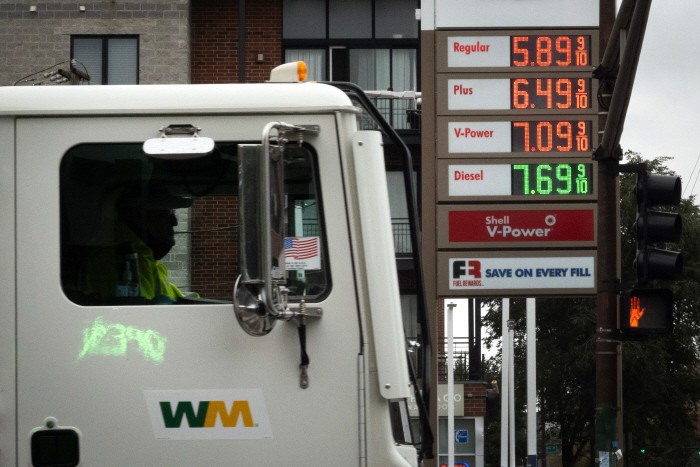 |
| Prices per gallon (3.785 liters) of regular, mid-grade, and premium gasoline alongside diesel are displayed at a gas station in Chicago, Illinois, on the 15th (local time). Driven by surging energy costs, the U.S. Consumer Price Index (CPI) increase accelerated to 3.7% in September. / AFP, Yonhap |
Gasoline jumps 38%, diesel surges 71%
The most direct burden is fuel costs. The Wall Street Journal reported that the national average price of regular unleaded gasoline stood at $4.28 (5,726 won) per gallon on the 16th, up 38% from $3.11 (4,161 won) when President Trump took office, while diesel prices surged 71% to $6.25 (8,361 won).
In The Washington Post survey, the proportion of respondents stating that gasoline prices are difficult to afford surged by 43 percentage points, jumping from 28% in February before the war with Iran to 71% in October. Responses citing difficulty affording groceries climbed from 45% to 60%, rent and mortgages from 37% to 50%, and household energy and utility bills from 45% to 57%. Those reporting strain from dining-out expenses also grew from 49% to 61%.
According to the U.S. Department of Agriculture's Moderate-Cost Food Plan, weekly grocery expenses for a family of four rose 4.6% from $306.50 (410,000 won) in January 2025 to $320.50 (429,000 won) in August this year. Over the same period, ground beef prices jumped 22.5%, whereas egg prices dropped 54.1%.
Housing and automobile prices also rose. The median monthly mortgage payment for homebuyers climbed from $2,112 (2.83 million won) at the time of President Trump's inauguration in January last year to $2,196 (2.94 million won) in August. The 30-year fixed mortgage rate stood at 7.4% this month, the highest level of his second administration. The average manufacturer's suggested retail price (MSRP) for new vehicles was $52,014 (69.58 million won), up 3.8% compared to January of last year.
Mark Zandi, chief economist at Moody's Analytics, estimated that the war with Iran has imposed an additional cost burden exceeding $2,000 (2.68 million won) on the average American household.
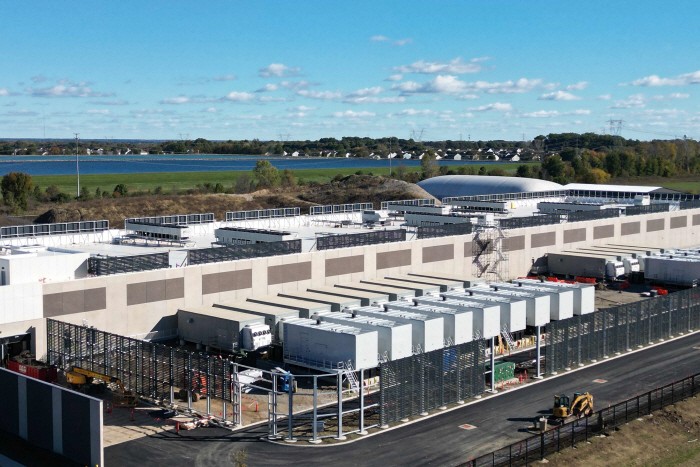 |
| A photograph taken on the 17th (local time) showing a Cologix data center under construction in Lewis Center, Ohio. The $1 billion data center being built in Orange Township received one of the last tax incentives approved by Ohio before the state paused new tax breaks for data centers for further review. As opposition to data center construction spreads across the United States, it has emerged as a major issue in the November midterm elections. Ohio is home to around 200 data centers, ranking fourth in the nation by the number of data centers. / AFP, Yonhap |
Business investment nears $4 trillion
Despite high inflation, the U.S. economy showed a relatively robust trend in employment, consumer spending, and business investment. The unemployment rate stood at 4.2% in September, and the prime-age employment rate for individuals aged 25 to 54 was around 81%, nearing a 25-year high. However, a "low-hire, low-fire" environment continued as corporations held back on both hiring and layoffs. The average duration of job searches for unemployed workers also stretched to nearly six months.
Business investment is being driven by artificial intelligence (AI)-related industries. Price-adjusted quarterly business investment approached an annualized $4 trillion. Investments in computing equipment, data centers, and software accounted for a significant portion of the gains. Consumer spending in the second quarter also grew at an inflation-adjusted annual rate of 3.8%.
Gains also continued in asset markets. The average 401(k) retirement account balance rose from $127,100 (170.03 million won) when President Trump took office to $155,800 (208.46 million won) in the second quarter of this year. On the New York Stock Exchange, the S&P 500 index gained approximately 30%, including dividends, compared to its closing level just prior to his inauguration.
However, surging power demand from AI data centers was also pointed out as a factor driving up household electricity bill burdens. Roughly one in six U.S. households is already behind on utility payments. Average temperatures across the U.S. this past summer were about 3 degrees Fahrenheit above normal, marking the hottest summer on record, The New York Times reported.
Zinia Weitz (58), a resident of McAlester, Oklahoma, received an overdue electric bill of $1,340.96 (1.79 million won) alongside a power shutoff notice. Her monthly disability allowance was $860 (1.15 million won). To save on electricity costs, the Weitzes left most of their three-bedroom house unused, living in a living room of about 28 square meters with an oxygen concentrator running.
Local utility Public Service Company of Oklahoma (PSO) cut power 58 times per 100 residential customers in 2024, the highest rate among U.S. investor-owned utilities. The company cited fuel and equipment costs, an aging power grid, extreme weather, and new massive power demand—including from data centers—as drivers of rising costs. PSO is planning $1.2 billion (1.6054 trillion won) in generation and storage facility investments.
A study by the Center for Economic and Policy Research (CEPR) cited by the Financial Times (FT) estimated that adding 10 data centers to a given power service territory increases residential electricity bills by 13%. It pegged the increase from a single large-scale facility at 4%. In Pennsylvania, electricity rates surged 18.9% last year.
The FT analyzed that while AI investments boost corporate earnings and stock prices, the cost of grid expansion places a heavy burden on households. Torsten Sløk, chief economist at Apollo Global Management, warned that if the AI investment frenzy cools, the risk of stagflation—where slowing growth and inflationary pressure hit simultaneously—could surface.
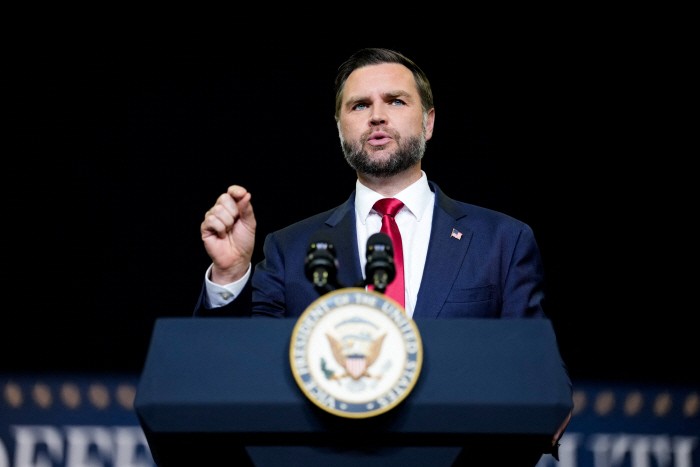 |
| U.S. Vice President J.D. Vance speaks at a midterm election campaign rally held at the Level Up Training Complex in Monroe, Michigan, on the 15th (local time). / Reuters, Yonhap |
Farm net income drops 2.6%; Republican strongholds including Kansas and Iowa also see tight races
Economic discontent is also spreading to rural areas, a core support base for President Trump. The U.S. Department of Agriculture projected that net farm income this year will decrease by 2.6% from last year, or 5.5% when adjusted for inflation. Farm Bureau, an agricultural federation, forecast that farmers will incur losses on most crops through 2027.
Tariffs pushed up steel prices for tractors and curtailed export markets for some agricultural products. The war with Iran caused fertilizer and diesel prices to surge. Diesel prices in Iowa exceeded $6 (approx. 8,027 won) per gallon.
The political action committee of the Kansas Livestock Association decided in July not to endorse Republican Senator Roger Marshall, whom it had backed in the 2020 election. As Democratic candidate Adam Hamilton demonstrates competitiveness, possibilities are also being raised that Kansas could see its first Democratic senator since 1932.
The Democratic Party is pursuing a strategy to erode Republican support among rural voters. It is running advertisements across roughly 36 agricultural House districts in 22 states highlighting issues such as foreign beef imports and rural hospital closures. The Democratic Governors Association allocated $10 million (13.4 billion won) each to Iowa, Georgia, Ohio, and Wisconsin.
In Pennsylvania's 7th Congressional District, a survey last month showed Democratic candidate Bob Brooks leading incumbent Republican Representative Ryan Mackenzie 45% to 40%, with a margin of error of plus or minus 5.8 percentage points. Sixty-two percent of respondents answered that Trump administration policies hurt them rather than helped them, The Wall Street Journal reported.
However, a large-scale shift of rural voters toward the Democratic Party has not been observed. This is because many voters still oppose the Democratic Party's stance on cultural issues such as abortion and transgender rights. The New York Times and the Associated Press noted the possibility that some Republican supporters may abstain from voting rather than defecting to the Democratic Party.
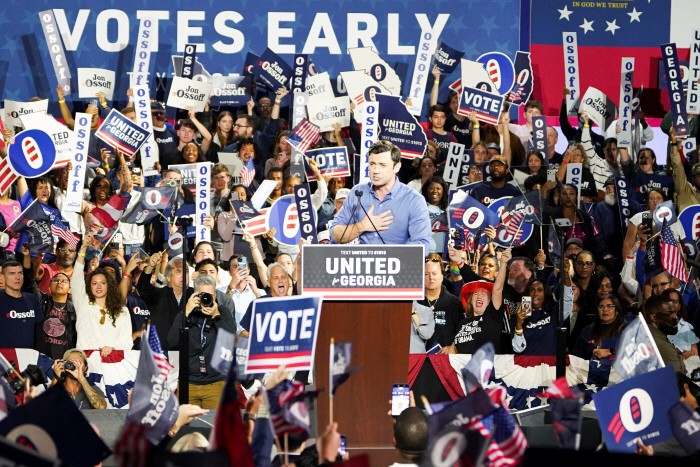 |
| U.S. Senator Jon Ossoff (Democrat) speaks during a joint midterm campaign rally held alongside Democratic gubernatorial candidate Keisha Lance Bottoms at the Cobb Convention Center in Atlanta, Georgia, on the 17th (local time). / Reuters, Yonhap |
Democrats favored to retake House while Senate remains neck and neck
While Democrats are favored to retake the House majority, the outcome in the Senate could hinge on contests in battleground states. The Wall Street Journal reported that Republicans must not lose more than two seats to retain their standalone Senate majority.
In VoteHub's Senate polling averages as of the 15th, Democrats led in seven states: North Carolina (50.9% to 41.4%), Georgia (52.4% to 43.7%), New Hampshire (48.8% to 42.7%), Ohio (48.0% to 43.7%), Michigan (48.7% to 44.9%), Texas (48.4% to 45.4%), and Alaska (49.8% to 46.8%). However, the margins were limited to 3.0 percentage points in Alaska and Texas, and 4.3 percentage points in Ohio.
In Maine, a poll also showed Democratic candidate Troy Jackson leading incumbent Republican Senator Susan Collins by 1.9 percentage points, with a margin of error of plus or minus 4.4 percentage points. The Financial Times forecast that if polls shift toward Republicans within the margin of error, Republican seats in Maine, Alaska, Ohio, Iowa, and Texas could all be retained.
Republicans contend that polls underestimate support from conservative voters. U.S. House Speaker Mike Johnson said during a campaign rally in North Carolina, "The polls are wrong." According to the American Association for Public Opinion Research (AAPOR), Republican candidates' lead over Democratic candidates in the 2024 House elections was, on average, 4.9 percentage points higher than polls indicated.
Conversely, the FT explained that polling in the 2018 and 2022 midterm elections was largely accurate, and in 2022, Democrats performed slightly better than expected.
The Wall Street Journal reported that in their final campaign stretch, Republicans are highlighting cultural issues such as transgender athletes competing in women's sports, border security, and socialism, while Democrats are focusing on the cost of living and corruption. A Reuters survey this month found that in 41 out of 62 battleground districts, Republican candidates distanced themselves from President Trump's policies or downplayed their ties to him.
Turnout is another key factor. The FT pointed out a tendency for rural voter turnout to drop relatively more sharply in midterm elections than in presidential contests. David Paleologos, director of the Suffolk University Political Research Center, analyzed that declining turnout among rural and suburban voters in Iowa, Ohio, and Michigan could work in Democrats' favor. However, he explained that applying the same metric to Maine, which has different political dynamics, is difficult.
Sam Kay, a pollster at Republican polling firm OnMessage, noted that Republican supporters are dissatisfied with the war with Iran, diesel prices, and President Trump overall, saying, "Nobody knows whether Republicans not responding to polls means they will not turn out to vote."
Ha Man-joo
Most Read
-
1
Celltrion nears additional contract with major U.S..

-
2
"Aren't those foreigners on welfare?": M..

-
3
U.S. weighs dropping MOAB, world's most powerful n..

-
4
Houthis launch successive attacks on Saudi airport..

-
5
Saudi Arabia, Iran hold first diplomatic talks to..

-
6
Saudi airport in Riyadh struck again, leaving at l..

-
7
Five ASEAN countries welcome Myanmar coup leader

PEOPLE






HEADLINE NEWS
- Trump's approval rating hits low of 33% as public turns back over soaring inflation
- Trump says Hyundai announced 748.6-billion-won investment in Georgia
- China tightens grip on boosting domestic demand and expanding anti-graft dr..
- Food prices jump 35% over 10 years, fueling massive protests by 800,000 acr..

-
Address : In-Young Bldg., 34, Uisadang-daero 1-gil, Yeongdeungpo-gu, Seoul
Copyright by ASIATODAY CO., LTD. All rights resereved