



Houthis launch successive attacks on Saudi airports, killing 3 and injuring 36
Oct 08, 2026, 03:02 pm


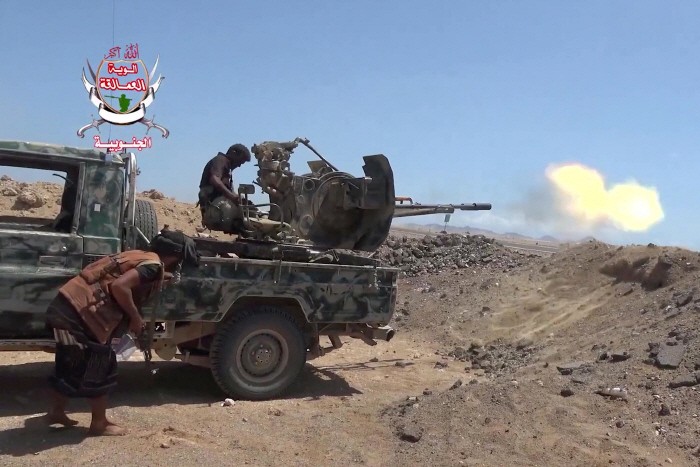 |
| A screen capture from video footage released on the 6th (local time) by the pro-Yemeni government Southern Giants Brigades shows a fighter firing a turret gun from the bed of a technical—a pickup truck mounted with a machine gun—during clashes with Houthi rebels in Taiz Province. / AFP, Yonhap |
Yemen's pro-Iranian Houthi rebels announced on the 8th (local time) that they launched an additional ballistic missile attack targeting King Khalid International Airport in Riyadh, the capital of Saudi Arabia.
Earlier on the 6th and 7th, major Saudi Arabian airports were struck consecutively by Houthi rebel attacks, causing casualties, Reuters reported.
The General Authority of Civil Aviation (GACA) of Saudi Arabia stated that a total of 3 people were killed and 36 injured in the strikes on King Khalid International Airport in Riyadh and Abha International Airport in the south.
According to the authorities, 1 person was killed and 8 injured at King Khalid International Airport, while 2 were killed and 28 wounded at facilities at Abha Airport.
The attacks were reported to have occurred on the 6th and 7th, respectively, although the exact dates of impact for each airport were not explicitly disclosed.
Houthi military spokesperson Yahya Saree officially confirmed that King Khalid International Airport was struck using drones.
The Saudi-led coalition declared immediate retaliation, announcing air strikes targeting more than 80 Houthi military strongholds across areas including Saada, Hodeidah, Al Jawf, and Marib.
Aviation facilities within Yemen also became targets amid the escalations.
Yemen's Ministry of Transport reported that ballistic missiles and drones launched by Houthi rebels fell near Aden International Airport, reportedly occurring just as a commercial passenger flight was preparing to land.
According to Yemeni military and government sources, ground combat is concentrating around the Bab el-Mandeb Strait, a vital chokepoint for crude oil transport.
With maritime transit security in the Strait of Hormuz increasingly compromised amid U.S.–Iran tensions, the strategic significance of the Bab el-Mandeb route has grown further.
Backed by Saudi air support, Yemeni government forces are conducting counteroffensives to recapture areas around Mokha seized by the Houthis last month.
Meanwhile, military movements from neighboring countries have also been detected as signs point to a protracted conflict.
With Turkey and Pakistan agreeing to provide technical and defensive assistance to Saudi Arabia, Syria is also reported to be considering military support options, including troop deployments and air defense assistance.
Syrian diplomatic authorities, however, concurrently noted that domestic considerations—such as civil war reconstruction—remain their primary focus.
Lee Jeong-eun
Most Read
-
1
Trump shares map on social media labeling Strait o..

-
2
Kia Sportage outperforms Mazda CX-5 in German auto..

-
3
U.S. deploys carrier, 10,000 more troops to Middle..

-
4
Trump rejects Iran's offer to open Strait of Hormu..

-
5
N. Korea conducts first swarm attack drill with dr..

-
6
U.S.-China summit falls short on substance as Trum..

-
7
Japan tracks Ukraine fiber-optic drones, bolsters..

PEOPLE






HEADLINE NEWS
- Seoul dismisses Ukraine's claim of 'S. Korean support for Russia' as "inaccurate and inappropriate"
- S. Korea, Japan race to develop nuclear-powered submarines
- Henri Kagan, Kenso Soai win Nobel Prize in Chemistry for uncovering how mol..
- Vance says Alaska LNG cooperation will move forward with Seoul's current or..

-
Address : In-Young Bldg., 34, Uisadang-daero 1-gil, Yeongdeungpo-gu, Seoul
Copyright by ASIATODAY CO., LTD. All rights resereved