



Xi secures fourth term as China reshuffles next-generation power elite
Nov 09, 2026, 03:14 pm


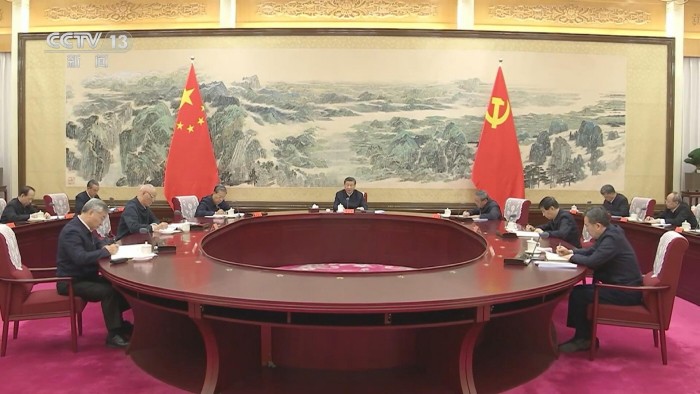 |
| A recent enlarged meeting of the Political Bureau of the Communist Party of China (CPC) Central Committee, one of the country's highest political decision-making bodies. The composition of the leadership is expected to undergo significant changes after the 21st CPC National Congress in October next year, amid expectations that President Xi Jinping will secure a fourth term. /People's Daily |
China's future leadership structure is expected to undergo a rapid reshuffle following last month's fifth plenary session of the 20th Central Committee of the Communist Party of China (CPC), which has been interpreted as effectively paving the way for General Secretary and President Xi Jinping to secure a fourth term.
The changes are expected to bring a new generation of relatively young officials close to Xi into senior leadership positions.
The fifth plenary session of each CPC Central Committee generally provides an indication of the country's future top leadership, which is formally determined at the National Party Congress held the following year. The congress takes place every five years.
As anticipated, the latest session adopted "full and rigorous Party self-governance" as a central theme, with analysts suggesting that it also laid much of the groundwork for the next leadership lineup.
According to Beijing-based sources familiar with China's political leadership, speaking on Monday, the meeting provided a strong indication that Xi would remain in power for a fourth term.
Under this assessment, Xi could remain in office until at least 2032, barring unforeseen developments.
The leadership has also moved to remove senior Party and government officials considered unlikely to serve alongside Xi over the next five years because of their age or involvement in corruption and other misconduct cases.
According to the sources, this helps explain why as many as 45 members of the 205-seat Central Committee lost their positions during the latest round of personnel changes.
At the same time, the meeting appeared to signal an effort to bring promising younger officials into the forefront of the Party and government leadership.
As a result, attention is increasingly turning to the officials who could make up the next leadership team, particularly the seven-member Politburo Standing Committee, the CPC's highest decision-making body.
Excluding Xi, whose continued membership is assumed in this scenario, the potential candidates reportedly include Executive Vice Premier Ding Xuexiang, 64; Shanghai Party Secretary Chen Jining, 62; Vice Premiers Zhang Guoqing, 62, and Liu Guozhong, 64; Li Shulei, 62, a secretary of the CPC Central Committee Secretariat and head of the Central Publicity Department; Beijing Party Secretary Yin Li, 64; and Chongqing Party Secretary Yuan Jiajun, 64.
Among them, Ding is being discussed as a possible successor to Premier Li Qiang, 67, if Li leaves the Standing Committee.
Chen and Liu are also being mentioned as potential candidates for chairman of the Standing Committee of the National People's Congress (NPC), China's national legislature, and chairman of the Chinese People's Political Consultative Conference (CPPCC), respectively.
Other names reportedly under consideration for the 24-member Politburo include Pan Gongsheng, 63, governor of the People's Bank of China; Commerce Minister Wang Wentao, 62; Beijing Mayor Yin Yong, 57; Guangdong Governor Meng Fanli, 61; Jiangsu Party Secretary Xin Changxing, 63; and State Council Secretary-General Wu Zhenglong, 62.
Particular attention is being paid to Guo Ningning, 56, deputy Party secretary of Fujian Province, who is regarded by some sources as a potential dark horse among the so-called post-70s generation, referring to officials born in the 1970s.
According to the sources, Guo's background as a fellow Tsinghua University alumna of Xi and her doctorate in economics are seen as important assets.
Unlike senior Party and government officials who could lose their positions following the decisions made at the fifth plenary session, these emerging figures are expected by the sources to continue advancing through the political ranks.
Their respective roles and positions could become clearer before the 21st CPC National Congress, expected to take place in October next year.
In the article's assessment, China's efforts to overtake the United States and emerge as the world's leading power around 2035 could increasingly depend on this next generation of leaders as Xi moves toward a fourth term.
Hong Soon-do
Most Read
-
1
Ukraine halts strikes on Russian oil refineries un..

-
2
China's fifth plenum to conclude amid expectations..

-
3
Southeast Asian auto parts makers hit hard by Chin..

-
4
Hegseth rejects calls for impeachment over Iran wa..

-
5
U.S. links Myanmar peace efforts to rare earth acc..

-
6
Democrats flip U.S. Congress in historic midterm s..

-
7
USFK commander cites interoperability gaps, urges..

PEOPLE






-
Address : In-Young Bldg., 34, Uisadang-daero 1-gil, Yeongdeungpo-gu, Seoul
Copyright by ASIATODAY CO., LTD. All rights resereved