



Democrats flip U.S. Congress in historic midterm sweep
Nov 05, 2026, 09:41 am


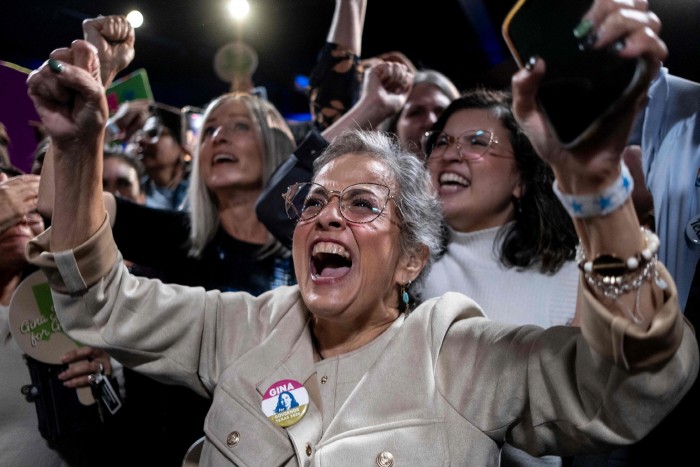 |
| Supporters cheer at an election watch party for Democratic Texas gubernatorial candidate and state Rep. Gina Hinojosa at Assembly Hall in Austin, Texas, on Nov. 3, the day of the U.S. midterm elections. With 91% of the votes counted, Hinojosa was projected to win with 52.8% of the vote, putting Texas on course to elect its first Hispanic governor and its first Democratic governor in more than three decades. /AFP-Yonhap |
The Democratic Party regained control of both chambers of the U.S. Congress in Tuesday's midterm elections. It marked the first time in 20 years, since 2006, that the opposition party had flipped both chambers in a midterm election, significantly reshaping the U.S. political landscape as President Donald Trump faces strong congressional checks during the second half of his term.
As of 2:30 a.m. Wednesday Eastern Time (4:30 p.m. Korea time), Democrats had secured or were projected to win 54 Senate seats, compared with 44 for Republicans. In the House of Representatives, Democrats had been declared winners in 235 seats, compared with 146 for Republicans. Trump told The New York Times (NYT) that he was willing to accept the election results and work with Democrats.
Democrats flipped five Republican-held Senate seats in seven closely contested states in the final stages of the election, including Texas, Kansas, Ohio, Iowa and Maine. Including North Carolina and South Carolina, Democrats captured a total of seven seats previously held by Republicans.
In Michigan, where a Democratic-held Senate seat was at stake, Democratic candidate Abdul El-Sayed defeated Republican Mike Rogers. El-Sayed became the first Muslim elected to the U.S. Senate in American history. The elections also produced surprising results in longstanding Republican strongholds. Democratic candidates won Senate races in Texas for the first time in 38 years, since 1988, and in Kansas for the first time in 94 years, since 1932.
The election results are expected to bring significant changes to Trump's governance during the latter half of his presidency. With Democrats controlling both chambers, they will be able not only to block legislation pursued by the Trump administration but also to exercise control over House committees and subpoena powers, as well as the Senate's authority to confirm Cabinet members, federal judges and other nominees.
After Democrats were projected to regain control of both chambers, Trump told the NYT that he was "absolutely willing to accept those results" and that he looked forward to "working with the Democrats."
On Truth Social, however, he claimed that he had not been on the ballot and that Republicans would have won in a landslide had he been running. In an interview with Fox News, he acknowledged that the election results were "a little surprising" and said the war with Iran had partly contributed to Republican losses. He said he would veto legislation sent to him by Democrats if he considered it excessive. Nevertheless, he added that he might be able to negotiate with Democrats in a few months.
As Trump acknowledged the impact of the Iran war, voter surveys also revealed dissatisfaction with rising prices and the conflict. In a survey conducted by polling firm SSRS on behalf of the Associated Press (AP) and major television networks, about 90% of respondents cited the cost of living as a major factor in their voting decisions. An NBC exit poll found that 71% believed Congress had not done enough to check Trump. Reuters identified dissatisfaction with the Iran war and tariff policies as major factors behind the Democratic victory.
Ha Man-joo
Most Read
-
1
U.S., Israel plan to resume strikes on Iran after..

-
2
Ukraine halts strikes on Russian oil refineries un..

-
3
China's fifth plenum to conclude amid expectations..

-
4
ASEAN to discuss Myanmar's return next month

-
5
AI-discovered PHP flaw triggers global cybersecuri..

-
6
Southeast Asian auto parts makers hit hard by Chin..

-
7
Trump envoy says U.S. no longer guarantees Middle..

PEOPLE







-
Address : In-Young Bldg., 34, Uisadang-daero 1-gil, Yeongdeungpo-gu, Seoul
Copyright by ASIATODAY CO., LTD. All rights resereved