



Trump envoy says U.S. no longer guarantees Middle East security
Oct 22, 2026, 01:27 pm


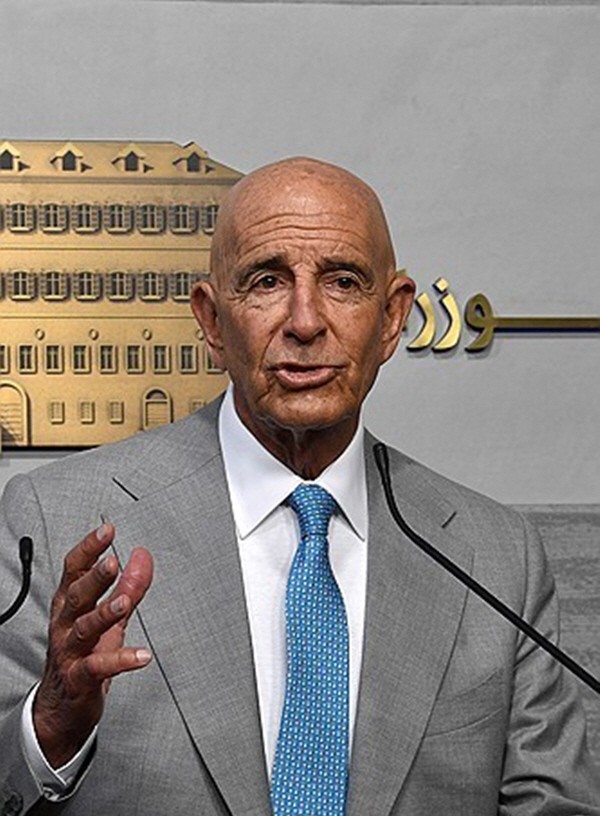 |
| Tom Barrack, U.S. ambassador to Türkiye and special presidential envoy for Syria and Iraq, speaks at a press conference at a government building in Beirut, Lebanon, on July 21, 2025 (local time). / EPA, Yonhap |
Tom Barrack, U.S. ambassador to Türkiye and special presidential envoy for Syria and Iraq, said on Oct. 20 (local time) that the United States could no longer fulfill its role of providing security to the Middle East in exchange for oil, advising countries in the region to focus on securing their own security.
Barrack said at the Global Security Forum in Doha, Qatar, an annual event attended by senior security officials and experts from around the world, that "the United States, which has served as the world's guarantor for the past 80 years, can no longer fulfill that role," The Wall Street Journal (WSJ) reported.
"The actions taken by this administration are not a message of abandonment but of realignment," he added. "This is not an easy task, much like raising teenage children."
Barrack said the security system established after World War II was based on a reciprocal arrangement in which the United States provided security in exchange for oil supplies, but that this arrangement no longer aligned with U.S. policy priorities.
He explained that Americans do not want to make sacrifices for the Middle East and that Middle Eastern countries also recognize that the United States cannot guarantee their security.
He said shifting toward smaller, more diversified alliances, such as new defense agreements involving Saudi Arabia, Pakistan and Türkiye, was the right approach. However, he also acknowledged that the process would be uncertain.
Middle Eastern countries acknowledge that they have no realistic alternatives to the military technology supported by the United States, but they are also questioning whether they can continue to rely on Washington as a security partner.
President Donald Trump and Iranian officials have indicated that they are preparing for the possibility of renewed large-scale armed conflict amid a diplomatic stalemate that has continued for months.
The United States has stepped up economic pressure on Iran but has yet to achieve a breakthrough, while its Middle Eastern allies are preparing for the possibility of another armed conflict that could target sensitive energy infrastructure.
Gulf countries are watching the situation with concern and fear further attacks after missile and drone strikes by the Houthis, an Iran-aligned armed group in Yemen, caused extensive damage to energy facilities and an international airport in Riyadh, the Saudi capital.
Saudi Arabia requested U.S. military intervention, but Trump limited the U.S. role to providing intelligence and guidance.
Officials in the Trump administration have also conveyed the message at security meetings in Asia and Europe that countries must take responsibility for their own security.
Kim Hyun-min
Most Read
-
1
Celltrion nears additional contract with major U.S..

-
2
Putin proposes trilateral U.S.-China-Russia summit..

-
3
U.S. weighs dropping MOAB, world's most powerful n..

-
4
"Aren't those foreigners on welfare?": M..

-
5
Houthis launch successive attacks on Saudi airport..

-
6
Saudi Arabia, Iran hold first diplomatic talks to..

-
7
Attention centers on APEC for possible Trump-Xi-Pu..

PEOPLE







-
Address : In-Young Bldg., 34, Uisadang-daero 1-gil, Yeongdeungpo-gu, Seoul
Copyright by ASIATODAY CO., LTD. All rights resereved