



Putin proposes trilateral U.S.-China-Russia summit to Trump for next month
Oct 20, 2026, 09:50 am


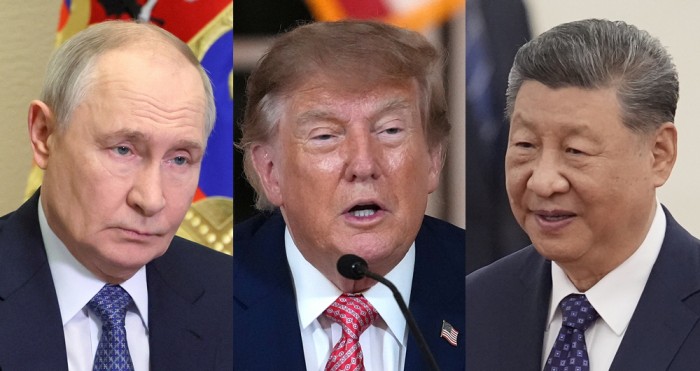 |
| Russian President Vladimir Putin (from left), U.S. President Donald Trump, and Chinese President Xi Jinping. / Reuters, AP, EPA, Yonhap |
The Wall Street Journal reported on the 18th (local time) that Russian President Vladimir Putin proposed to U.S. President Donald Trump holding negotiations alongside Chinese President Xi Jinping next month to bring an end to the war in Ukraine.
A former Russian intelligence official stated that President Putin made the proposal during a telephone call with President Trump on the 9th. An agreement was also reached during this call for the U.S. to purchase Russian diesel and support its sale on global markets.
According to sources familiar with the discussions, Russia suggested holding trilateral talks with the U.S. and China on the sidelines of the Asia-Pacific Economic Cooperation (APEC) summit, which will be held in Shenzhen, China, from the 18th to the 19th of next month.
The plan is seen as President Putin's initiative to capitalize on his improved ties with President Trump. Such an atmosphere could act as a source of anxiety for Ukraine and its allies.
Discussing the end of the war among the U.S., China, and Russia while excluding Ukraine, a warring party, is unusual and could deepen concerns across Europe and the wider international community.
Russian Kremlin spokesperson Dmitry Peskov told the WSJ, "Nothing has been clearly decided yet regarding the talks or a potential agenda," adding, "All three parties acknowledge the possibility that a meeting could take place."
A senior U.S. official indicated that while President Trump had not agreed to the meeting, there is a possibility he could respond positively because he made ending the war a campaign pledge.
Chinese experts noted that if trilateral talks materialize, it would mark significant progress for President Xi, who is seeking to strengthen his role as a diplomatic mediator.
A source familiar with talks between China and Russia said Russian officials proposed the initiative to China through diplomatic channels, and China expressed a stance that it would not object if President Trump agrees.
Yun Sun, director of the China Program at the Stimson Center, a think tank in Washington, D.C., said, "China wants to serve as a pivotal axis among major powers and play a mediator role between the U.S. and Russia."
Kim Hyun-min
Most Read
-
1
Celltrion nears additional contract with major U.S..

-
2
U.S. weighs dropping MOAB, world's most powerful n..

-
3
"Aren't those foreigners on welfare?": M..

-
4
Houthis launch successive attacks on Saudi airport..

-
5
Saudi Arabia, Iran hold first diplomatic talks to..

-
6
Saudi airport in Riyadh struck again, leaving at l..

-
7
Five ASEAN countries welcome Myanmar coup leader

PEOPLE






HEADLINE NEWS

-
Address : In-Young Bldg., 34, Uisadang-daero 1-gil, Yeongdeungpo-gu, Seoul
Copyright by ASIATODAY CO., LTD. All rights resereved