



Zelenskyy says Trump pressuring Ukraine, not Putin, to surrender
Oct 20, 2026, 10:24 am


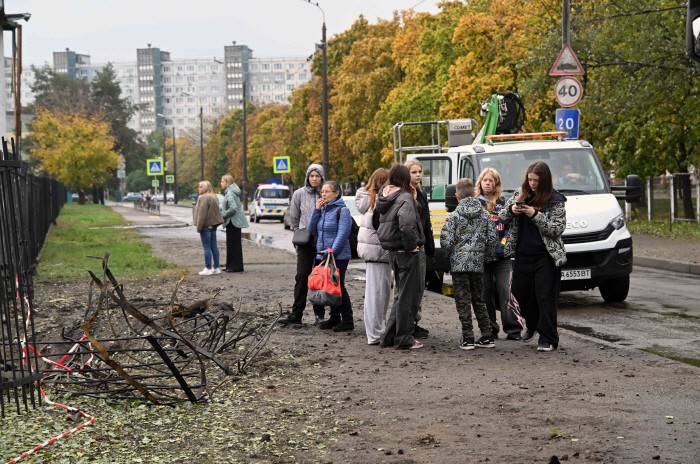 |
| Ukrainian citizens stand beside a missile blast crater near a school damaged by a Russian ballistic missile attack in Kyiv on the 19th (local time). / AFP, Yonhap |
[Article Summary]
1. President Zelenskyy criticized recent actions by the Trump administration, stating they appear to be pressuring Ukraine, rather than Russia, to surrender.
2. Russian airstrikes on the 19th killed 10 people and struck 28 Ukrainian energy facilities including substations, leaving roughly 550,000 households without power.
3. Ukraine stated that it failed to receive ballistic missile early warnings for the third time in a week. The U.S. government denied restricting intelligence sharing.
4. President Putin proposed a trilateral summit among the U.S., China, and Russia excluding Ukraine. President Trump left open the possibility of a meeting, though holding it has not been confirmed.
In an interview with Bloomberg News published on the 18th (local time), Ukrainian President Volodymyr Zelenskyy criticized the Donald Trump administration's actions, stating they appear to be pressuring Ukraine, rather than Russia, to surrender.
Russia launched massive airstrikes across Ukraine on the 19th, and Ukraine stated that it did not receive early warnings regarding the initial ballistic missile attack from partners, including the United States.
The Wall Street Journal reported that Russian President Vladimir Putin proposed a trilateral summit involving President Trump and Chinese President Xi Jinping while excluding Ukraine.
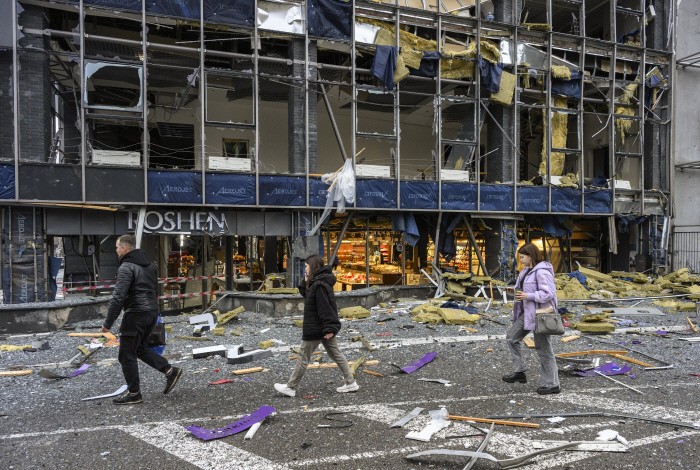 |
| Ukrainian citizens walk past a shopping mall struck by a Russian missile attack in Kyiv on the 19th (local time). According to Ukraine's State Emergency Service, attacks across the Kyiv area left at least one person dead and 10 injured, including three children. / EPA, Yonhap |
Zelenskyy says, "Trump is pressuring Ukraine to surrender"
In an interview with Bloomberg conducted in Kyiv, President Zelenskyy said, "I believe steps have been taken to convince Ukraine to surrender."
However, he emphasized, "I am not saying that our partners are pursuing such a goal. I do not want to believe that our American partners think they can end the war faster at Ukraine's expense," while adding, "But that is how it looks." In doing so, he stopped short of definitively concluding that the United States has made Ukraine's capitulation its objective.
Among the unfriendly measures President Zelenskyy cited were restrictions on the use of SpaceX's satellite communications service Starlink and delays in deliveries of Patriot interceptor missiles.
He stated that he had proposed receiving additional U.S. Patriot interceptor missiles on the condition of halting strikes on Russian oil refineries.
President Zelenskyy explained, "The formula I recently proposed was that instead of us striking Russian diesel facilities, the U.S. would provide Patriot missiles to protect our facilities." However, he pointed out, "The U.S. only wants us to stop attacking diesel facilities," adding, "If we attack, they will cut something off."
While assessing that President Trump maintains good relations with President Putin, President Zelenskyy noted, "Right now, Trump cannot force Putin to end the war."
He also raised specific grievances regarding Patriot deliveries. President Zelenskyy stated that the U.S. is currently supplying only 12 Patriot interceptor missiles per month, roughly a quarter of the delivery pace seen under the former Joe Biden administration.
President Zelenskyy explained that while the Biden administration provided them free of charge in the form of military aid, the Trump administration is supplying them via sales.
He stated that Ukraine had already paid for weapons, including ballistic missile interceptors, through the Priority Ukraine Requirements List (PURL) program.
He then added, "Some supplies were approved by the U.S. side, but the rest were not approved. This is not a technical problem."
President Zelenskyy stated on Telegram that he discussed measures to expand Patriot interceptor supplies and accelerate deliveries with officials from U.S. defense contractor Lockheed Martin on the 19th.
Reuters reported that he expressed hope for an expansion in interceptor missile production, noting that Patriot air defense systems and F-16 fighter jets play a critical role in defending against Russian ballistic missiles and jet-powered drones.
President Zelenskyy also mentioned the possibility of relations between the two countries improving following the U.S. midterm elections on November 3.
He said, "Politics is very aggressive during election seasons," adding, "This is a painful time, but once the elections are over, life will go on and I believe the situation will become calmer."
The New York Times reported that while President Zelenskyy noted President Trump has an instinctive affinity for dictators, President Trump urged the Ukrainian people to vote President Zelenskyy out of office.
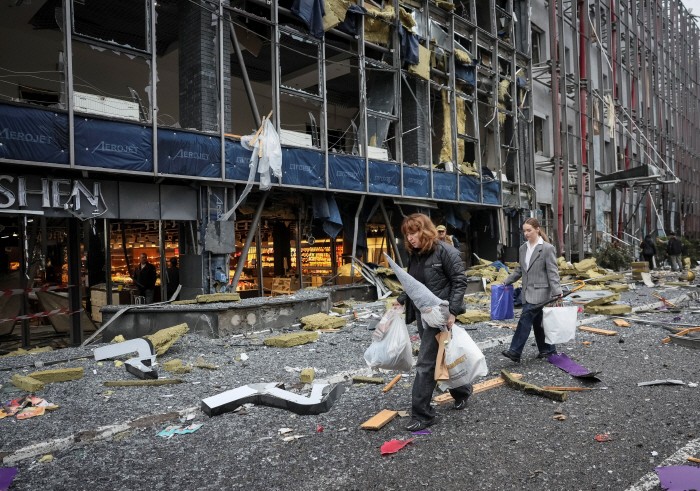 |
| Ukrainian citizens walk past a shopping mall damaged by a Russian missile attack in Kyiv on the 19th (local time). / Reuters, Yonhap |
Russia strikes 28 Ukrainian energy facilities
From the night of the 18th to the early morning of the 19th, Russia launched 16 ballistic missiles targeting the Ukrainian capital of Kyiv and surrounding areas. Russian forces also carried out strikes mobilizing over 200 drones spanning from Kharkiv and Dnipro in the east to Odesa in the south and Volyn and Rivne in the west.
President Zelenskyy stated that Russia struck 28 key energy facilities, including power substations, disrupting electricity, heating, and water supplies for more than 500,000 residents.
The Financial Times (FT) reported that Russia attacked energy facilities across 11 Ukrainian regions, causing blackouts for approximately 550,000 households. Ukraine's Ministry of Energy stated that rolling blackouts were implemented for households and enterprises while power restoration work was underway.
The attacks that day claimed a total of 10 lives across Ukraine. Oleh Syniehubov, governor of Kharkiv Oblast, announced that a Russian drone struck a park near Kharkiv, killing six people, including two children.
Two fatalities occurred in Kyiv and surrounding areas, and two in the industrial city of Kryvyi Rih. In Kyiv, a 21-year-old woman was killed, and a data center belonging to telecommunications firm Datagroup was destroyed. A metro station located on the left bank of the Dnipro River was also damaged.
The Ukrainian Air Force announced that it shot down 247 targets, including four cruise missiles and 243 drones. However, it did not disclose the number of ballistic missile interceptions. The New York Times reported that Ukraine is maintaining a policy of withholding ballistic missile interception rates amid shortages of interceptor missiles.
The Russian Ministry of Defense claimed that the operation was a massive precision strike targeting Ukrainian defense industrial facilities, drone and cruise missile storage sites, and data centers. Ukrainian Prime Minister Serhiy Koretskyi stated that Russia has struck Ukrainian energy infrastructure more than 2,000 times since mid-July.
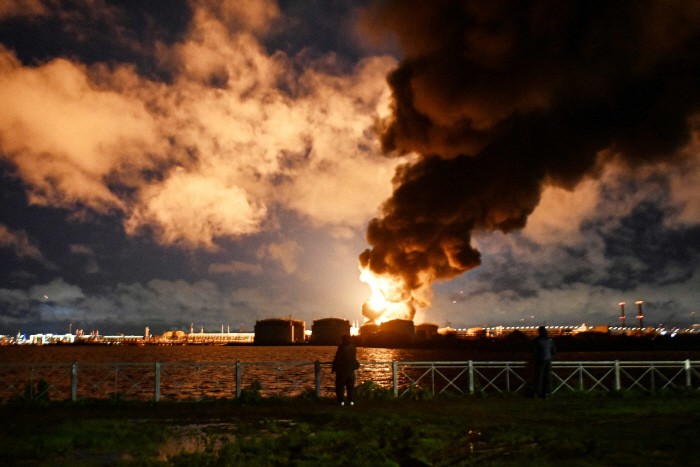 |
| Russian citizens watch an oil terminal burning following a Ukrainian airstrike in Saint Petersburg on the 18th (local time). Russian authorities stated that they shot down dozens of Ukrainian drones near Saint Petersburg that day, with an oil terminal struck and flight operations disrupted at one of Russia's major airports. / AFP, Yonhap |
Ukraine claims U.S. ballistic missile early warnings missed three times in a week
This is not the first time Ukraine has missed ballistic missile early warnings. President Zelenskyy wrote on Telegram on the 19th, "Another wave of Russian ballistic missile strikes occurred multiple times overnight, and once again there was no advance warning from our partners."
Ukrainian Air Force spokesperson Yuriy Ihnat stated that they did not receive early warnings prior to the first ballistic missile attack, which began around 11:00 PM on the 18th (5:00 AM on the 19th KST). However, he explained that intelligence was received for the second wave of attacks that followed at around 3:00 AM on the 19th (9:00 AM KST the same day).
Spokesperson Ihnat remarked, "For whatever reason, information was not conveyed during the first attack," adding, "Since this is not the first time such a situation has occurred, experts are investigating the cause together with our partners."
The New York Times reported that Ukrainian officials stated they had also failed to receive early warnings twice last week. Bloomberg tallied this as the third instance within a week where Ukraine did not receive standard advance warnings.
Ukrainian officials suspect that the U.S. is intermittently restricting intelligence sharing, Bloomberg reported, citing sources. They suspect the possibility that the U.S. curtailed intelligence provision ahead of the first attack before restoring the early-warning system during the second attack.
The Ukrainian side stated that U.S. intelligence support over the past week has been unusually irregular, and that they had not received sufficient explanations as to whether this was due to severe weather or technical glitches.
President Zelenskyy also raised the intelligence-sharing issue during phone calls with U.S. Democratic Senator Richard Blumenthal and Republican Senator Thom Tillis, according to a call readout provided by the two lawmakers.
The U.S. government denies any deliberate suspension or restriction of intelligence sharing. President Trump criticized President Zelenskyy to reporters on the 19th, saying he "does not know what he's talking about."
He continued, "We share intelligence. We provide a lot of information," asserting, "Don't talk to me about Ukraine. We gave Ukraine so much, and they gave us nothing."
U.S. Secretary of State Marco Rubio explained that the missing early warnings last week were due to a software problem in Ukraine's early-warning system. However, he stated that he had no detailed knowledge regarding the attacks that occurred on the night of the 18th.
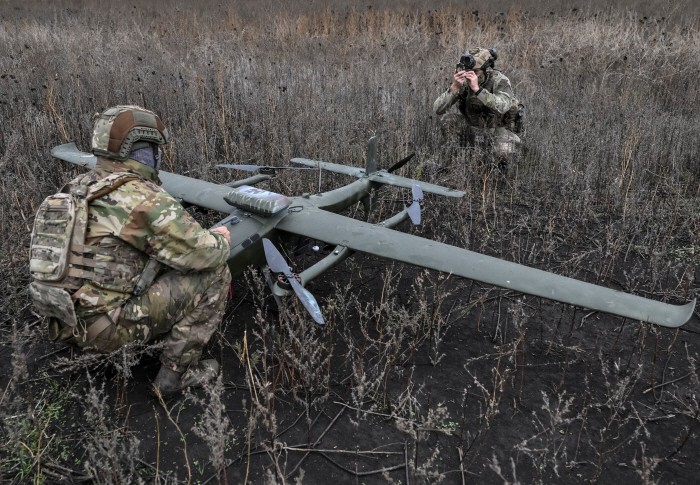 |
| Members of a special-purpose battalion of the Zaporizhzhia Regional Police in Ukraine prepare a "Gara" reconnaissance and strike drone for flight at a position near the frontline in Donetsk Oblast on the 16th (local time). / Reuters, Yonhap |
Zelenskyy claims that Starlink curbs disrupt drone operations, but Musk says Starshield is controlled by U.S. government
Controversy also continues surrounding restrictions on the use of the satellite communications service Starlink and its military-grade counterpart, Starshield.
In an interview with Bloomberg, President Zelenskyy claimed that within Ukraine, Starlink connections disconnect whenever an object moves at speeds exceeding 161 km/h (100 mph), whereas outside the country the service operates without restrictions. He also noted that Russian drones fly at speeds around 400 km/h.
On the 19th, President Zelenskyy stated that on some frontlines, Starlink terminals fail to function even when drones reach speeds of 130 km/h. He wrote on X (formerly Twitter), "This slows frontline logistics and limits the use of various drones, particularly mid-range strike drones and drones intercepting jet-powered Shahed drones".
SpaceX CEO Elon Musk stated last week that the military-grade Starshield is under U.S. government control. He wrote on X, "Any limits on speed or usage are decided by the U.S. military and ultimately by the President of the United States".
Conversely, President Trump told reporters on the 16th, "I don't know who did it, but I don't think it was me and I don't think it was Elon". He claimed that, according to his understanding, the service remains the same as before.
Secretary of State Rubio also denied U.S. government involvement on the 17th, remarking, "Nobody ordered Starlink to be slowed down. It just happened that way".
Ukraine maintains that these restrictions are affecting strikes on rear targets in Russia and the interception of jet-powered drones.
Attacks targeting Starlink infrastructure have also followed in succession across Europe. In Lithuania, an attempted arson occurred on the 18th at a Starlink base station in the capital, Vilnius. Although control equipment caught fire, the blaze was quickly extinguished and communications services were not interrupted.
The Lithuanian government subsequently raised the alert level at more than 15 strategic infrastructure sites. Similar incidents targeting Starlink facilities also occurred in Bulgaria and Poland.
The New York Times reported that while responsibility for all three incidents has not been determined, some European officials raise the possibility that Russia may be attacking satellite communications infrastructure in nations supporting Ukraine.
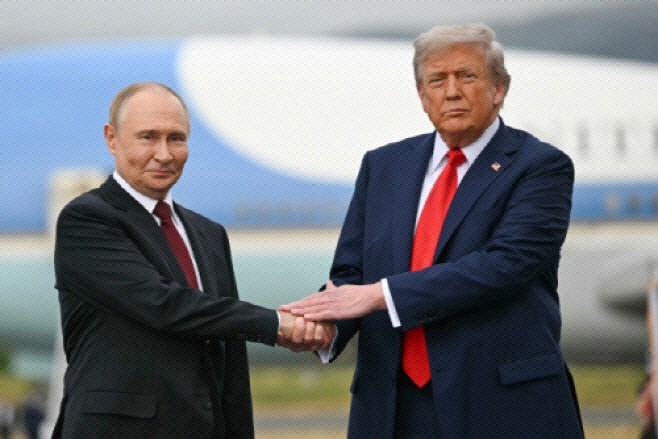 |
| U.S. President Donald Trump (right) and Russian President Vladimir Putin shake hands at Joint Base Elmendorf-Richardson north of Anchorage, Alaska, on August 15, 2025 (local time). / AFP, Yonhap |
Putin proposes trilateral U.S.-China-Russia summit excluding Ukraine and Europe, pushing for meeting on sidelines of November APEC in China
President Putin proposed a trilateral summit to President Trump and President Xi Jinping, The Wall Street Journal reported, citing people familiar with the discussions.
President Putin floated the initiative during a telephone call with President Trump on the 9th, according to a former Russian intelligence official briefed on the discussions. During the same call, the U.S. and Russia agreed on supplying Russian diesel to the U.S. and global markets.
President Putin proposed holding trilateral talks on the sidelines of the Asia-Pacific Economic Cooperation (APEC) summit held in Shenzhen, China, on November 18–19. This initiative excludes President Zelenskyy, a warring party in the war in Ukraine, from the talks.
The Wall Street Journal analyzed that President Putin aims to capitalize on his improving relations with President Trump to secure a settlement ending the war on terms favorable to Russia.
A meeting among the leaders of the U.S., China, and Russia is a format that excludes Europe as well as Ukraine. The Wall Street Journal explained that the Kremlin views Europe as a primary obstacle standing in the way of Russia's victory in the war in Ukraine.
Kremlin spokesperson Dmitry Peskov acknowledged that the possibility of a trilateral summit had been discussed. He told the WSJ, "There is no clear understanding yet regarding the meeting itself or a potential agenda," adding, "All three parties acknowledge the hypothetical possibility that such a summit could take place". However, he drew the line by stating that no concrete proposals or agreements had been reached regarding the meeting, its agenda, or its content.
Russia's Interfax news agency reported that Peskov also stated that while Russia appreciates U.S. mediation efforts, the war cannot be definitively resolved without Ukrainian representatives willing to take responsibility.
A senior U.S. official told the WSJ that President Trump had not agreed to a trilateral meeting. However, the official explained that there is a possibility President Trump could react positively to the initiative given that he is pushing to end the war.
Secretary of State Rubio told reporters in Samarkand, Uzbekistan, on the 19th, "I believe there were discussions regarding a meeting. I do not know if everything has been finalized".
President Trump also stated on that day that he is willing to meet with Putin and Xi in China without President Zelenskyy, though holding the summit has not been finalized, The Washington Post reported.
Spokesperson Mao Ning of the Chinese Foreign Ministry stated that she had no information to provide regarding related reports.
Ukrainian Foreign Minister Andrii Sybiha strongly criticized the trilateral summit initiative. He wrote on X, "A trilateral meeting between the leaders of Ukraine, the U.S., and Russia could help end the war faster. Conversely, a meeting between the leaders of Russia, China, and the U.S. would only encourage Putin to continue this war".
He added, "As long as Putin continues this terror, he should have no place at any negotiating table".
The WSJ reported, citing a former Russian intelligence official, that President Putin envisions the trilateral summit like a "second Yalta Conference" dividing the world into spheres of influence.
China also faces burdens. The WSJ reported that Chinese officials are concerned that a U.S.-China-Russia summit could overshadow the APEC summit. In addition, the newspaper analyzed that China appearing more directly involved in the war in Ukraine could trigger pushback from Europe.
Yun Sun, director of the China Program at the Stimson Center, a think tank in Washington, assessed, "China wants to be perceived as a pivotal axis among major powers and potentially as a mediator between the U.S. and Russia."
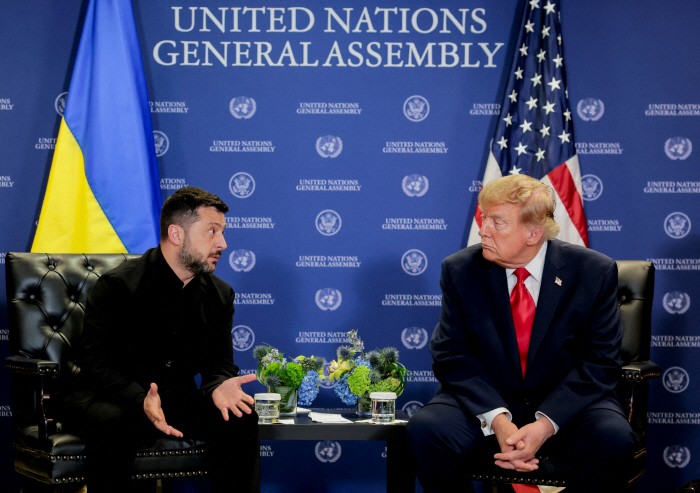 |
| U.S. President Donald Trump (right) meets with Ukrainian President Volodymyr Zelenskyy on September 22 (local time) during the 81st United Nations General Assembly (UNGA) held in New York, U.S. / Reuters, Yonhap |
Russian hardliners welcome Trump-Zelenskyy clash, but caution prevails over sustained sanctions and Trump's unpredictability
Hardliners within the Russian Kremlin are welcoming the open conflict between President Trump and President Zelenskyy, Reuters reported on the 19th.
Dmitry Medvedev, former Russian president and deputy chairman of the Security Council, mocked President Zelenskyy on Telegram. He claimed that President Zelenskyy, once called "Person of the Year" and a "new Churchill," has been branded by his former patron as someone blocking peace and U.S. interests. He then sarcastically remarked that Zelenskyy bit the hand that fed him until it bled.
Kirill Dmitriev, President Putin's special envoy for economic cooperation with the U.S., evaluated that President Zelenskyy's public criticism of Trump had backfired. He claimed on X that President Zelenskyy had overplayed his hand and that his arrogance and attacks on President Trump would yield grave consequences.
Special Envoy Dmitriev also shared an image depicting a bear symbolizing Russia and an eagle symbolizing the U.S. facing off against a lion representing the United Kingdom and the European Union (EU). The image featured the phrase "the tables have turned."
However, cautious views are also emerging inside Russia that the rift between the U.S. and Ukraine has not yet translated into tangible benefits.
Reuters reported that most major U.S. sanctions against Russia remain in place and Ukrainian attacks on Russian oil facilities continue. European leaders also backed President Zelenskyy at last week's summit.
The fiscal impact of expanding Russian diesel exports could also be limited. Reuters analyzed that because initial diesel supply volumes are not large and Russia levies taxes at the production stage rather than on fuel exports, the effect on government finances is limited.
Reuters also reported that the U.S. waiving sanctions on buyers of Russian oil is not seen as a major concession in Russia.
Russia is also wary of the possibility of frequent policy shifts by President Trump. Initial expectations that the Trump-Putin summit held in Alaska, U.S., on August 15 of last year could lead to a war-ending agreement favorable to Russia have turned to disappointment, Reuters reported.
Sergey Poletaev, a commentator at Russian state-run media outlet RT, emphasized that the clash between the U.S. and Ukraine should not be mistaken for an immediate Russian victory. He argued, "Zelenskyy has made his choice," adding, "The remaining question is how long Washington will tolerate the consequences."
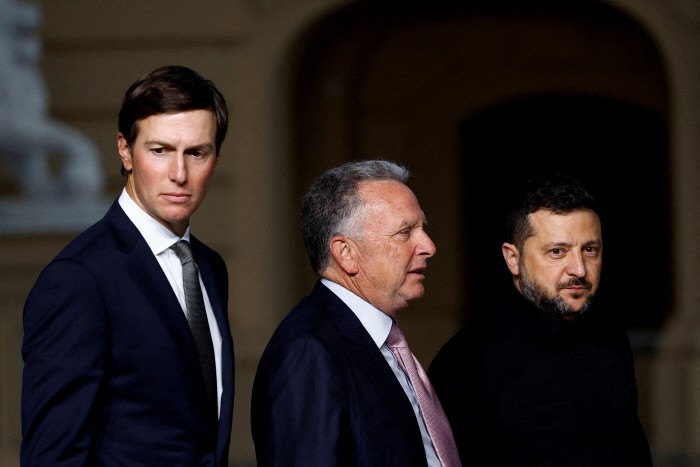 |
| Ukrainian President Volodymyr Zelenskyy (from right), U.S. Special Presidential Envoy Steve Witkoff, and Jared Kushner, son-in-law of U.S. President Donald Trump, walk together after concluding a joint press conference in Kyiv, Ukraine, on September 6 (local time). / Reuters, Yonhap |
Trump imports Russian diesel and suspends Russia sanctions, sparking legal concerns even within GOP
President Trump wrote on social media platform Truth Social on the 18th that President Zelenskyy "does not want this war to end and probably never has."
He claimed that Ukraine is inflicting severe damage on global diesel markets, including the United States, by attacking Russian oil refineries. He went on to criticize him, saying, "Zelensky doesn't care."
Conversely, he emphasized that Russia is supplying millions of barrels of diesel to world markets at affordable prices.
President Trump explained that he suspended sanctions in order not to drive Russia away from the bargaining table. "I want this war to end," he stated.
On the 9th, President Trump announced that he reached an agreement with President Putin to supply Russian diesel to the U.S. and world markets. Following that, on the 16th, he signed an executive order waiving the application of Russia energy tariffs and sanctions that were slated to take effect on the 18th under the Graham Act.
On the 9th, the U.S. Department of the Treasury's Office of Foreign Assets Control (OFAC) issued a license enabling imports of Russian diesel.
However, legal controversies are also being raised over the U.S. measure permitting Russian diesel imports. Bloomberg pointed out that the Ending Importation of Russian Oil Act, enacted in 2022, remains in effect.
The law bans U.S. imports of Russian petroleum products, stipulating that for the president to waive the prohibition, the administration must consult with relevant congressional committees and certify that Russia has agreed to withdraw its troops from Ukraine, halt hostilities, and poses no immediate threat to NATO member states.
Bloomberg reported that legal controversies arose as President Trump permitted Russian diesel imports despite these conditions not being met.
Bipartisan lawmakers on the U.S. Senate Foreign Relations Committee also stated that the decision to permit Russian diesel imports directly violates the law.
Criticism over easing pressure on Russia emerged within the Republican Party as well. Republican Senator Darlene Graham, sister of the late Senator Lindsey Graham, said, "Personally, I'd choose to keep up the pressure on Russia," adding, "Because I don't trust Putin, and I don't trust Russia."
Separate legislative moves have also emerged in the U.S. Congress to block imports of Russian diesel. Democratic lawmakers and one Republican lawmaker introduced a bill on the 16th to ban imports of Russian diesel. However, Bloomberg analyzed that passing the legislation would not be easy given that Republicans control Congress.
On the 19th, President Zelenskyy stated on X, "Ukraine never wanted this war and welcomed every attempt by partners toward a dignified end to the war." He pointed out, "We responded positively to every ceasefire proposal," stressing that the continuation of the war is due to Russia's attacks and its willingness to prolong the conflict.
When asked by Bloomberg how he would describe efforts to repair relations with the U.S., President Zelenskyy answered, "If the potential danger facing Ukraine is of tsunami scale, I believe we must intervene while it is still a mild storm." He emphasized, "I believe there is far more at stake than a diesel deal."
Ha Man-joo
Most Read
-
1
Celltrion nears additional contract with major U.S..

-
2
U.S. weighs dropping MOAB, world's most powerful n..

-
3
"Aren't those foreigners on welfare?": M..

-
4
Houthis launch successive attacks on Saudi airport..

-
5
Saudi Arabia, Iran hold first diplomatic talks to..

-
6
Saudi airport in Riyadh struck again, leaving at l..

-
7
Five ASEAN countries welcome Myanmar coup leader

PEOPLE






HEADLINE NEWS

-
Address : In-Young Bldg., 34, Uisadang-daero 1-gil, Yeongdeungpo-gu, Seoul
Copyright by ASIATODAY CO., LTD. All rights resereved