



Saudi Arabia postpones 'Davos in the Desert' amid airport strikes
Oct 20, 2026, 10:41 am


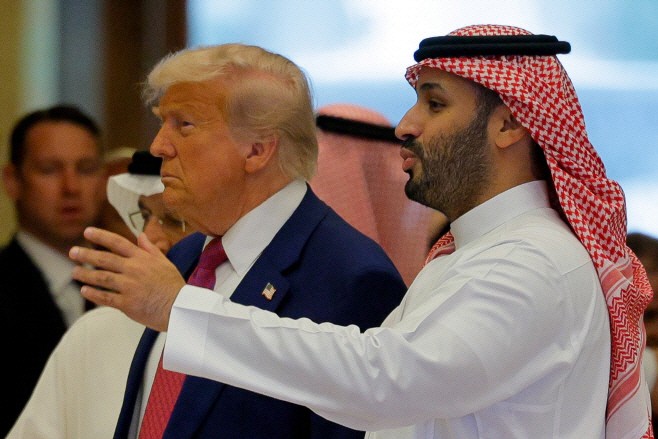 |
| U.S. President Donald Trump (left) and Saudi Arabian Crown Prince Mohammed bin Salman attend the Saudi-U.S. Investment Forum held in Riyadh, Saudi Arabia, on May 13, 2025 (local time). / Reuters, Yonhap |
[Article Summary]
1. Saudi Arabia postponed the 10th Future Investment Initiative (FII), scheduled for October 26–29, to 2027 amid an onslaught of missile and drone attacks by the Houthis.
2. Houthi attacks on Riyadh's international airport have killed at least 17 people and injured over 330 this month, disrupting flight operations and international events.
3. The Houthis struck a Yemeni government military training base on the 19th, killing 53 people, while claiming additional attacks on Saudi oil facilities and airports.
4. Amid projections that its economy will contract 3.6% this year, Saudi Arabia faces interceptor missile shortages and mounting burdens in attracting foreign capital.
The Future Investment Initiative (FII) Institute of Saudi Arabia announced on the 19th (local time) that it is postponing the 10th edition of the FII, originally scheduled to be held in the capital Riyadh from October 26 to 29, to 2027.
The decision comes as safety concerns mount across the global financial sector following an expansion of missile and drone attacks by Yemen's pro-Iranian Houthi rebels targeting Riyadh's international airport and oil facilities. The postponement of the FII, dubbed "Davos in the Desert," adds to the headwinds facing Saudi Crown Prince Mohammed bin Salman's drive to diversify the economy away from oil and attract foreign capital.
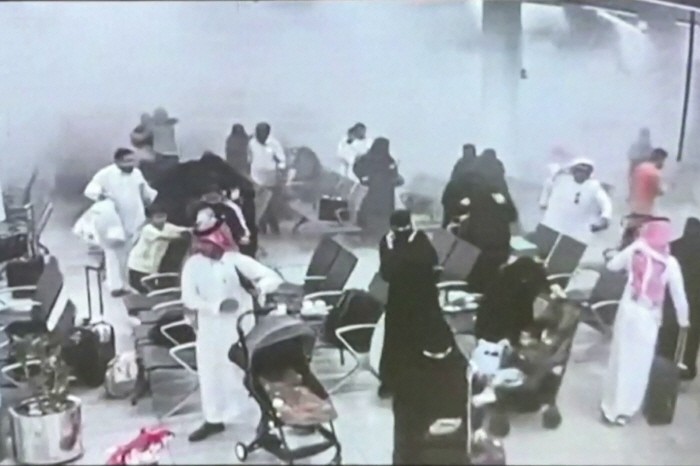 |
| A closed-circuit television (CCTV) screen grab released by the Saudi-led coalition during a press conference held in Riyadh, Saudi Arabia, on the 15th (local time). The coalition stated that this footage shows Yemen's Houthi rebels attacking Saudi Arabia's Abha International Airport on the 7th. / AFP, Yonhap |
Saudi postpones FII to 2027; Wall Street executives reconsider attendance over safety concerns
In a statement that day, the FII Institute said, "This decision is intended to ensure that the 10th edition delivers the full scale, quality, and impact expected by our partners, members, speakers, and delegates." Maha Al Saud, CEO of the FII Institute, also announced the postponement via X. The institute stated it would disclose the new schedule in due course.
The FII is Saudi Arabia's flagship event where it invites global investors, corporate leaders, and heads of state to promote its economic diversification projects and attract foreign investment. More than 8,000 participants attended last year. This year, Goldman Sachs CEO David Solomon, Citigroup CEO Jane Fraser, and BlackRock CEO Larry Fink were scheduled to speak.
However, Wall Street executives in the U.S. reconsidered traveling to Riyadh as Houthi attacks expanded. Some officials from JPMorgan Chase and Citigroup canceled on-site meetings. Internal discussions also took place over whether JPMorgan Chase CEO Jamie Dimon and Citigroup CEO Jane Fraser should attend, The Wall Street Journal reported.
A Saudi business advisor said, "Executives are extremely reluctant to fly to Riyadh, and companies do not want to put their employees at risk for investment conferences."
Organizers weighed a hybrid format combining virtual participation with an entirely online event. Providing alternative land and sea transit routes was also discussed. However, with safety concerns among global financial executives and travel advisories for the Middle East issued by Western nations continuing, the event was postponed.
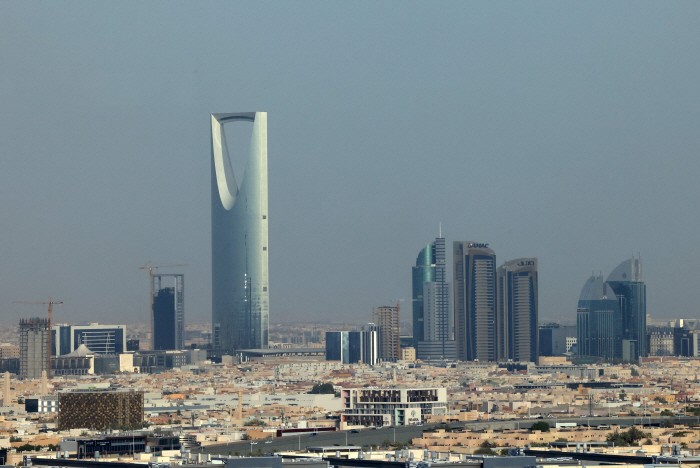 |
| A view of the 99-story Kingdom Centre skyscraper (left), a major landmark in Riyadh, Saudi Arabia, taken on August 1, 2023 (local time). As attacks on Saudi Arabia by Yemen's Houthi rebels continued repeatedly, Kingdom Centre requested tenant companies on the 18th to work from home until further notice. The building management office requested in an email sent to tenants, "Please refrain from coming to the office during this period," AFP reported. The shopping mall on the building's lower levels is operating normally. / AFP, Yonhap |
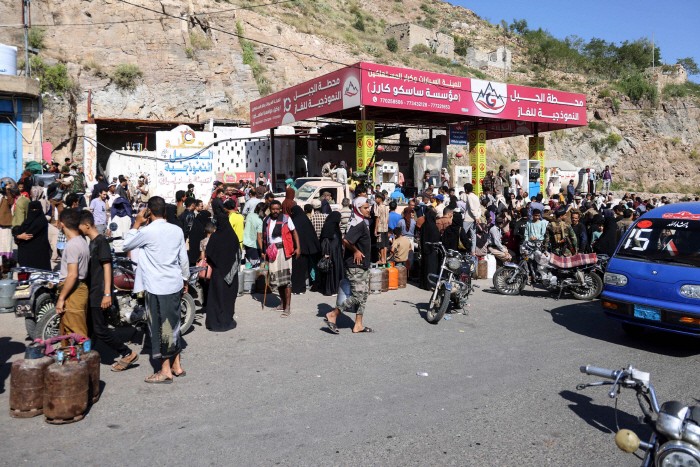 |
| Yemeni residents line up to refill gas canisters at a gas station in Taiz on the 19th (local time). Following the resumption of the prolonged Yemeni civil war, the Saudi-led coalition conducted hundreds of airstrikes against Houthi rebels in support of Yemen's internationally recognized government. The civil war, which had been in a lull for several years, flared up again in July, and fighting intensified after the Houthis took control of Yemen's Red Sea coast last month. / AFP, Yonhap |
Houthis claim strikes on Saudi Aramco and airports
The Houthis claimed on the 19th that they attacked six locations in Saudi Arabia, including oil facilities, international airports, and military bases. Houthi military spokesperson Yahya Saree stated on X that the strikes were in retaliation for Saudi Arabia launching more than 200 airstrikes over the past 48 hours on targets including Sanaa, the Yemeni capital. He claimed they executed six military operations mobilizing ballistic missiles, cruise missiles, and drones.
Spokesperson Saree stated that they struck Aramco facilities in the Red Sea oil export port city of Yanbu in two phases, sparking a massive fire. He claimed they also attacked the Shaybah oil field in the eastern Rub al-Khali desert, King Khalid International Airport in Riyadh, Abha International Airport in the southwest, and King Khalid Air Base in Khamis Mushait.
Warning that they will continue attacks deep into Saudi territory, he stated, "We will meet blockade with blockade, and escalation with escalation."
Massive casualties also occurred inside Yemen. The Houthis fired three ballistic missiles at the Al-Alam government military training base in the southern province of Shabwah on the 19th. Local authorities stated that 53 people were killed and 200 were injured, Reuters reported.
Majed Al-Nozaili, a spokesperson for the Yemeni armed forces, told Saudi broadcaster Al Arabiya that at least 47 people were killed and 53 were injured.
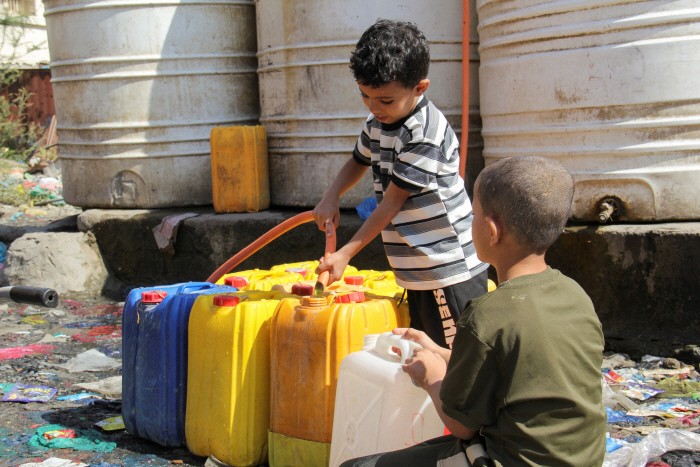 |
| Boys fill portable jerrycans with drinking water from a water tank installed by a charity in Taiz, southwestern Yemen, on the 18th (local time). / Reuters, Yonhap |
Houthis seize areas near Bab el-Mandeb; Saudi faces interceptor missile shortages and multi-front burdens
The clashes between Saudi Arabia and the Houthis are widening in tandem with territorial recapture operations by Yemeni government forces. The Houthis seized strategic areas along the Red Sea coast last month, escalating threats against vessels transiting the Bab el-Mandeb Strait, a vital chokepoint for global maritime trade. This also poses a threat to Saudi Arabia's crude oil exports.
Saudi-backed Yemeni government forces launched operations this month to recapture areas near the strait. The Houthis are besieging Taiz, the last major urban stronghold of anti-Houthi forces.
After the Yemeni civil war began in 2014, Saudi Arabia intervened militarily in 2015. The two sides agreed to a truce in 2022, but resumed fighting this year. Since the war between the U.S. and Israel on one side and Iran on the other began, the Yemeni front has also expanded in conjunction with military clashes across the Middle East.
Although Saudi Arabia possesses a massive defense budget alongside advanced U.S.-made fighter jets and air defense systems, it has been unable to completely intercept Houthi attacks.
A senior U.S. official stated that the Saudi military has intercepted more than 90% of Houthi missiles targeting areas protected by air defense systems such as the Patriot. However, the official explained that since fighting resumed, more than half of Houthi attacks have targeted areas lacking air defenses.
The Houthis have weathered Saudi airstrikes by utilizing mobile missile launchers and missile production facilities built deep underground. Between Saudi Arabia and Yemen lies a rugged mountainous border spanning roughly 800 miles (1,287 km), which also offers advantages for concealing launchers and moving rapidly.
Saudi Arabia must respond to threats arising from multiple directions, including Iran, pro-Iranian militias in Iraq, and the Houthis in Yemen. The dispersal of air defense assets has also been compounded by shortages of interceptor missiles.
Saudi Arabia has requested military support, including air defense units, from Turkiye, Pakistan, and European nations. The National Defense Council chaired by Egyptian President Abdel Fattah el-Sisi stated on the 18th that it would provide Saudi Arabia with "all necessary and possible forms of support." The Egyptian parliament discussed the approval of military assistance on the 19th, but postponed the session to next week without holding a vote.
U.S. President Donald Trump rejected a request from Saudi Arabia last month for direct strikes by the U.S. military. Following that, on the 16th, he urged Saudi Arabia to accept military aid from Israel. The U.S. has been providing military support to Saudi Arabia, including intelligence and targeting data.
The WSJ reported that analysts anticipate Saudi Arabia could potentially face having to respond to multiple fronts simultaneously if clashes with Iran resume following the U.S. midterm elections next month.
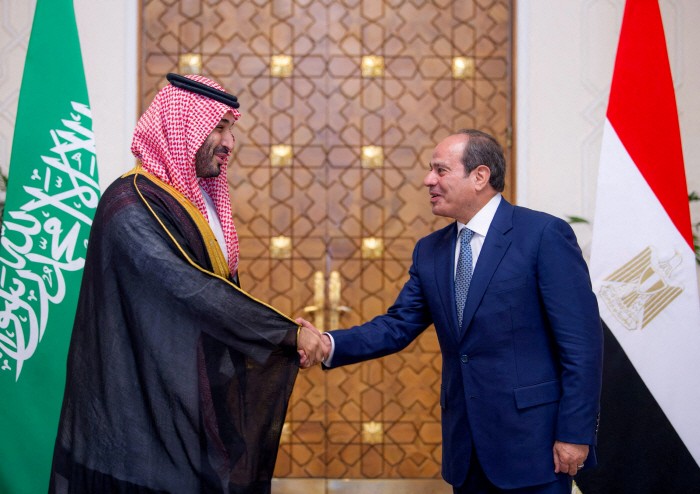 |
| Egyptian President Abdel Fattah el-Sisi (right) shakes hands with Saudi Arabian Crown Prince Mohammed bin Salman in Cairo, Egypt, on September 15 (local time). / Saudi Royal Court via Reuters, Yonhap |
Saudi faces setback in attracting foreign capital with FII postponement, with economy projected to contract 3.6% this year
The postponement of the FII is also placing a burden on Saudi Arabia's efforts to attract foreign capital. At last year's FII, investment and commercial agreements valued at more than $50 billion (66.675 trillion won) were announced. Yasir Al-Rumayyan, governor of the Public Investment Fund (PIF), stated that the FII has facilitated cumulative transactions of over $250 billion (333.375 trillion won) since its inception, Bloomberg News reported.
However, Bloomberg pointed out that because a significant number of the agreements take the form of non-binding memorandums of understanding (MOUs), calculating the scale of actually implemented investments and their final value remains difficult.
The FII serves as a core platform for attracting investment under Crown Prince Mohammed bin Salman's Vision 2030. It has showcased projects to the international financial community aimed at diversifying the oil-centered economy into tourism, sports, technology, and advanced manufacturing.
At the inaugural event in 2017, Crown Prince Mohammed bin Salman unveiled plans to develop the new futuristic city NEOM alongside Blackstone Chairman Steve Schwarzman and SoftBank Group Chairman Masayoshi Son. Recently, Saudi Arabia has been adjusting some of its mega-development initiatives and pivoting its strategy toward investments in artificial intelligence (AI), gaming, and advanced manufacturing.
The Saudi economy is already experiencing difficulties. The Saudi Ministry of Finance projected that the economy will contract by 3.6% this year. Net inflows of foreign direct investment (FDI) also declined year-on-year in both the first and second quarters.
With defense expenditures and infrastructure costs climbing, funding for mega-development projects aimed at reducing reliance on oil is also under pressure, The Wall Street Journal reported. Saudi Arabia is also slated to undertake massive expenditures ahead of hosting the 2030 World Expo and the 2034 World Cup.
The FII had rebuilt ties with the international financial community after Wall Street executives stayed away en masse following the 2018 assassination of journalist Jamal Khashoggi, who wrote for U.S. daily The Washington Post. This time, however, Houthi missile and drone attacks alongside flight disruptions have blocked global investors from visiting Saudi Arabia.
Michael Ratney, a senior advisor at the Center for Strategic and International Studies (CSIS) who previously served as U.S. ambassador to Saudi Arabia, observed that "at some point they will have to find an off-ramp," assessing that the Houthis possess the capability to inflict severe damage through asymmetric attacks, the WSJ reported.
Allison Minor, a senior fellow at CSIS, also evaluated that it is exceptionally difficult for Saudi Arabia to thwart every attack, noting that "sometimes the attack that penetrates air defenses can be fatal."
Ha Man-joo
Most Read
-
1
Celltrion nears additional contract with major U.S..

-
2
U.S. weighs dropping MOAB, world's most powerful n..

-
3
"Aren't those foreigners on welfare?": M..

-
4
Houthis launch successive attacks on Saudi airport..

-
5
Saudi Arabia, Iran hold first diplomatic talks to..

-
6
Saudi airport in Riyadh struck again, leaving at l..

-
7
Five ASEAN countries welcome Myanmar coup leader

PEOPLE






HEADLINE NEWS

-
Address : In-Young Bldg., 34, Uisadang-daero 1-gil, Yeongdeungpo-gu, Seoul
Copyright by ASIATODAY CO., LTD. All rights resereved