



Five ASEAN countries welcome Myanmar coup leader
Oct 12, 2026, 09:27 am


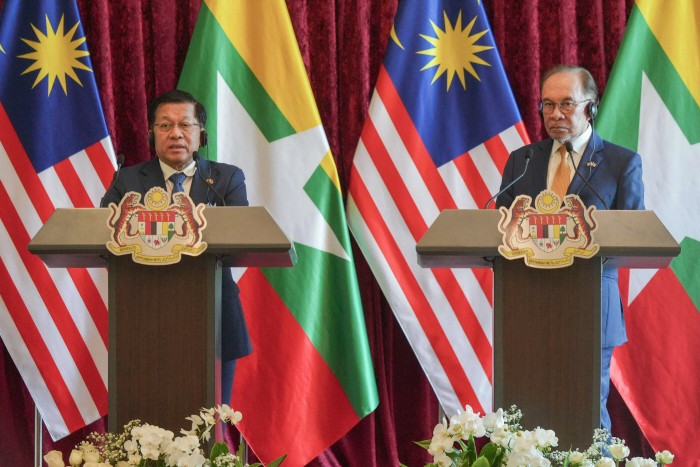 |
| Malaysian Prime Minister Anwar Ibrahim (right) and Myanmar President Min Aung Hlaing hold a joint press conference following talks in Putrajaya, Malaysia, on the 8th. / AFP, Yonhap News |
Controversy has erupted over an official visit to Malaysia by Myanmar President Min Aung Hlaing, who led the 2021 military coup. Since the coup that ousted the democratically elected government of Aung San Suu Kyi, Myanmar’s leadership has been barred from Association of Southeast Asian Nations (ASEAN) summits; however, the number of member states hosting him has grown to five since he assumed the presidency this past April.
President Min Aung Hlaing visited Malaysia on the 7th and 8th for bilateral talks with Prime Minister Anwar Ibrahim. According to reports from the AP and Reuters, Prime Minister Anwar said on the 8th that Malaysia would "do whatever it takes to deepen cooperation," expressing commitment toward facilitating Myanmar's full return to ASEAN. He simultaneously conveyed concerns regarding Myanmar's lack of democratic reforms and the ongoing violence.
While Myanmar retains its ASEAN membership, its political leaders have been excluded from summits since October 2021. The ban stems from the military junta's failure to implement the "Five-Point Consensus" peace plan agreed upon by ASEAN leaders, including Myanmar, in April of that year. That policy remains in effect. At the 48th ASEAN Summit held in Cebu, Philippines, this past May, Myanmar was represented instead by its permanent secretary of foreign affairs.
Outside the formal summit circuit, however, dynamics are shifting. Min Aung Hlaing visited Laos in July, followed by Thailand in August, and both Vietnam and Cambodia in September. In July, Myanmar’s foreign minister attended an informal ASEAN foreign ministers' retreat in Bangkok in person for the first time since the coup. Ahead of the state visit to Laos, Richard Horsey, senior adviser on Asia at the International Crisis Group (ICG), noted that the trip marked the "clearest step out of diplomatic isolation" and would inevitably erode the political leverage of the Five-Point Consensus.
Malaysia’s invitation came with conditions attached. According to Reuters, Prime Minister Anwar remarked on a podcast last month that he would formally invite Min Aung Hlaing if Myanmar agreed to accept the repatriation of thousands of Rohingya refugees. The Malaysian government maintains that it can no longer host Myanmar refugees, describing the community as both a fiscal burden and a security risk. Anwar stated on the 8th that 10,493 Myanmar nationals have been repatriated so far this year. However, the AP reported that it remains unclear whether any Rohingya were among those returned. Anwar has consistently expressed an intention to pressure Myanmar to repatriate Rohingya refugees.
Domestic politics also appears to have influenced Malaysia's outreach. Hunter Marston, director of the Southeast Asia Program at the Lowy Institute, told Channel NewsAsia (CNA) that the move followed back-to-back electoral defeats for Anwar’s ruling coalition in state elections in Johor and Negeri Sembilan in July and August, which intensified pressure to address public pushback against hosting Rohingya refugees. Anwar’s Pakatan Harapan (PH) coalition secured only 8 of 56 seats in Johor and ceded control of the state government in Negeri Sembilan. According to the AP, approximately 126,000 Rohingya reside in Malaysia, where an influx of online hate speech and disinformation has fueled rising harassment and surveillance against them.
Malaysia insists the visit does not signify formal recognition of Myanmar's military-backed government. The Ministry of Foreign Affairs explained that the engagement aligns with the Five-Point Consensus and follows the May summit decision to maintain "constructive and principled engagement" with Myanmar. Horsey offered a different reading, telling Reuters: "Anwar, facing repatriation pressure, needs Naypyidaw's cooperation, and the visit is the quid pro quo. While Anwar insists it is not recognition, that is precisely how Min Aung Hlaing will spin it."
Experts caution that as more member states engage Min Aung Hlaing bilaterally, ASEAN's collective leverage over Myanmar risks unravelling. Marston pointed out that "this increasingly divides ASEAN," leaving the Philippines, Singapore, and Indonesia in a "very uncomfortable position" while placing the Five-Point Consensus on "very shaky ground." Moe Thuzar, a senior fellow at Singapore's ISEAS-Yusof Ishak Institute, acknowledged the need to maintain open lines of communication, but warned that dialogue must not come at the expense of compliance obligations and accountability.
The next test comes next month at the 49th ASEAN Summit in Manila, Philippines. The Philippines, holding this year's ASEAN chair, must decide whether to invite Min Aung Hlaing—an invitation Horsey observed in July is "by no means guaranteed." Next year's chair passes to Singapore, one of the nations Marston identified as facing an uneasy stance.
Jeong Ri-na
Most Read
-
1
Kia Sportage outperforms Mazda CX-5 in German auto..

-
2
Houthis launch successive attacks on Saudi airport..

-
3
Saudi Arabia, Iran hold first diplomatic talks to..

-
4
U.S. deploys carrier, 10,000 more troops to Middle..

-
5
Saudi airport in Riyadh struck again, leaving at l..

-
6
Putin's ally visits China on the 8th ahead of APEC..

-
7
Five ASEAN countries welcome Myanmar coup leader

PEOPLE






HEADLINE NEWS

-
Address : In-Young Bldg., 34, Uisadang-daero 1-gil, Yeongdeungpo-gu, Seoul
Copyright by ASIATODAY CO., LTD. All rights resereved