



U.S. Congressional Research Service says U.S.-S. Korea alliance has reached inflection point
Oct 13, 2026, 10:21 am


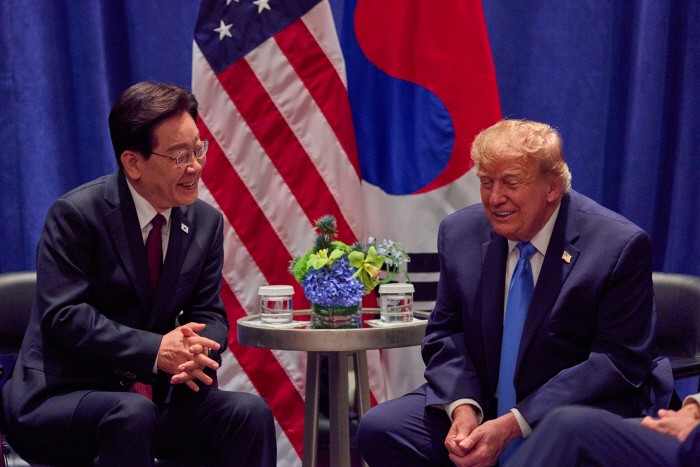 |
| President Lee Jae-myung, visiting the U.S. to attend the United Nations General Assembly, holds a summit with U.S. President Donald Trump at a New York hotel on September 22 (local time). / Joint Press Pool |
[Article Summary]
1. A senior official from the Trump administration called on South Korea to adhere to long-standing alliance standards in intelligence and counterintelligence, while U.S. curbs on intelligence sharing regarding North Korea have persisted for over six months.
2. Former USFK Commander Robert Abrams stated that perceptual gaps remain between some South Korean policymakers and his American view regarding the "acceleration" of OPCON transfer, noting that transition conditions have yet to be fully met.
3. Despite ongoing friction over 350 billion dollars in U.S. investments, support for the Iran conflict, and joint military drills, President Lee Jae-myung and President Donald Trump confirmed "substantial progress" in strategic investment talks during their New York summit on the 23rd of last month.
4. A day after holding a 30-minute summit with President Trump, President Lee met with Mexican President Claudia Sheinbaum for 119 minutes in Mexico.
5. Jenny Town, a senior fellow at the Stimson Center, assessed that the resilience of the alliance is being put to the test amid trade, investment, and tariff frictions, while the U.S. Congressional Research Service (CRS) cited observations that the South Korea-U.S. alliance may have reached an inflection point.
The South Korea-U.S. alliance faces a coordinated test across intelligence, counterintelligence, wartime operational control (OPCON) transfer, investment, and trade. Following remarks on the 9th (local time) by a senior Trump administration official calling on South Korea to uphold long-standing alliance standards in intelligence and counterintelligence, concerns over perceptual gaps regarding OPCON transfer and the overall trajectory of the alliance were voiced a day later during a Korea Defense Veterans Association (KDVA) panel in Washington, D.C. Nevertheless, leader-level engagement continues, with President Lee Jae-myung and President Donald Trump confirming "substantial progress" in strategic investment negotiations during their summit in New York on the 23rd of last month.
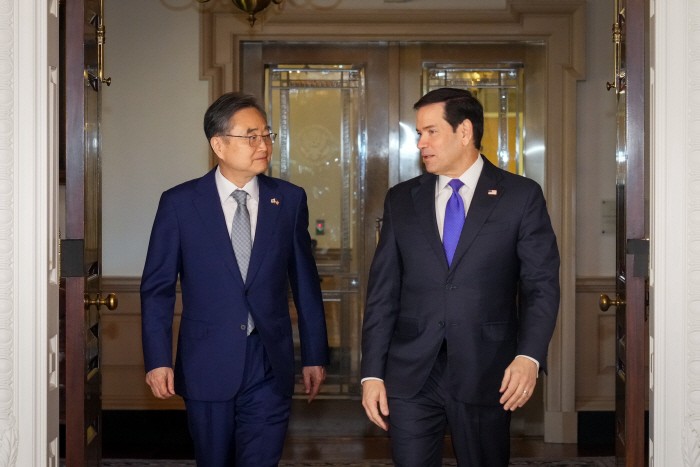 |
| South Korean Foreign Minister Cho Hyun (left) and U.S. Secretary of State Marco Rubio arrive to take a commemorative photo at the State Department building in Washington, D.C., on September 18 (local time). / Provided by the Ministry of Foreign Affairs |
Senior U.S. official expects Seoul to adhere to intelligence and counterintelligence alliance standards
A senior official from the Trump administration specifically cited intelligence and counterintelligence matters in a written response to South Korean media inquiries on bilateral intelligence coordination, expressing expectations that Seoul uphold standards that have anchored the alliance for decades.
The restrictions on intelligence sharing reportedly began after Unification Minister Chung Dong-young mentioned Kusong in North Pyongan Province as the location of a North Korean uranium enrichment facility during a National Assembly session last March. Stars and Stripes, the U.S. military newspaper, reported in April, citing the office of lawmaker Lim Jong-deuk, that the Defense Intelligence Agency had briefed the National Assembly on detailed aspects of this facility as a South Korea-U.S. joint secret. Minister Chung denied leaking classified information, maintaining that his statements were based on publicly available data. Washington subsequently curtailed South Korea's access to intelligence regarding North Korean nuclear facilities.
It was also recently revealed that the National Intelligence Service was excluded from a South Korea-U.S.-Japan working-group meeting addressing North Korean cyber threats in June at the request of the U.S. side.
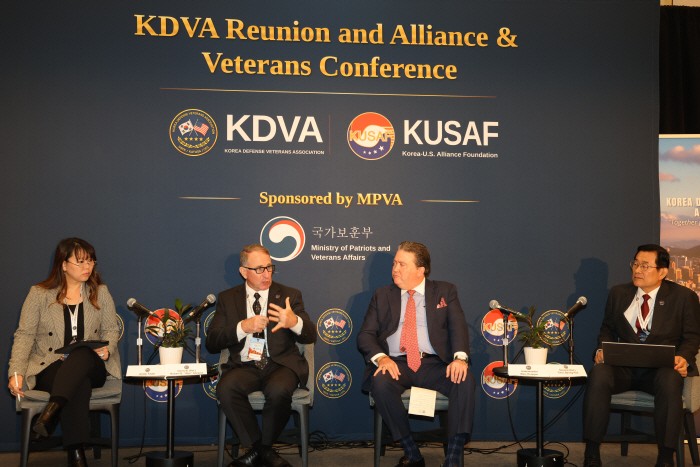 |
| Jenny Town, senior fellow at the Stimson Center and director of 38 North (from left), former USFK Commander Robert Abrams, former Chargé d'Affaires at the U.S. Embassy in Seoul Marc Knapper (former U.S. Ambassador to Vietnam), and former ROK-U.S. Combined Forces Command Deputy Commander Choi Byung-hyuk (former South Korean Ambassador to Saudi Arabia) discuss wartime operational control transfer during the Defense and Diplomacy Dialogue hosted by the Korea Defense Veterans Association (KDVA) in Washington, D.C., on October 10 (local time). / Washington Correspondent Ha Man-ju |
Abrams points to divergent interpretations of acceleration as gaps remain in OPCON transfer conditions
The most pronounced friction point in Washington was the transfer of wartime operational control (OPCON). During the Defense and Diplomacy Dialogue panel on the 10th, Robert Abrams, chairman and president of the KDVA and former USFK commander, defined the reemergence of the term "accelerate" in recent bilateral OPCON discussions as "a clear case of a real language barrier."
He pointed out that from the perspective of South Korean policymakers, acceleration might be interpreted as accepting certain risks while conditions remain short of 100% fulfillment. In contrast, from what he termed the "American perspective," it means expediting the schedule while strictly meeting 100% of the conditions, prioritizing the acquisition, development, deployment, fielding, training, and necessary budget allocations across 26 critical military capabilities.
Abrams disclosed that following a recent closed-door briefing in South Korea, shortfalls still remain in the transition conditions, with no progress seen on several crucial benchmarks. He also voiced concern over emerging tendencies in some quarters to equate sovereignty with unilateral South Korean decision-making rather than joint bilateral determination. While emphasizing respect for South Korea's sovereign right to determine its own destiny, he assessed that departing from proven bilateral procedures and combined command-and-governance frameworks could elevate military risks.
Retired General Choi Byung-hyuk, former deputy commander of the ROK-U.S. Combined Forces Command, framed OPCON as "a matter of military effectiveness rather than sovereignty," stating that "South Korean-led defense must not mean South Korea defending itself alone."
Marc Knapper, former Chargé d'Affaires at the U.S. Embassy in Seoul, stressed that airing differences during the OPCON transition must not signal to North Korea, China, or Russia that a rift has opened within the alliance. He urged that even after the transfer, the U.S. extended deterrence, the nuclear umbrella, regional deployment of strategic assets, and high-intensity combined exercises must be maintained.
The South Korean government and the ruling party continue to signal their intent to expedite the transition. Defense Minister Kang Shin-chul said upon taking office last month that a framework led by the South Korean military and backed by U.S. forces would make the combined defense posture "much stronger," according to CNBC. On the same day, the Democratic Party launched an OPCON transfer task force, with President Lee aiming to complete the transition before his term ends in 2030.
Assessments of readiness remain split even within South Korea. Retired Lieutenant General Chun In-bum, former commander of Special Warfare Command, told CNBC that South Korea is not fully prepared to assume OPCON, pointing out that "critical gaps remain in high-altitude strategic C4ISR and theater missile defense to counter nuclear threats."
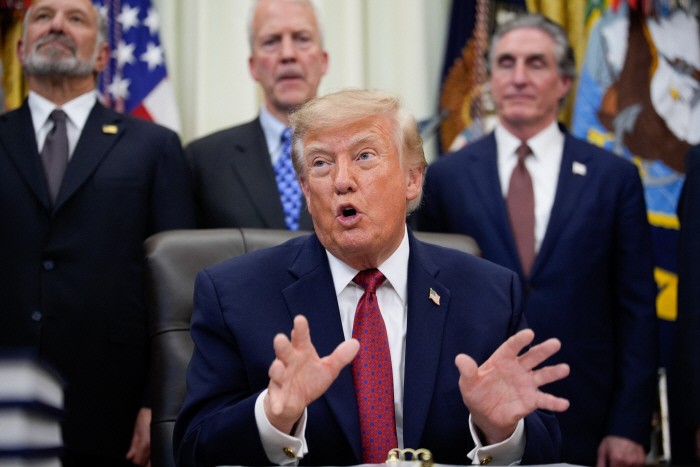 |
| U.S. President Donald Trump (center) announces South Korea's 200 billion dollar investment plan in the United States under the US-Korea Trade and Investment Initiative at the Oval Office in the White House in Washington, D.C., on September 30 (local time). The plan includes a 54 billion dollar project to construct an Alaska liquefied natural gas (LNG) pipeline. / EPA-Yonhap |
Perceptual gaps emerge between South Korea and U.S. over 350 billion dollar investment package while leaders confirm substantial progress at summit
Economic issues unfolded concurrently over the same period. The Financial Times reported on the 18th of last month that President Lee remarked he was experiencing "sleepless nights" over where to direct the 350 billion dollar (467.075 trillion won) investment package in the United States. President Lee rejected portions of the initial package that had neared final agreement and instructed further consultations, maintaining that investments would only be made in projects deemed "commercially viable." The FT characterized the investment package as "one of multiple friction points between the two allies."
In August, President Trump scaled back the South Korea-U.S. Ulchi Freedom Shield (UFS) joint exercises and criticized South Korea for offering no concrete support in the war with Iran. President Lee stated that Seoul would not deploy troops to support operations surrounding the blockade of the Strait of Hormuz. U.S. officials criticized the pace of South Korea's investment implementation as sluggish compared to countries like Japan, with President Trump warning of higher tariffs as a consequence, Reuters reported.
Discrepancies in official announcements also persisted. On the 30th of last month, President Trump unveiled a 200 billion dollar (266.9 trillion won) investment outline comprising up to 120 billion dollars (162.84 trillion won) across eight nuclear reactors, approximately 22 billion dollars (29.854 trillion won) for a gas-fired power plant in Texas, and 50 billion dollars (66.71 trillion won) for the Alaska liquefied natural gas (LNG) venture. South Korea withheld any definitive financing commitments for the Alaska LNG project, indicating plans for further review regarding commercial feasibility and legal procedures.
When President Trump announced on the 2nd of this month that an 8.4 billion dollar (11.2098 trillion won) enhanced oil recovery project was also part of the bilateral deal, an official from South Korea's Ministry of Trade, Industry and Energy clarified that no agreement had been reached on that matter. Reuters reported that South Korea had similarly conditioned its participation in the Alaska LNG venture on assessments of commercial viability and legal compliance.
Nevertheless, high-level discussions between the heads of state remain on track. President Lee and President Trump held a 30-minute summit in New York on the 23rd of last month, welcoming "substantial progress" achieved in strategic investment negotiations. Both leaders also conferred on OPCON transfer, nuclear fuel enrichment and reprocessing, nuclear-powered submarines, shipbuilding, and North Korea issues. Reuters reported that Washington reiterated its position that the OPCON transfer process should proceed as expeditiously as possible while fulfilling all required preconditions.
Meanwhile, roughly 300 South Korean workers who were detained during a raid on the Hyundai Motor-LG Energy Solution joint-venture plant in Georgia in September of last year filed administrative claims last month against nine U.S. federal agencies, a required prerequisite before initiating a federal lawsuit. Reuters noted that footage and photographs of workers shackled at the wrists, waists, and ankles during the raid stirred intense public shock in South Korea. Former Commander Abrams also observed that the incident continues to leave lingering bad blood in South Korea.
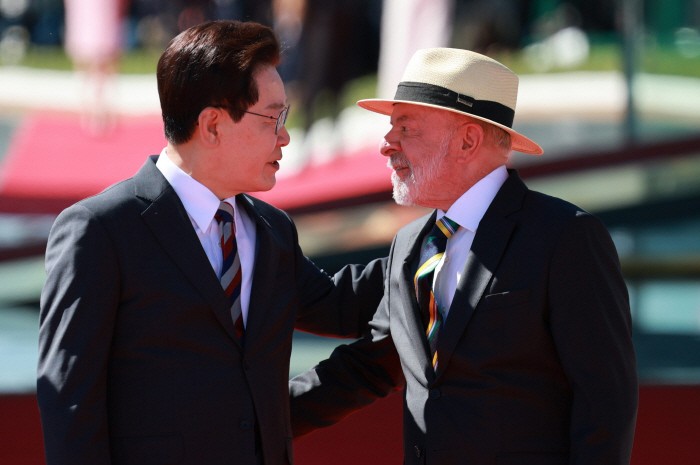 |
| President Lee Jae-myung, on a state visit to Brazil, greets President Luiz Inácio Lula da Silva during a welcome ceremony held in the square in front of the presidential residence in Brasília on July 27 (local time). / Yonhap |
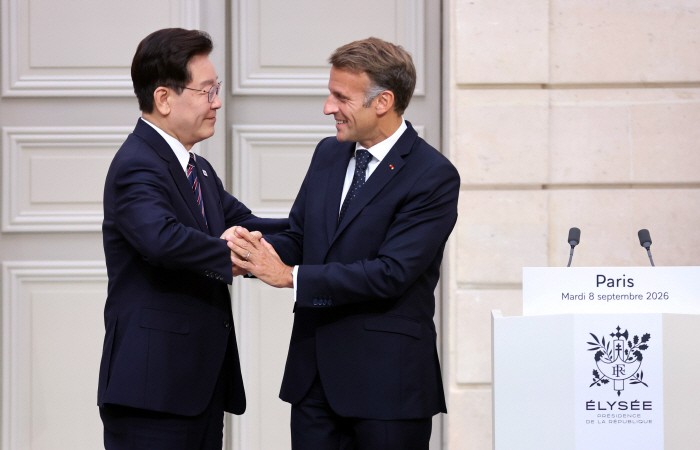 |
| President Lee Jae-myung and French President Emmanuel Macron greet each other following a joint press conference at the Élysée Palace in Paris on September 8 (local time). / Yonhap |
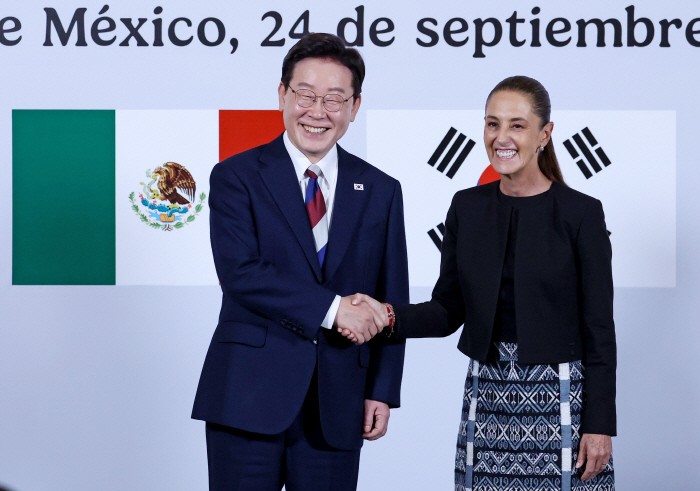 |
| President Lee Jae-myung and Mexican President Claudia Sheinbaum shake hands following a joint press conference at the National Palace in Mexico City on September 24 (local time). / Yonhap |
President Lee engages in summit diplomacy with Sheinbaum following Macron and Lula
Since taking office, President Lee has expanded summit diplomacy across major European and Latin American nations. Brazilian President Luiz Inácio Lula da Silva paid a state visit to South Korea in February, while President Lee made a return state visit to Brazil in July, holding a summit with President Lula and adopting a joint declaration.
From September 6 to 9, President Lee made a state visit to France for a summit with President Emmanuel Macron. Earlier in June, he had attended the Group of Seven (G7) summit held in Évian, France.
Summit diplomacy linking the United States and Mexico continued around the UN General Assembly. On the 23rd of last month, President Lee met with President Trump in New York for 30 minutes to discuss the 350 billion dollar strategic investment package in the U.S., OPCON transfer, nuclear fuel enrichment and reprocessing, nuclear-powered submarines, shipbuilding, and North Korea issues. Both sides assessed that "substantial progress" had been achieved in the strategic investment talks.
The following day, President Lee traveled to Mexico City for an official summit with President Claudia Sheinbaum. The summit lasted 119 minutes, comprising 44 minutes of restricted talks and 75 minutes of expanded discussions.
Presidents Macron, Lula, and Sheinbaum have each publicly clashed with President Trump over different fronts. At the UN General Assembly on the 22nd of last month, President Macron pushed back against President Trump's assertions regarding peace in the Gaza Strip. President Lula has repeatedly asserted Brazilian sovereignty in the face of pressure from President Trump concerning Brazil's domestic judicial proceedings, Reuters reported. The Wall Street Journal reported on the 6th of this month that President Sheinbaum has assumed an increasingly firm posture against U.S. pressure over cartel sanctions and perceived interference in Mexican domestic affairs.
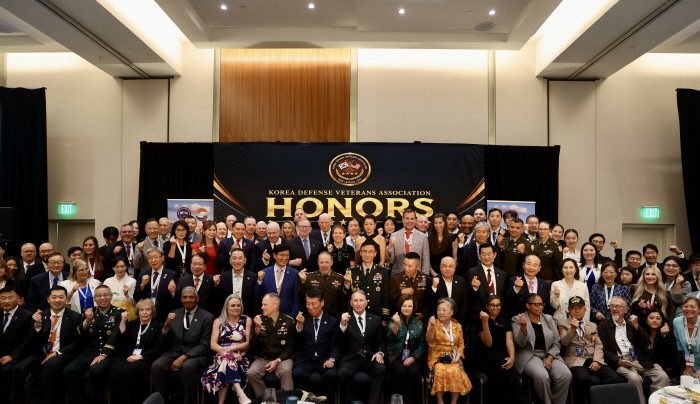 |
| Attendees pose for a commemorative photo at the 2026 Reunion and Alliance and Veterans Conference hosted by the Korea Defense Veterans Association (KDVA) in Washington, D.C., on October 10 (local time). / Washington Correspondent Ha Man-ju |
CRS notes alliance may have reached inflection point
Messages emerging from Washington were not exclusively focused on friction. Speaking at the KDVA event on the 10th, David Wilezol, U.S. Deputy Assistant Secretary of State for Japan, Korea, and Mongolia, reflected on the sacrifices made by American and South Korean service members during the Korean War, stating that there is an "obligation to make what was defended with the precious blood of youth even stronger through our efforts."
General Christopher LaNeve, Vice Chief of Staff of the U.S. Army, underscored that the U.S. objective remains "peace through strength" backed by alliances, emphasizing that the South Korea-U.S. alliance delivers "an indispensable positional advantage" in contingencies.
Former Commander Abrams similarly recounted that during his recent trip to South Korea, he witnessed enduring respect for the bilateral alliance and American contributions across the government, business sector, and general public. At the same time, he observed that concerns persist within the South Korean government over areas where Seoul and Washington do not see fully eye to eye—such as Persian Gulf support and OPCON transfer—while noting that the Georgia raid incident continues to leave bad blood in South Korea.
In a report released this year, the U.S. Congressional Research Service (CRS) cited views from some observers suggesting that the South Korea-U.S. alliance may have reached an "inflection point." The CRS pinpointed simultaneous readjustments in the alliance's scope and burden-sharing as core focal points, spanning OPCON transfer, USFK's regional roles, responses to regional threats including China, economic security, and technology cooperation.
The Stimson Center analyzed that the South Korea-U.S. alliance has entered a period of structural realignment, concurrently recalibrating military, economic, and technological dimensions amid shifts in U.S. strategic priorities and intensifying U.S.-China competition. The think tank noted that rather than the transition itself, the crucial test lies in whether the two countries navigate these changes deliberately and in a coordinated manner. Handled prudently, the process could simultaneously bolster deterrence and South Korea's strategic autonomy; mishandled, it could inject deeper ambiguity into operational roles, missions, and decision-making authority.
At the conclusion of the OPCON panel on the 10th, Senior Fellow Town remarked, "There is a lot of concern in Washington about the trajectory of the alliance," observing that while the partnership is robust and resilient, mounting frictions across investment, trade, and tariffs intersecting with security files mean that "how strong that resilience is is now being tested." She pointed out that while substantial demands are placed on South Korea, comparatively little heed is given to Seoul's stated priorities, such as nuclear-powered submarines and rights regarding uranium enrichment and spent nuclear fuel reprocessing.
Ha Man-ju
Most Read
-
1
Kia Sportage outperforms Mazda CX-5 in German auto..

-
2
Houthis launch successive attacks on Saudi airport..

-
3
Saudi Arabia, Iran hold first diplomatic talks to..

-
4
U.S. deploys carrier, 10,000 more troops to Middle..

-
5
Saudi airport in Riyadh struck again, leaving at l..

-
6
Putin's ally visits China on the 8th ahead of APEC..

-
7
Chinese military support and training center opens..

PEOPLE






HEADLINE NEWS

-
Address : In-Young Bldg., 34, Uisadang-daero 1-gil, Yeongdeungpo-gu, Seoul
Copyright by ASIATODAY CO., LTD. All rights resereved