



China slaps first-ever sanctions on sitting ministers of Taiwan's diplomatic allies
Oct 13, 2026, 10:00 am


China has slapped sanctions on one cabinet minister each from Paraguay and Belize, two Latin American nations that maintain diplomatic relations with Taiwan.
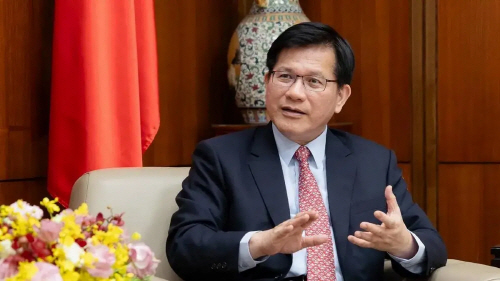 |
| Taiwanese Foreign Minister Lin Chia-lung. He visited Belize in Latin America last September and met with Francis Fonseca, the minister overseeing foreign affairs and other portfolios, which led to Fonseca being sanctioned by China on October 12. / Global Times (Huanqiu Shibao) |
According to diplomatic sources in Beijing on the 13th, the Chinese Ministry of Foreign Affairs announced in a notice the previous day that it had decided to impose "countermeasures" against Gustavo Villate, Paraguay’s Minister of Information and Communications Technology, and Francis Fonseca, Belize’s Minister of Foreign Affairs, Foreign Trade, Education, Culture, Science and Technology. Key sanctions include freezing assets within Chinese territory, prohibiting transactions and cooperation with Chinese organizations and individuals, and denying visas.
Sources noted that this marks the first time China has directly sanctioned sitting cabinet-level officials of Taiwan's diplomatic allies. However, Beijing had its own distinct reasons for taking this abrupt action.
First, Minister Villate drew Beijing’s ire after discussing cooperation in artificial intelligence (AI) and other fields with Taiwan’s Deputy Foreign Minister Chen Ming-chi, who visited Paraguay in June. Minister Fonseca also failed to escape Beijing’s crosshairs after conducting official exchanges with Taiwan this year, including a meeting with Taiwanese Foreign Minister Lin Chia-lung during Lin's visit to Belize in September.
Regarding the sanctions, the Chinese Foreign Ministry stated, "Anti-China politicians in Paraguay and Belize have supported diplomatic ties with Taiwan for their own selfish interests," adding that "they have undermined China's core interests through a series of egregious words and deeds on China-related issues."
Foreign Ministry spokesperson Mao Ning also commented, "A few politicians in Paraguay and Belize willingly served as pawns for the Taiwan authorities seeking independence relying on foreign forces, visiting Taiwan and hosting visits by Taiwan independence elements, thereby grossly interfering in China's internal affairs." She added, "They also spread false information about Chinese cyberattacks, attacking and smearing China to create a negative international impact."
She went on to emphasize, "China will take all necessary punitive measures against individuals who stubbornly support Taiwan independence separatist forces to resolutely defend national sovereignty and territorial integrity," adding, "We advise the few remaining so-called diplomatic allies of the Taiwan authorities not to be repeatedly manipulated and exploited by Taiwan independence separatist forces. Tying oneself to Taiwan independence forces offers no future and will only lead to missed development opportunities and isolation from the international community."
Currently, only 12 nations maintain official diplomatic relations with Taiwan: Paraguay—Taiwan's sole diplomatic ally in South America—along with Belize and Guatemala in Central America, the Holy See (Vatican), Eswatini in Africa, Palau, Haiti, the Marshall Islands, Saint Kitts and Nevis, Saint Lucia, Saint Vincent and the Grenadines, and Tuvalu.
As recently as 2016, Taiwan had 21 diplomatic allies. However, the number has steadily dwindled under Beijing's global campaign to isolate Taiwan around the "One China" principle. Given the current momentum, it appears to be only a matter of time before that figure drops below 10.
Hong Soon-do
Most Read
-
1
Kia Sportage outperforms Mazda CX-5 in German auto..

-
2
Houthis launch successive attacks on Saudi airport..

-
3
Saudi Arabia, Iran hold first diplomatic talks to..

-
4
U.S. deploys carrier, 10,000 more troops to Middle..

-
5
Saudi airport in Riyadh struck again, leaving at l..

-
6
Putin's ally visits China on the 8th ahead of APEC..

-
7
Chinese military support and training center opens..

PEOPLE





HEADLINE NEWS

-
Address : In-Young Bldg., 34, Uisadang-daero 1-gil, Yeongdeungpo-gu, Seoul
Copyright by ASIATODAY CO., LTD. All rights resereved