



Putin's ally visits China on the 8th ahead of APEC summit
Oct 08, 2026, 05:22 pm


With speculation mounting over the possibility of a trilateral summit among the U.S., China, and Russia on the sidelines of the two-day Asia-Pacific Economic Cooperation (APEC) summit slated for the 18th and 19th of next month in Shenzhen, Guangdong Province, China, a visit to China by a high-ranking Russian official is drawing keen attention.
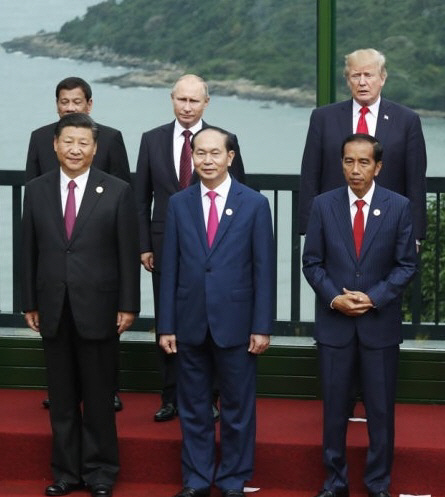 |
| The leaders of the U.S., China, and Russia who attended the APEC summit held in Vietnam in 2017. Nine years later, prospects are rising that they may cross paths once again at the APEC summit in Shenzhen, Guangdong Province, China, in mid-November this year. / Global Times |
According to Beijing diplomatic sources well-versed in China-Russia relations on the 8th, a Chinese Foreign Ministry spokesperson announced the previous day that Nikolai Patrushev, aide to the Russian President and chairman of the Maritime Collegium, will visit China from the 8th to the 13th for talks with Wang Yi, member of the Political Bureau of the CPC Central Committee, Minister of Foreign Affairs, and Director of the Office of the Central Foreign Affairs Commission.
Regarding the visit, the Global Times, an English-language sister newspaper of the party's official mouthpiece People's Daily, reported that with President Vladimir Putin scheduled to attend the APEC summit, Aide Patrushev could potentially engage in in-depth communication while coordinating stances with the Chinese side ahead of the event. Given that he is one of President Putin's closest confidants—having served as Secretary of Russia's Security Council for 16 years before assuming his current post in 2024—this analysis appears well-founded.
Indeed, the prospect of a trilateral summit among the U.S., China, and Russia during the APEC summit has been persistently raised, primarily from the Russian side. For instance, President Putin noted at an event held on the 1st: "I am aware that discussions are underway regarding the possibility of a trilateral meeting," adding, "We can say we are in full favor of it."
He continued, saying, "The trilateral meeting will largely depend on the host country, China. Meetings allow for an exchange of views and clarification of positions, and are therefore always beneficial," while adding that "the most important thing is to identify the issues that will form the basis of a trilateral summit; the agenda needs to be defined."
Yury Ushakov, foreign policy aide to the Russian president, also stated in an interview last month that "it is highly likely that General Secretary and President Xi Jinping will take steps to host a trilateral meeting," adding, "I think it is natural for the three leaders to gather and hold talks." On the 6th, he similarly described the concept of holding a U.S.–China–Russia trilateral summit as "interesting," though he also remarked that "as of now, there are no working-level consultations for it."
Prior to this, U.S. President Donald Trump and President Xi Jinping confirmed their mutual intention to attend both the APEC summit in November and the G20 summit in the U.S. in December during their bilateral summit at the White House in Washington, D.C., on the 24th of last month. Judging by the atmosphere, a trilateral summit cannot be ruled out as entirely impossible.
However, Chinese Foreign Ministry spokesperson Guo Jiakun deflected a direct answer on the 3rd regarding the possibility of a U.S.–China–Russia summit, stating, "As the host of this year's APEC, China hopes to make new contributions to promoting economic growth in the Asia-Pacific and the world," while adding, "I have no information to provide on the question raised." While the likelihood is noted, whether the summit will fully materialize appears to remain shrouded in fog.
Hong Soon-do
Most Read
-
1
Trump shares map on social media labeling Strait o..

-
2
Kia Sportage outperforms Mazda CX-5 in German auto..

-
3
U.S. deploys carrier, 10,000 more troops to Middle..

-
4
Trump rejects Iran's offer to open Strait of Hormu..

-
5
N. Korea conducts first swarm attack drill with dr..

-
6
Houthis launch successive attacks on Saudi airport..

-
7
U.S.-China summit falls short on substance as Trum..

PEOPLE






HEADLINE NEWS
- Seoul dismisses Ukraine's claim of 'S. Korean support for Russia' as "inaccurate and inappropriate"
- S. Korea, Japan race to develop nuclear-powered submarines
- Henri Kagan, Kenso Soai win Nobel Prize in Chemistry for uncovering how mol..
- Vance says Alaska LNG cooperation will move forward with Seoul's current or..

-
Address : In-Young Bldg., 34, Uisadang-daero 1-gil, Yeongdeungpo-gu, Seoul
Copyright by ASIATODAY CO., LTD. All rights resereved