



U.S. courts Southeast Asia as it tightens AI chip export controls
Nov 20, 2026, 09:41 am


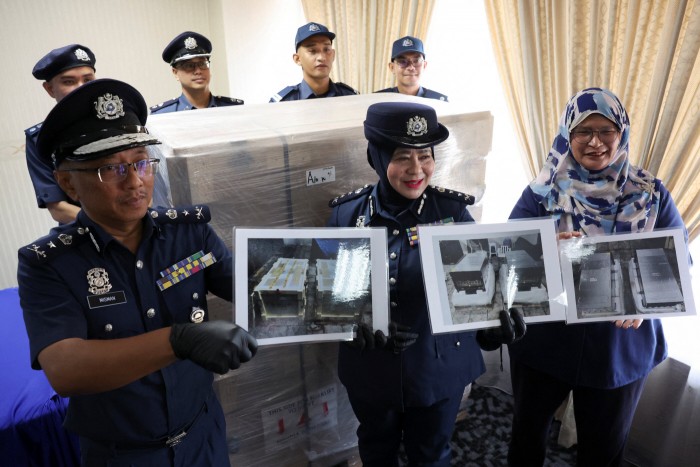 |
| Malaysian customs officials display photos of seized servers during a press conference on the seizure of 30 servers equipped with advanced artificial intelligence (AI) chips in Sepang, Malaysia, on Oct. 28 (local time). /Reuters-Yonhap News Agency |
The United States has imposed stringent export controls on key Southeast Asian hubs to prevent advanced artificial intelligence (AI) chips from being diverted to China, while launching a diplomatic outreach effort to ease regional opposition.
According to Channel NewsAsia (CNA) and the South China Morning Post (SCMP) on Nov. 19 (local time), Kevin Kim, the Korean American U.S. ambassador to the Association of Southeast Asian Nations (ASEAN) and former chargé d'affaires at the U.S. Embassy in Seoul, said at a virtual press conference the previous day that the new semiconductor controls reflected Washington's belief that Southeast Asia would be "at the heart of the superintelligence industry." Reaching out to Southeast Asian countries concerned about a potential slowdown in data center investment, Kim called for trust-based partnerships to keep sensitive advanced technologies from falling into the "wrong hands."
Kim, who took office in June, stressed that establishing regulatory frameworks and verification procedures to ensure that U.S. technology and capabilities are used appropriately was an urgent task, given that winning the superintelligence race is a key priority for President Donald Trump and his entire administration. At the same time, he pledged that Washington would keep all channels of communication open with its Southeast Asian partners and maintain close exchanges on their concerns and relevant information. The move is seen as an attempt to prevent unilateral regulations from alienating Southeast Asian countries and to keep the region's digital infrastructure integrated into the U.S.-led AI ecosystem.
Singapore, Southeast Asia's financial and technology hub affected by the new restrictions, immediately pledged to take enforcement action of its own, seeking to avoid a direct confrontation with Washington. Speaking to Singaporean media following the ASEAN-U.S. Special Summit in Manila, the Philippines, on Nov. 17, Singaporean Prime Minister Lawrence Wong said his country would assist U.S. authorities in monitoring how local companies use chips and take firm action against companies circumventing export controls to uphold the rule of law and protect Singapore's reputation as a trusted business hub.
Singaporean Deputy Prime Minister Gan Kim Yong also said at the Singapore FinTech Festival on Nov. 18 that Singapore would not tolerate attempts to exploit connections with the country to violate the laws of other jurisdictions. He added that Singapore was in talks with U.S. authorities to ensure its companies could maintain access to advanced chips.
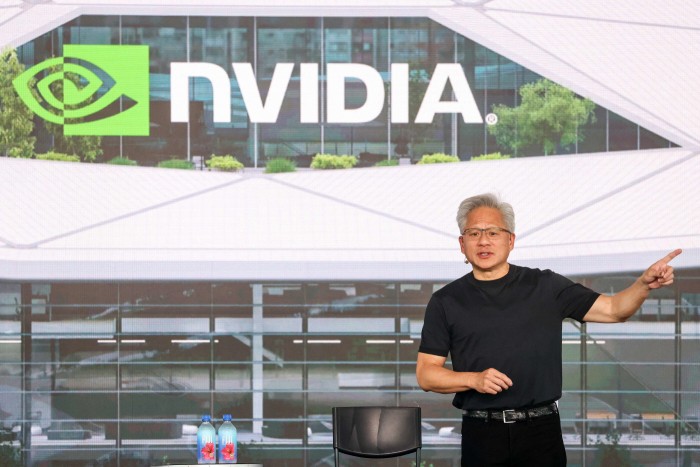 |
| Nvidia CEO Jensen Huang speaks at a company-wide meeting at the Beitou-Shilin Technology Park in Taipei, Taiwan, in May. /AFP-Yonhap News Agency |
Two-tier system exempts U.S. tech giants
The interim final rule (IFR), announced by the U.S. Department of Commerce on Nov. 16 and taking effect on Nov. 19, identifies five countries — Singapore, Malaysia, Indonesia, Thailand and Brazil — as presenting a "higher-than-normal risk of diversion." Prior authorization from the U.S. government will be required to export, reexport or transfer in-country advanced AI chips such as Nvidia's H100 and H200 and its next-generation Blackwell chips to or within these countries.
The key feature of the rule is that it targets not only the physical smuggling of chips but also the cloud computing loophole through which Chinese tech giants such as Alibaba, ByteDance and Tencent have remotely rented large-scale computing resources from Southeast Asian data centers to train advanced AI models.
New chip shipments will be subject to licensing requirements immediately upon the rule's entry into force on Nov. 19, while data center operators already providing remote computing services will be given a 90-day grace period to obtain licenses.
By contrast, shipments to companies headquartered in the United States or whose ultimate parent companies are based there, such as Amazon Web Services (AWS), Microsoft and Google, will be exempt from licensing requirements subject to monthly transaction reporting. This creates a two-tier regulatory environment in which local operators face different requirements from their U.S. counterparts.
This disparity has raised concerns that Southeast Asia's data center boom could come to an abrupt halt, particularly in Malaysia, where a total of 385.7 billion ringgit (approximately 124 trillion won) in investment has flowed into 55 operational data centers and 62 new projects.
Chris McGuire, a senior fellow at the Council on Foreign Relations (CFR), said recent digital forensic research had found that all of China's advanced AI models were trained using cutting-edge U.S. chips. He described the new restrictions on remote access as a significant measure that could substantially widen the AI gap between the United States and China.
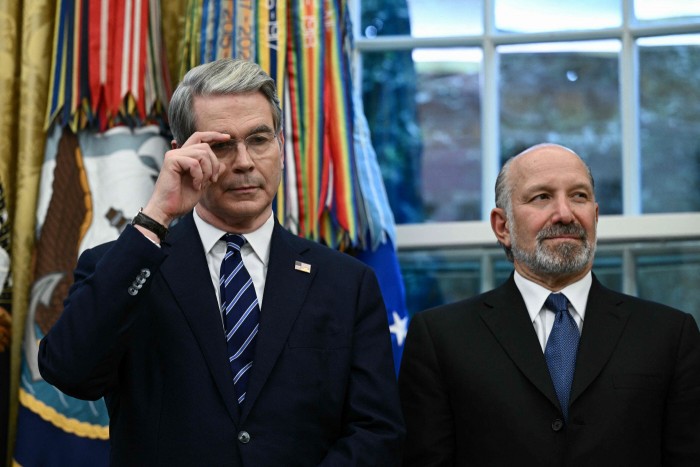 |
| U.S. Treasury Secretary Scott Bessent (left) and Commerce Secretary Howard Lutnick listen to President Donald Trump speak in the Oval Office of the White House in Washington, D.C., in August. /AFP-Yonhap News Agency |
Shenzhen U.S.-China summit and Cabinet divisions add uncertainty
There are also considerable concerns that stringent due diligence requirements concerning customers' ownership structures and licensing procedures could instead push Southeast Asian companies toward Chinese-made alternatives or an independent third technology ecosystem.
Within the United States, the new rule is also seen as exposing policy divisions between Treasury Secretary Scott Bessent's team, which led the push for a tougher stance on China and drafted the rule, and Commerce Secretary Howard Lutnick, who has faced criticism for delaying sanctions against Megaspeed out of concern over deteriorating relations with China.
Trump himself signaled caution against further escalation, saying he did not want to insult China ahead of his third face-to-face summit with Chinese President Xi Jinping this year, scheduled for Nov. 19 on the sidelines of the Asia-Pacific Economic Cooperation (APEC) summit in Shenzhen.
Deborah Elms, head of trade policy at the Hinrich Foundation, told Al Jazeera that policy uncertainty was growing as divisions within the U.S. administration had surfaced amid the U.S. midterm election defeat and the Nvidia controversy, compounded by uncertainty over the China policy of the new Congress taking office next January and the expiration of the U.S.-China trade truce on Jan. 10 next year.
Jeong Ri-na
Most Read
-
1
AMD's Lisa Su floated as potential Nvidia successo..

-
2
Iran resumes attacks after two months, targeting U..

-
3
Alice Huang, affair partner of Jensen Huang, repor..

-
4
China President Xi's Keynote Speech at the APEC C..

-
5
Xi secures fourth term as China reshuffles next-ge..

-
6
Hegseth rejects calls for impeachment over Iran wa..

-
7
Nvidia executive Kimberly Powell at center of Jens..

PEOPLE







-
Address : In-Young Bldg., 34, Uisadang-daero 1-gil, Yeongdeungpo-gu, Seoul
Copyright by ASIATODAY CO., LTD. All rights resereved