



Iran resumes attacks after two months, targeting U.S. base in Bahrain
Nov 16, 2026, 10:41 am


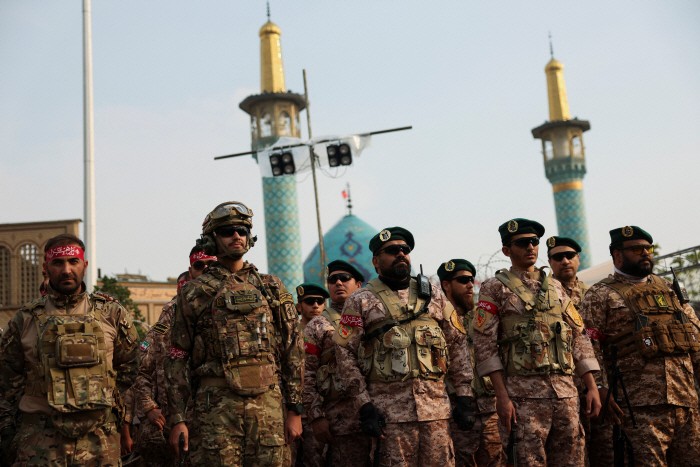 |
| Members of Iran's Islamic Revolutionary Guard Corps (IRGC) stand at a military training center set up for civilians in Tajrish Square in Tehran, Iran, on Nov. 2 (local time). /Reuters-Yonhap News Agency |
Iran has launched its second drone attack in three days targeting a U.S. military base in Bahrain, resuming attacks that had largely subsided since September.
According to AFP, Reuters and other news agencies on Nov. 15 (local time), Iran's Islamic Revolutionary Guard Corps (IRGC) announced that it had launched six drones targeting a U.S. air defense radar installation at the Al-Riffa helicopter base in Bahrain in retaliation for what it called "hostile U.S. actions."
The IRGC had also claimed to have attacked a U.S. early-warning radar facility on Nov. 13, but U.S. Central Command (CENTCOM) said it had shot down two drones without sustaining any damage.
Bahrain is home to major U.S. military installations that serve as key support hubs for military operations in the Middle East, including a forward base that previously hosted the U.S. Navy's Fifth Fleet and U.S. Naval Forces Central Command.
Regarding the latest attack, Bahraini authorities said their air defense systems had intercepted and destroyed several drones before they reached their targets.
In a statement, Bahrain's Foreign Ministry condemned the attack as "a heinous act of aggression and a violation of international law," holding Iran fully responsible.
Neighboring Arab countries, including Saudi Arabia, Qatar, Jordan and Egypt, also issued statements condemning the attack and expressing solidarity with Bahrain.
The latest drone attack came in response to a series of U.S. military strikes in recent weeks against Iranian targets, including Qeshm Island in the Strait of Hormuz.
At a press conference, Iranian Foreign Ministry spokesperson Esmaeil Baghaei said, "We will continue to respond to military aggression by the United States or any other country," adding that "Iran is not waiting for anyone and is focused on its own security."
The conflict, which began with joint U.S. and Israeli airstrikes in February, has remained mired in difficulties, with no diplomatic solution in sight.
Following the Republican Party's defeat in the U.S. midterm elections, President Donald Trump indicated that he was willing to hold off on further strikes if Iran and the Houthi rebels in Yemen refrained from further provocations, while maintaining the U.S. naval blockade of Iran, Reuters reported.
At the same time, Trump declared that there would be no further agreement with Iran and instructed Vice President JD Vance, who had been seeking separate talks with Iranian negotiators to discuss peace terms, to shift his focus to domestic issues, according to British newspaper The Guardian.
Separately from the attack, the IRGC claimed on Nov. 15 that two vessels had struck naval mines in the Strait of Hormuz and caught fire, and that one of them, a supertanker carrying two million barrels of crude oil, had sunk.
The U.S. military had previously said that it had recently cleared all naval mines from major shipping lanes.
Lee Jeong-eun
Most Read
-
1
AMD's Lisa Su floated as potential Nvidia successo..

-
2
Southeast Asian auto parts makers hit hard by Chin..

-
3
U.S. links Myanmar peace efforts to rare earth acc..

-
4
Alice Huang, affair partner of Jensen Huang, repor..

-
5
Hegseth rejects calls for impeachment over Iran wa..

-
6
Democrats flip U.S. Congress in historic midterm s..

-
7
Xi secures fourth term as China reshuffles next-ge..

PEOPLE







-
Address : In-Young Bldg., 34, Uisadang-daero 1-gil, Yeongdeungpo-gu, Seoul
Copyright by ASIATODAY CO., LTD. All rights resereved