



U.S. links Myanmar peace efforts to rare earth access, countering China
Nov 03, 2026, 01:18 pm


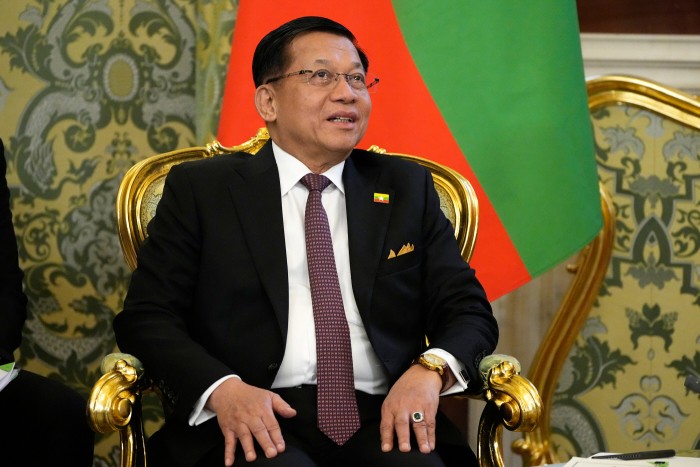 |
| Myanmar President Min Aung Hlaing speaks during a meeting with Russian President Vladimir Putin at the Grand Kremlin Palace in Moscow, Russia, on Aug. 18. / AP-Yonhap |
The United States has explicitly outlined plans in an official State Department strategy document to use peace mediation efforts in Myanmar's civil war to expand its influence and gain access to the country's rare earth resources. Analysts see the move as a shift toward a more pragmatic diplomatic approach aimed at countering China's dominance over resources and its regional influence, moving away from Washington's longstanding policy of isolating Myanmar's military.
According to Reuters on Nov. 2 (local time), the plans were outlined in the U.S. Embassy in Myanmar's Integrated Country Strategy (ICS), which was approved by the State Department on Aug. 31 and published on its website on Oct. 16.
Reuters noted that the document was unusually explicit about Washington's plans to help U.S. companies establish a foothold in Myanmar by participating in peace negotiations involving various armed groups, including pro-democracy forces and ethnic insurgents.
According to the document, the U.S. Embassy in Myanmar has set a goal of achieving a ceasefire that "presents a pathway to a lasting peace agreement by 2030."
To this end, the embassy plans to facilitate at least three multilateral forums aimed at producing concrete agreements or policy proposals on fiscal federalism, which involves distributing fiscal authority between central and local governments, and territorial demarcation.
The document explicitly states that such diplomatic engagement would "create opportunities to access Myanmar's abundant rare earth resources and combat online scam centers."
The move is seen as an effort to counter China. Myanmar's rare earth deposits are largely located in conflict areas controlled by ethnic armed groups, and most are currently exported to China.
As a major importer of these resources, China could view U.S. involvement as a direct challenge. The State Department document also explicitly states that efforts to increase working-level diplomatic engagement and public messaging "align with the administration's priority of countering Chinese influence."
The document also sets specific trade targets and security priorities aimed at reducing the U.S. trade deficit with Myanmar.
The embassy aims to secure at least three major commercial or investment deals worth more than $5 million (approximately 6.7 billion won) each for U.S. companies and triple Myanmar's imports of U.S. goods and agricultural products from current levels by the end of 2030.
It also identifies expanded law enforcement cooperation to crack down on online scam centers targeting Americans and increased cooperation on the repatriation of Myanmar nationals from the United States as priorities.
In line with these plans, Washington has moved away from its longstanding policy of diplomatically isolating Myanmar's military and has begun holding high-level, behind-the-scenes talks.
Michael Vance, U.S. Assistant Secretary of State for Intelligence and Research, met with Myanmar President Min Aung Hlaing in the capital, Naypyidaw, on Sept. 15 and 16. He also reportedly led talks in Tokyo, Japan, early last month, with rare earth resources among the major topics discussed.
Min Aung Hlaing, Washington's negotiating counterpart, is a former commander-in-chief of Myanmar's armed forces who led the 2021 military coup.
The United Nations estimates that the civil war triggered by the coup has killed 100,000 people and displaced more than 3.5 million.
However, the document does not address whether the United States intends to lift sanctions on Myanmar or how it plans to resolve regulatory compliance concerns, both of which are crucial to attracting actual investment.
Washington has maintained financial sanctions against Min Aung Hlaing, other military officials and affiliated companies while continuing to express support for legitimate and responsible business activities. The Trump administration has also removed some Myanmar nationals and companies from its sanctions list.
A State Department spokesperson told Reuters, "We are pursuing a policy that welcomes dialogue with all stakeholders involved in the conflict."
The spokesperson added that Washington is encouraging Myanmar to make progress on key U.S. priorities, including combating scam centers, improving conditions for U.S. businesses operating in the country and establishing a genuine peace process to stabilize the country.
Jeong Ri-na
Most Read
-
1
U.S., Israel plan to resume strikes on Iran after..

-
2
Ukraine halts strikes on Russian oil refineries un..

-
3
China's fifth plenum to conclude amid expectations..

-
4
ASEAN to discuss Myanmar's return next month

-
5
AI-discovered PHP flaw triggers global cybersecuri..

-
6
Southeast Asian auto parts makers hit hard by Chin..

-
7
UK court orders worldwide asset freeze on Vietnam'..

PEOPLE







-
Address : In-Young Bldg., 34, Uisadang-daero 1-gil, Yeongdeungpo-gu, Seoul
Copyright by ASIATODAY CO., LTD. All rights resereved