



UK court orders worldwide asset freeze on Vietnam's budget carrier VietJet
Oct 22, 2026, 10:11 am


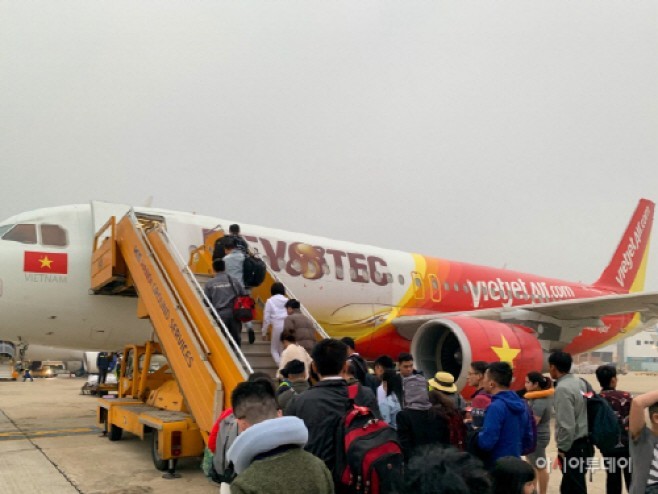 |
| Vietnamese budget carrier VietJet. / Hanoi Correspondent Jeong Ri-na |
The worldwide assets of VietJet Air, Vietnam's flagship low-cost carrier (LCC), have been frozen by order of a British court. A dispute that began with approximately $8 million (about 10.6 billion won) in overdue aircraft lease payments during the COVID-19 pandemic has ballooned over five years into an unpaid judgment debt of roughly $250 million (about 331.8 billion won), prompting the court to conclude there is a real risk VietJet will dissipate its assets rather than satisfy the debt.
According to Bloomberg and other media outlets on the 22nd (local time), Justice Pushpinder Saini of the Commercial Court of the High Court of England and Wales granted an application by aircraft leasing firm FW Aviation on the 15th to issue the worldwide freezing order.
FW Aviation, an affiliate of London investment firm FitzWalter Capital, characterized VietJet not as a debtor that "cannot pay," but as one that "will not pay," and Justice Saini ruled that this characterization was fully substantiated by the evidence. Justice Saini stated that there was little room to sympathize with the disruptions VietJet claimed would result from an asset freeze, noting that the disruption was not due to genuine insolvency, but was VietJet's own fault for deliberately refusing to honor judgment debts and tenaciously obstructing enforcement.
The asset freeze ceiling is capped at up to $251.6 million (about 333 billion won). The targeted assets include approximately 112 aircraft operated entirely under lease by VietJet, as well as unfulfilled aircraft on order, such as Airbus A330-900 and A321neo jets. Ordered engines including Rolls-Royce units, cabin equipment, pre-delivery payments (PDPs), maintenance reserves, lease security deposits, and ticket sale proceeds collected by sales agents are also frozen under the order.
VietJet currently operates 11 direct flights between South Korea and Vietnam connecting Incheon and Busan with Hanoi, Ho Chi Minh City, Da Nang, Nha Trang, and Phu Quoc. However, because this freezing order does not constitute an outright seizure, VietJet can continue regular flight operations within the ordinary course of business. Instead, the carrier must obtain court permission before disposing of or altering aircraft orders located outside Vietnam, maintenance reserves, or lease deposits.
What the court singled out as particularly problematic was VietJet's order book of roughly 300 aircraft. Justice Saini concluded that through "pre-delivery payment participation agreements," VietJet transferred virtually the entire value of its order book as of late 2024 to an affiliate entity, Angelica Holding, incorporated in the Cayman Islands.
Regarding this company, which appears to have neither an office nor employees, Justice Saini noted that it bears all the hallmarks of a typical Cayman paper company, and deemed the receivables VietJet was to receive in exchange to be entirely illusory. He also characterized the transactions as "bizarre arrangements" for which no credible explanation could be found. In court, VietJet argued that these were standard financing and refinancing transactions long utilized in the industry.
FW Aviation secured this freezing order on its second attempt. In July of last year, the same court had dismissed an initial freezing application, ruling that the risk of asset dissipation had not been proven. However, Justice Saini viewed that subsequent evidence regarding the aircraft orders altered the circumstances, pointing out that VietJet kept the relevant contracts undisclosed for more than a year and that questions remained regarding materials submitted to the court.
The dispute stems from four leased Airbus passenger aircraft operated by VietJet during the COVID-19 pandemic. According to court records cited by the BBC, VietJet's overdue lease payments at the time amounted to roughly $8 million (about 10.6 billion won), and notice of lease termination was served in October 2021. FitzWalter, which took over the rights of the original syndicate of lenders, pursued aircraft repossession and damages litigation, but VietJet continued operating the aircraft for about a year without paying lease fees even after the termination notices were served.
In British courts, VietJet suffered a string of defeats. The High Court of England and Wales ruled in July 2024 that the termination of the lease agreements was valid, and in April of last year ordered VietJet to pay approximately $180 million (about 238.8 billion won).
Following the dismissal of its appeal in June of last year, accumulated subsequent rulings, interest, and legal costs drove the total debt to roughly $250 million (about 331.8 billion won). According to the judgment, the only amount VietJet has paid to date is $2 million (about 2.7 billion won) remitted in May of last year.
Even after prevailing in court, FW Aviation recovered almost none of the compensation, facing continuous hurdles during the enforcement process. When FW Aviation transferred the registration of the four repossessed aircraft to the Channel Island of Guernsey, a VietJet shareholder filed a lawsuit, and a Hanoi court blocked the aircraft from leaving the country by refusing to deregister them in Vietnam. The Vietnamese court also refused to recognize the British court ruling.
Added to this, when an arrest order was issued for nine VietJet aircraft in Singapore in May of this year, VietJet immediately scaled back its Singapore flight routes. While VietJet claimed this was a necessary measure under mortgage agreements, Justice Saini concluded it was a transparent attempt to frustrate enforcement.
Jeong Ri-na
Most Read
-
1
Celltrion nears additional contract with major U.S..

-
2
Putin proposes trilateral U.S.-China-Russia summit..

-
3
U.S. weighs dropping MOAB, world's most powerful n..

-
4
"Aren't those foreigners on welfare?": M..

-
5
Houthis launch successive attacks on Saudi airport..

-
6
Saudi Arabia, Iran hold first diplomatic talks to..

-
7
Attention centers on APEC for possible Trump-Xi-Pu..

PEOPLE







-
Address : In-Young Bldg., 34, Uisadang-daero 1-gil, Yeongdeungpo-gu, Seoul
Copyright by ASIATODAY CO., LTD. All rights resereved