



U.S. Eighth Army commander stresses readiness beyond Korean Peninsula
Oct 22, 2026, 10:23 am


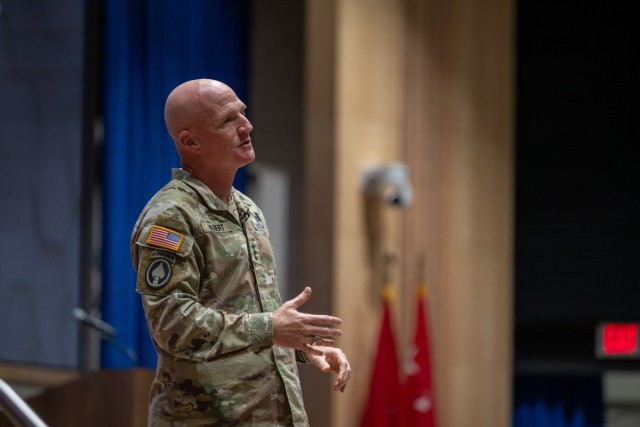 |
| Lieutenant General Joseph Hilbert, commander of the U.S. Eighth Army, delivers a lecture on October 16 (local time) to students at the U.S. Army War College in Carlisle Barracks, Pennsylvania, regarding the Eighth Army's role in supporting U.S. Forces Korea and contributing to strengthening deterrence across Northeast Asia. / Captured from U.S. Army website |
[Article Summary]
1. Lieutenant General Joseph Hilbert, commander of the U.S. Eighth Army, stressed readiness for deployments beyond the Korean Peninsula, calling it irresponsible to limit the military's mission to the peninsula merely because it is stationed in South Korea.
2. The U.S. National Defense Strategy presented a direction in which South Korea assumes primary responsibility for deterring North Korea, while the U.S. strengthens its denial defense posture along the First Island Chain.
3. Experts projected that South Korea's primary role in a regional contingency would focus on ammunition and weapons supplies alongside logistical sustainment for U.S. forces rather than dispatching combat troops.
Lieutenant General Joseph Hilbert, commander of the U.S. Eighth Army, pointed out that U.S. troops stationed in South Korea must also prepare to counter threats beyond the Korean Peninsula, noting that asserting they cannot carry out other missions simply because they are in South Korea is "irresponsible."
Commander Hilbert emphasized that while the U.S. Eighth Army fulfills its foundational mission of deterring North Korea, it must also prepare for operations outside the Korean Peninsula. As the Donald Trump administration pursues an expanded South Korean defense responsibility against North Korea and strategic flexibility for U.S. Forces Korea, utilizing South Korea's defense industrial base to support U.S. military logistics in the region is also emerging as a major task.
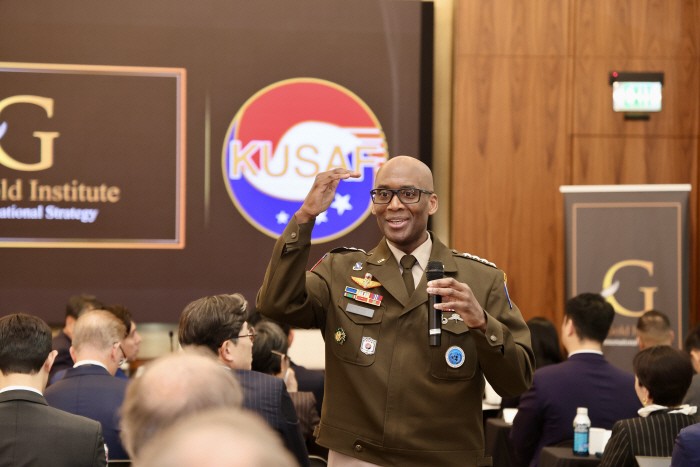 |
| General Xavier Brunson, commander of U.S. Forces Korea, delivers a speech at the Indo-Pacific Summit co-hosted by the Gold Institute for International Strategy and the Korea-U.S. Alliance Foundation in Washington, D.C., on the 14th (local time). / Washington Correspondent Ha Man-joo |
U.S. Eighth Army Commander Hilbert says, "Focusing solely on Korean Peninsula threats is irresponsible," stressing readiness to deploy outside peninsula
In an email interview with the Hong Kong daily South China Morning Post (SCMP) published on the 21st, Commander Hilbert emphasized that the mission of the U.S. Eighth Army is not confined to the Korean Peninsula.
He pointed out that a "myopic focus" solely on threats within the Korean Peninsula is "irresponsible," adding that it is equally irresponsible to "argue that merely because we are stationed in Korea, we cannot execute other missions."
Commander Hilbert prefaced that while the Eighth Army remains focused on fulfilling U.S. defense commitments under the ROK-U.S. Mutual Defense Treaty, it constitutes "part of a global force maintaining readiness to be deployed wherever the national command authority requires."
He explained, "We generally view readiness as largely agnostic to the type of threat," adding that "if a unit is trained and ready to execute the mission assigned by the Army, it can be deployed against whatever threat demands a response."
Commander Hilbert particularly emphasized that deterring North Korea and preparing for out-of-area missions are mutually compatible. He said, "Every day, we train alongside our South Korean allies against the primary threat, while also maintaining readiness to respond to whatever contingencies our nation calls upon us to meet."
He also cited the Eighth Army's participation in multinational joint exercises across the Asia-Pacific region as an example of preparing for missions beyond the Korean Peninsula.
However, in this interview, Commander Hilbert did not disclose specific troop deployment numbers or plans to deploy the U.S. Eighth Army to specific flashpoints such as the Taiwan Strait.
Headquartered at Camp Humphreys in Pyeongtaek, Gyeonggi Province, the U.S. Eighth Army commands the ground component of U.S. Forces Korea. The SCMP reported that the Eighth Army is the sole U.S. Army field army stationed on the Asian mainland within the Asia-Pacific region and the only U.S. Army field army permanently forward-deployed overseas. Total USFK personnel stand at approximately 28,500.
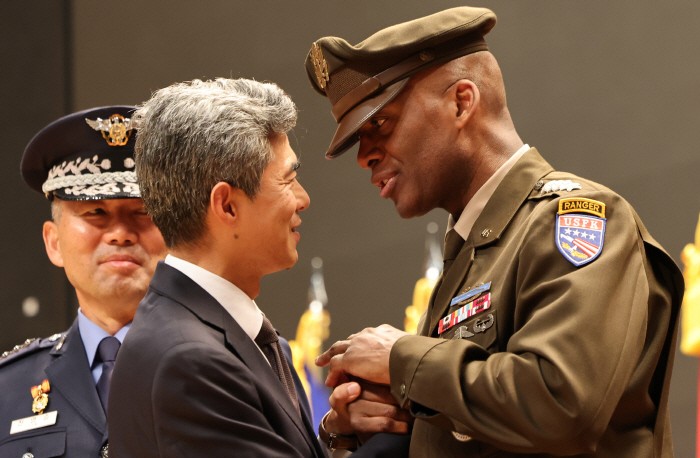 |
| Newly appointed Minister of National Defense Kang Shin-chul (left) greets U.S. Forces Korea Commander General Xavier Brunson at his inauguration ceremony held at the Ministry of National Defense in Yongsan District, Seoul, on the 22nd. / Yonhap |
U.S. National Defense Strategy calls on South Korea to lead North Korea deterrence, while U.S. forces reinforce First Island Chain defense
The U.S. Eighth Army's preparation for out-of-area missions aligns with the Trump administration's push to modernize the ROK-U.S. alliance and enhance the strategic flexibility of U.S. Forces Korea (USFK).
Traditionally, the Eighth Army has focused primarily on deterring North Korea's military threats. However, the Trump administration has signaled the possibility of expanding USFK's role to address other regional contingencies beyond the Korean Peninsula.
General Xavier Brunson, commander of USFK, also stated in a press briefing in August of last year that strategic flexibility will sit at the core of modernizing the ROK-U.S. alliance to counter the threats posed to a free and open Indo-Pacific by a nuclear-armed China, Russia, and North Korea.
This trajectory was also reflected in the U.S. National Defense Strategy (NDS) released in January. The NDS explicitly stated that South Korea possesses the capability to assume "primary responsibility" for deterring North Korea with "critical but more limited" U.S. support. It also explained that this shift in burden-sharing aligns with U.S. interests in adjusting its force posture on the Korean Peninsula.
At the same time, the U.S. outlined a policy to establish a "robust denial defense" posture along the First Island Chain (stretching from Okinawa, Japan, through Taiwan and the Philippines to Borneo). The Korean Peninsula lies inside the First Island Chain.
The SCMP analyzed that expanding South Korea's responsibility for deterring North Korea alongside bolstering First Island Chain defenses connects directly to the Trump administration's strategy to deploy USFK more flexibly in response to other regional contingencies, including the Taiwan Strait.
Troy Stangarone, visiting senior fellow at the Korea Economic Institute of America (KEI), noted that the U.S. had already relocated troops and materiel from the Korean Peninsula to support military campaigns during the 2003 Iraq War and the recent conflict with Iran, forecasting that such force redeployments will likely continue depending on operational circumstances.
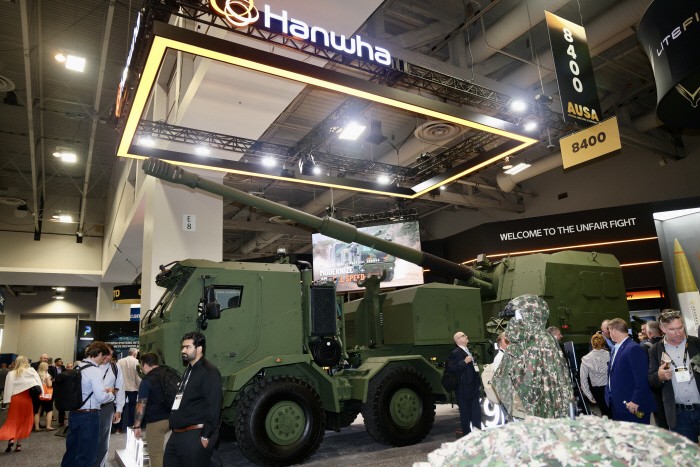 |
| Hanwha Aerospace's K9 self-propelled howitzer is on display at the Association of the United States Army (AUSA) Annual Meeting held at the Walter E. Washington Convention Center in Washington, D.C., from the 12th to the 14th (local time). / Washington Correspondent Ha Man-joo |
USFK Commander Brunson envisions regional logistics hub utilizing South Korea's defense industrial base
Coupled with the regional utilization of U.S. Forces Korea, concepts are being presented wherein South Korea's role could expand beyond deterring North Korea to logistical and sustainment support for U.S. forces. Commander Brunson evaluated South Korea's defense industrial base as "absolutely top tier" at the Association of the United States Army (AUSA) Annual Meeting held in Washington, D.C., on the 12th.
He emphasized the need to shift away from the traditional depot maintenance mindset of shuttling between the U.S. mainland and the Asia-Pacific region to maintain U.S. military equipment, as transporting and redeploying equipment in this manner takes days to weeks.
Commander Brunson stressed, "Going forward, particularly in Pacific combat operations, what matters is how long we can sustain operations," highlighting the ability to sustain logistical support within the First Island Chain based out of South Korea.
The regional sustainment hub concept he outlined represents a plan to enhance the operational sustainment capabilities of U.S. forces in the region by leveraging South Korea's manufacturing and maintenance capacity.
Commander Hilbert also stated at the Land Forces Pacific (LANPAC) Symposium held in Hawaii in May that collaborating with South Korea's advanced manufacturing base can alleviate the burden of transporting equipment across the Pacific and enhance the strategic flexibility of the U.S. Joint Force.
South Korean defense contractors' participation in U.S. military weapons system development programs is also underway. In August, the U.S. Army signed a contract with Hanwha to supply K9 self-propelled howitzer prototypes for its new mobile tactical artillery program. The contract is valued at up to $260 million (345.072 billion won).
The SCMP introduced this as the first instance of the U.S. military procuring a South Korean weapons system. However, this contract covers the supply of K9 self-propelled howitzer prototypes, and formal fielding by the U.S. Army has not been confirmed.
At last week's AUSA Annual Meeting, U.S. defense contractor General Atomics unveiled a scale model of the Mojave short takeoff and landing (STOL) unmanned aerial vehicle co-developed and produced with Hanwha Aerospace. The two companies signed a cooperation agreement last year for the development and production of the drone.
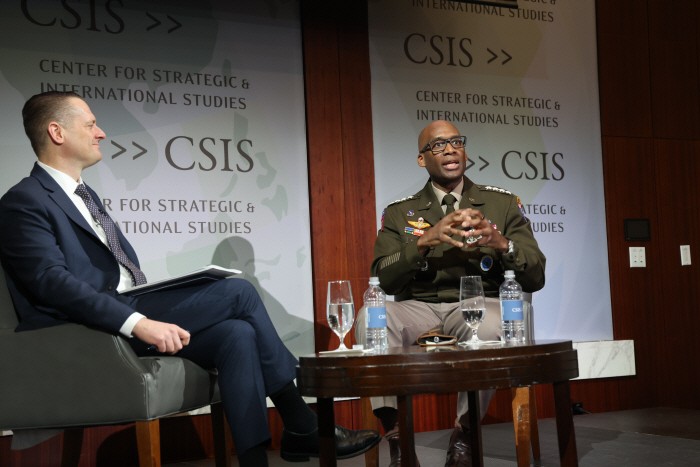 |
| General Xavier Brunson, commander of U.S. Forces Korea (right), speaks during a dialogue at the Center for Strategic and International Studies (CSIS) in Washington, D.C., on the 13th (local time). / Washington Correspondent Ha Man-joo |
Experts view South Korea as regional logistics hub in contingencies
Experts projected that as the division of roles within the ROK-U.S. alliance shifts, South Korea is likely to assume primary responsibility for North Korea deterrence while simultaneously functioning as a logistics support hub for U.S. forces during regional contingencies.
Lami Kim, Korea Foundation Chair in Advanced Technology, National Security, and Defense at the International Institute for Strategic Studies (IISS) in the UK, evaluated that the ROK-U.S. alliance is shifting from a "one-way" structure in which the U.S. took responsibility for defending South Korea into a "more mutual partnership" where both nations contribute to each other's security.
Chair Kim explained that this transition reflects South Korea's military capabilities, which have improved beyond comparison with the 1950s. She pointed out that as the alliance increasingly evolves into a reciprocal relationship, it is becoming progressively harder to expect the U.S. security commitment to endure without South Korea making meaningful contributions.
Chair Kim projected that South Korea is highly likely to provide logistical support to U.S. forces in the event of regional contingencies, noting that particularly if a conflict drags on, South Korea's defense industrial base could play a pivotal role in replenishing U.S. weapons stockpiles and sustaining U.S. military operations.
Senior Fellow Stangarone also assessed that South Korea serves a crucial role as a logistics hub for U.S. forces in the region. He explained that South Korea is the only regional U.S. ally possessing the defense industrial base capable of supporting U.S. forces in regional contingencies.
However, Senior Fellow Stangarone distinguished between dispatching combat troops and providing logistical support when looking at South Korea's regional role. He noted that while calls demanding South Korea deploy combat troops in regional contingencies have surfaced periodically, it has long been clear that South Korea's primary role remains a support mission supplying necessary ammunition and weapons.
Adding to this, he emphasized, "While deterring North Korea must remain the priority, given that South Korea's own capabilities have grown, it can and should play a larger role in U.S. regional strategy."
Ha Man-joo
Most Read
-
1
Celltrion nears additional contract with major U.S..

-
2
Putin proposes trilateral U.S.-China-Russia summit..

-
3
U.S. weighs dropping MOAB, world's most powerful n..

-
4
"Aren't those foreigners on welfare?": M..

-
5
Houthis launch successive attacks on Saudi airport..

-
6
Saudi Arabia, Iran hold first diplomatic talks to..

-
7
Attention centers on APEC for possible Trump-Xi-Pu..

PEOPLE







-
Address : In-Young Bldg., 34, Uisadang-daero 1-gil, Yeongdeungpo-gu, Seoul
Copyright by ASIATODAY CO., LTD. All rights resereved