



China's fifth plenum to conclude amid expectations of sweeping crackdown
Oct 28, 2026, 02:02 pm


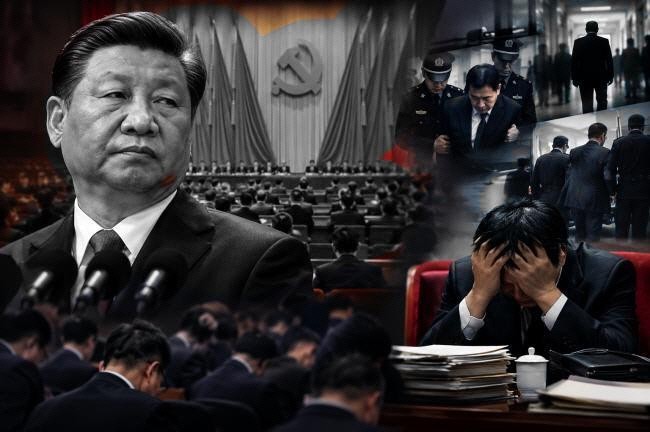 |
| A graphic published by an overseas anti-China media outlet illustrating the atmosphere surrounding the fifth plenary session of the 20th Central Committee of the Communist Party of China, which concludes on Oct. 29. The graphic suggests that a sweeping crackdown on corruption and misconduct will follow the meeting. / Apollo Net, a U.S.-based Chinese-language online newspaper |
China is expected to launch a sweeping and severe crackdown on senior Party and government officials following the conclusion of the four-day fifth plenary session of the 20th Central Committee of the Communist Party of China (CPC) on Oct. 29, as the Party establishes comprehensive and strict Party governance as a fundamental guiding principle. Depending on how events unfold, a succession of current and former top-ranking officials could also be removed from their positions.
According to Beijing-based sources familiar with developments in the Chinese-speaking world on Oct. 28, the meeting's most urgent objective was to find solutions to sluggish domestic demand, one of the Chinese economy's biggest weaknesses. It was therefore no coincidence that the trade-in subsidy program, known in Chinese as yijiu huanxin, which provides subsidies to consumers replacing old products with new ones and has been used relatively effectively to stimulate domestic consumption for several years, emerged as one of the meeting's main themes.
However, foreign media and Western countries, particularly the United States, which closely follows Chinese politics, were focused on a different issue. Their attention was largely directed toward whether the prolonged rule of President Xi Jinping, who also serves as general secretary of the CPC and has recently been the subject of persistent rumors about his health, would be confirmed. It appears reasonable to conclude that his continued rule has been all but decided.
There are several reasons for this assessment. Beyond the extensive and somewhat excessive praise of Xi and promotion of his achievements by state-run media, perhaps the most telling developments are the anticipated confirmation of a sweeping crackdown aimed at tightening Party discipline and new appointments to Party and government positions. The decision to remove large numbers of senior officials deemed obstacles to Xi's continued rule or implicated in major corruption and misconduct is particularly revealing. A plan to expel around 50 of the Central Committee's 205 members, or nearly 25%, is reportedly already in place.
Those reportedly affected include prominent figures such as Zhang Youxia, former vice chairman of the CPC Central Military Commission, and Ma Xingrui, former member of the CPC Politburo. Former Foreign Minister Qin Gang and former head of the CPC International Department Liu Jianchao can also be mentioned. These developments suggest that Xi may be determined to tighten Party discipline to secure his long-term hold on power.
Hu Chunhua, vice chairman of the Chinese People's Political Consultative Conference (CPPCC), who was once considered a leading potential successor to former CPC General Secretary and President Hu Jintao, is also thought highly likely to be among the roughly 50 Central Committee members facing removal. No media outlet or political analyst has reported seeing him during the four days of meetings.
New appointments involving officials born in the 1970s, known in Chinese as the qilinghou generation, who could succeed Xi in five or 10 years or even later, can also be seen as evidence that his extended rule has been effectively secured. If that is the case, officials born in the 1960s, known as the liulinghou generation and closer to Xi in age, would naturally be passed over as potential successors. This would allow Xi to govern the Party and the country without such concerns.
Some foreign media outlets have recently argued that the fifth plenary session of the 20th Central Committee could become one of the most ruthless meetings in the history of the Chinese Communist Party. That assessment would appear justified if the decision to expel around 50 Central Committee members leads to a sweeping and severe crackdown on top Party and government officials.
Names of potential targets are already circulating. In addition to CPPCC Vice Chairman Hu, they reportedly include former Vice President Wang Qishan, once described as Xi's right-hand man just over five years ago, and a current member of the Politburo Standing Committee whose name has reportedly been mentioned repeatedly for several years. The assessment that this fifth plenum could become one of the most ruthless Party meetings in history may therefore not be without reason.
Hong Soon-do
Most Read
-
1
Putin proposes trilateral U.S.-China-Russia summit..

-
2
U.S. weighs dropping MOAB, world's most powerful n..

-
3
"Aren't those foreigners on welfare?": M..

-
4
Attention centers on APEC for possible Trump-Xi-Pu..

-
5
U.S., Israel plan to resume strikes on Iran after..

-
6
China tightens grip on boosting domestic demand an..

-
7
Amid health rumors, Chinese President Xi Jinping i..

PEOPLE






-
Address : In-Young Bldg., 34, Uisadang-daero 1-gil, Yeongdeungpo-gu, Seoul
Copyright by ASIATODAY CO., LTD. All rights resereved