



Amid health rumors, Chinese President Xi Jinping inspects Inner Mongolia
Oct 19, 2026, 10:21 am


Chinese President and General Secretary Xi Jinping, recently surrounded by rumors of ill health, dispelled rapidly circulating speculation with an inspection tour of the Inner Mongolia Autonomous Region in northern China, where a national computing infrastructure project is currently underway.
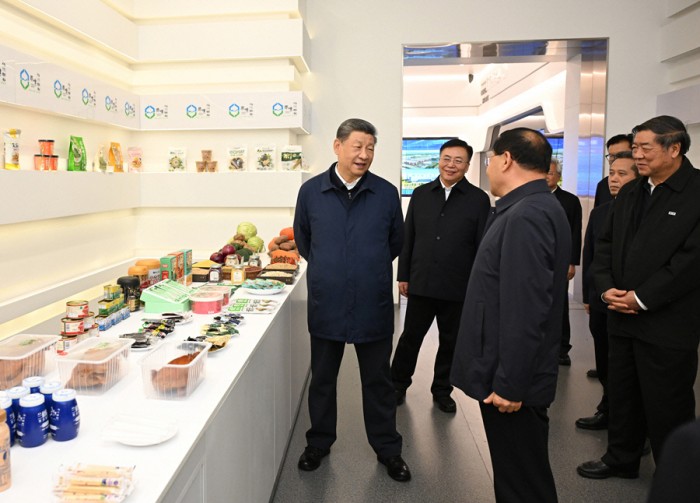 |
| Chinese President Xi Jinping inspects Ulanqab in the Inner Mongolia Autonomous Region. / Xinhua News Agency. |
Beijing sources familiar with Chinese party and government affairs reported on the 17th, citing a previous day report by the state-run Xinhua News Agency, that President Xi visited the city of Ulanqab in the Inner Mongolia Autonomous Region earlier that morning.
On site, he stated that the East Data, West Computing project and the development of a national integrated computing network are major initiatives of the Party Central Committee. He urged officials to strengthen scientific planning and factor support to ensure the efficient operation of completed projects and complete follow-up projects on schedule. He also called for actively extending the industrial chain and promoting the deep integration of the digital economy with the real economy, thereby turning computing power into a development advantage.
Speaking with computing center project leaders, technicians, and staff from the Chahar High-Tech Industrial Development Zone on site, he stressed that the computing network is one of the six major networks planned and built by the state, alongside water resources, new-type power grids, computing, next-generation communications, urban underground pipelines, and logistics. He emphasized that the computing industry is currently accelerating its development and holds bright prospects.
He further noted, "I hope you will faithfully implement the requirements of high efficiency, green practices, and safety. I also hope you focus on computing-power coordination and computing-water coordination to effectively build and operate computing center projects." He added, "I hope you actively promote the development of the green computing industry and make significant contributions to building a Digital China and developing new quality productive forces."
After visiting Ulanqab, President Xi made a brief stop at the nearby Huangqihai Nature Reserve, highlighting wetland ecological preservation and biodiversity protection. According to sources, Lake Huangqihai was once on the brink of drying up due to climate change and other factors. However, years of conservation efforts have gradually restored and expanded its water surface area.
President Xi was reportedly accompanied on this inspection tour of Inner Mongolia by party and government officials, including Vice Premier He Lifeng, who oversees China's economic affairs.
According to Xinhua, Ulanqab is known for its abundant wind and solar resources. In recent years, it has leveraged its comparative advantages in green power, climate, and location to achieve notable progress in developing its green computing industry. This is why President Xi reviewed the progress of projects in Inner Mongolia, including the East Data, West Computing initiative, at the Chahar High-Tech Industrial Development Zone.
 |
| An editorial cartoon from a media outlet illustrating China's national project known as East Data, West Computing. / The Beijing News. |
According to the agency, the East Data, West Computing project is widely known as a nationwide computing resource allocation initiative launched in 2022. As data centers became concentrated in the economically and industrially advanced eastern regions, issues such as land and water shortages emerged. The initiative is well known for its plan to build computing networks across the vast yet underdeveloped western regions, allowing a significant portion of data to be relocated there.
China currently aims to build eight computing hubs across the country to establish a computing resource distribution network spanning the entire continent. The Inner Mongolia Autonomous Region is counted among these eight major hubs. President Xi's surprise visit to the Inner Mongolia Autonomous Region, which dispelled rumors about his health, was certainly not without purpose.
Hong Soon-do
Most Read
-
1
Celltrion nears additional contract with major U.S..

-
2
U.S. weighs dropping MOAB, world's most powerful n..

-
3
"Aren't those foreigners on welfare?": M..

-
4
Houthis launch successive attacks on Saudi airport..

-
5
Saudi Arabia, Iran hold first diplomatic talks to..

-
6
Saudi airport in Riyadh struck again, leaving at l..

-
7
Five ASEAN countries welcome Myanmar coup leader

PEOPLE






HEADLINE NEWS
- Trump's approval rating hits low of 33% as public turns back over soaring inflation
- Trump says Hyundai announced 748.6-billion-won investment in Georgia
- China tightens grip on boosting domestic demand and expanding anti-graft dr..
- Food prices jump 35% over 10 years, fueling massive protests by 800,000 acr..

-
Address : In-Young Bldg., 34, Uisadang-daero 1-gil, Yeongdeungpo-gu, Seoul
Copyright by ASIATODAY CO., LTD. All rights resereved