



Russia, Ukraine begin local ceasefire in Oleshky
Oct 28, 2026, 10:42 am


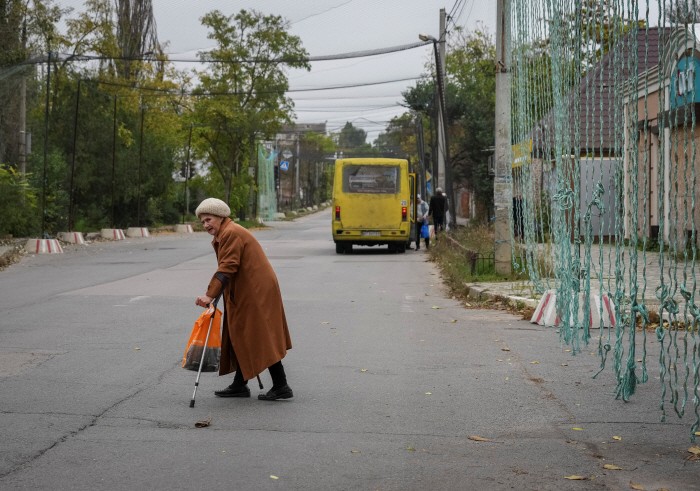 |
| A woman crosses a road equipped with anti-drone netting in the frontline city of Kherson, where Russian attacks on Ukraine continue, on Oct. 27 (local time). / Reuters-Yonhap |
[Article summary]
1. Russia and Ukraine began a localized ceasefire in the Oleshky area on Oct. 27. The ceasefire is scheduled to remain in effect until Nov. 1.
2. First Lady Melania Trump announced that she had moved the ceasefire forward by two days to facilitate the delivery of humanitarian aid and expanded its geographical scope beyond Oleshky.
3. Between 1,700 and 2,000 residents remain stranded in Oleshky, where food and medicine have run out. Efforts are underway to deliver relief supplies and evacuate civilians.
4. The leaders of Finland and Norway held a 90-minute telephone conversation with Russian President Vladimir Putin and subsequently contacted Ukrainian President Volodymyr Zelenskyy to discuss negotiations to end the war.
5. Despite plans to resume trilateral talks in Abu Dhabi in early November, Russian airstrikes on Kyiv continue, as do disagreements over territorial issues in Donetsk Oblast.
Russia and Ukraine entered into a localized humanitarian ceasefire in and around Oleshky, in the Russian-occupied part of Kherson Oblast in southern Ukraine, at 3 a.m. on Oct. 27 (local time in Ukraine, 10 a.m. in South Korea). Melania Trump, wife of U.S. President Donald Trump, who mediated the ceasefire, announced that its scope had been expanded beyond Oleshky to other parts of Kherson Oblast to ensure the safe passage of humanitarian aid convoys. The leaders of Finland and Norway also contacted Russian President Vladimir Putin and Ukrainian President Volodymyr Zelenskyy in succession, undertaking diplomatic mediation ahead of trilateral peace talks scheduled for early November.
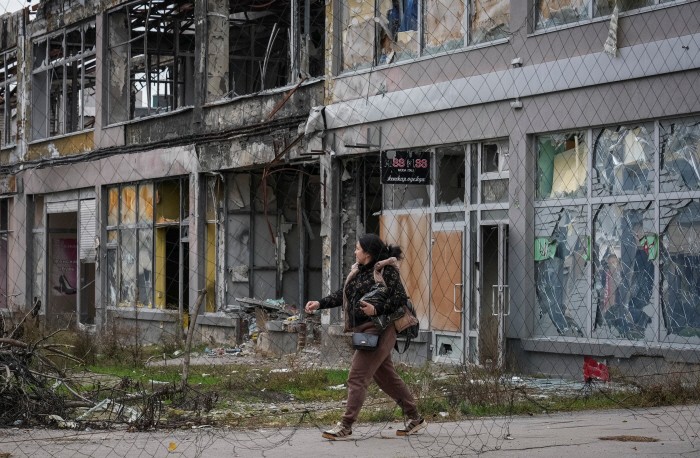 |
| A woman walks along a road fitted with anti-drone netting in the frontline city of Kherson in southern Ukraine, where Russian attacks continue, on Oct. 27 (local time). / Reuters-Yonhap |
Melania mediates ceasefire as 'exclusive intermediary'
According to Reuters, the Associated Press (AP) and other news agencies, Russia's Defense Ministry announced on Telegram that it had halted bombardment toward Kherson, across the Dnipro River, as of 4 a.m. on Oct. 27 (Moscow local time, 10 a.m. in South Korea). Ukrainian Parliament Commissioner for Human Rights Dmytro Lubinets also confirmed the start of the ceasefire. He said no violations had been reported by either side as of 5:30 p.m. that day (Ukrainian local time, 12:30 a.m. on Oct. 28 in South Korea).
David Arakhamia, parliamentary leader of Ukraine's ruling party and chief negotiator in peace talks, said the ceasefire would remain in effect until 10:59 p.m. on Nov. 1 (Ukrainian local time, 5:59 a.m. on Nov. 2 in South Korea).
The White House explained that Melania Trump had consulted with both countries in the official capacity of "Exclusive Intermediary," coordinating the ceasefire's objectives, technical procedures, timing and conditions. Reuters reported that Pope Leo was also involved in the mediation process.
Melania wrote on X that she had "moved the ceasefire forward by two days to protect civilian safety and deliver essential humanitarian aid." She also announced that she had "expanded the geographical scope of the ceasefire beyond Oleshky to other areas of Kherson Oblast to ensure the safe passage of humanitarian aid convoys."
Arakhamia described the agreement as "the greatest de-escalation since 2022." Ukrainian Foreign Minister Andrii Sybiha said it could serve as a confidence-building measure for future negotiations.
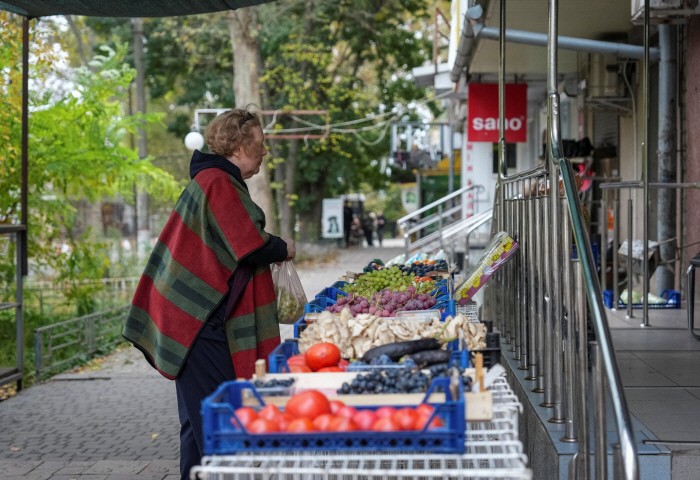 |
| A resident visits an open-air market in the frontline city of Kherson in southern Ukraine, where Russian attacks continue, on Oct. 27 (local time). / Reuters-Yonhap |
1,700–2,000 residents stranded in Oleshky
Oleshky is a city on the eastern bank of the Dnipro River. Russian forces occupied the city in the early stages of their full-scale invasion in February 2022, and it was severely flooded in June 2023 following the collapse of the upstream Kakhovka Dam.
The city had a prewar population of 24,000, but only 1,700 to 2,000 residents remain. Many are elderly, and around 50 are children.
According to the United Nations, residents are stranded without adequate supplies of food and medicine. Running water, electricity, gas and central heating have also largely been cut off. Landmines and drone attacks in surrounding areas make evacuation difficult.
Some residents told Reuters that they had survived on a cup of rice or buckwheat a day, sometimes supplemented with tomatoes, cucumbers or wild plants. They said they had risked their lives traveling along mined roads to obtain food and drinking water. Residents call one of these roads the "Road of Death."
The two countries agreed to establish humanitarian corridors to deliver relief supplies and evacuate residents. Clearing landmines could take several days before the corridors can be opened. The Russian side plans to bring in medical personnel, medicine, food and drinking water later this week before opening evacuation routes.
Residents of the Ukrainian-controlled city of Kherson, across the Dnipro River, said shelling had stopped on the first day of the ceasefire. Hennadii, 90, said, "Nobody is shooting." Oleksandra, 37, however, expressed caution about whether the ceasefire would last, saying, "There have been quiet days before."
Kyiv bridge and university struck despite Oleshky ceasefire
Although a ceasefire began in parts of Kherson Oblast, fighting continued on other fronts.
Russian forces launched ballistic missile attacks on the capital, Kyiv, between the night of Oct. 26 and the early hours of Oct. 27. According to local officials, at least one person was killed and 15 others were injured, including students staying in a university dormitory. The university grounds and the Southern Bridge, a major bridge, were also damaged.
A Ukrainian military source said Russian forces had attacked the Southern Bridge with four Iskander ballistic missiles. Kyiv city authorities said metro infrastructure had also been damaged and train services crossing the bridge had been suspended.
President Volodymyr Zelenskyy condemned the attack as a "serious escalation" against Ukraine's logistics network. He said energy facilities and logistics and infrastructure facilities had also been attacked in 10 other regions.
Russia's Defense Ministry announced that it had struck transport infrastructure in Kyiv, a logistics hub in Kharkiv and military-industrial facilities.
Ukraine also continued drone attacks on Russian territory and Russian-occupied areas. In Bryansk Oblast in western Russia, one person was killed and six were injured. Local officials said one person was killed and 30 others were injured in an attack on a bus in Russian-occupied Zaporizhzhia Oblast.
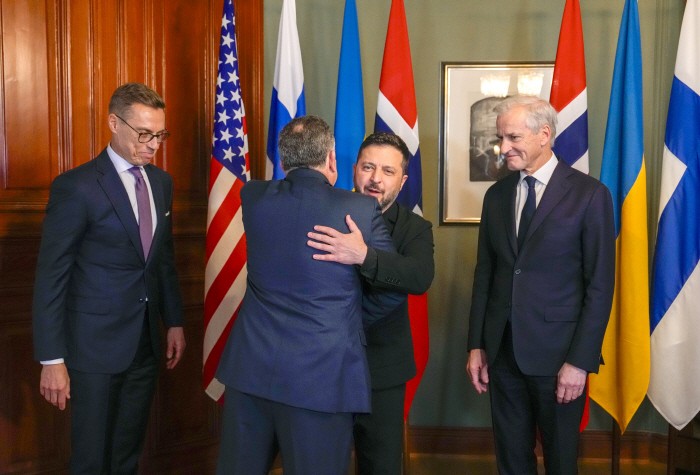 |
| Finnish President Alexander Stubb (from left), U.S. presidential special envoy Steve Witkoff, Ukrainian President Volodymyr Zelenskyy and Norwegian Prime Minister Jonas Gahr Støre greet one another ahead of high-level diplomatic talks on the war in Ukraine in Oslo, Norway, on Oct. 20 (local time). The talks were hosted by Støre and Stubb. / EPA-Yonhap |
Nordic leaders hold 90-minute call with Putin
Against this backdrop, mediation efforts by Finnish President Alexander Stubb and Norwegian Prime Minister Jonas Gahr Støre are drawing attention. The two leaders spoke by phone with Russian President Vladimir Putin for about 90 minutes on Oct. 27 to discuss ways to end the war. They subsequently held a call with Ukrainian President Volodymyr Zelenskyy.
The calls marked a departure from the practice of Western European leaders, who have largely avoided direct contact with Putin since Russia's full-scale invasion of Ukraine in 2022. It was the first telephone conversation between Putin and Stubb.
Reuters analyzed the contacts as taking place amid a shift in U.S. President Donald Trump's position toward Russia and a deterioration in U.S.-Ukraine relations to their lowest point in 18 months.
Reuters reported that an agreement this month to supply Russian diesel fuel to the United States and Trump's easing of sanctions on Russia had heightened concerns in Europe. Ukraine has complained of disruptions to U.S. intelligence sharing and satellite internet services on which its military relies.
The Finnish president's office explained that the calls were a follow-up to talks held in consultation with Ukraine in Oslo, Norway, on Oct. 20. Earlier, U.S. presidential special envoy Steve Witkoff met with Zelenskyy and Nordic leaders in Oslo before holding talks with Putin in St. Petersburg, Russia.
Stubb said Ukraine had requested the establishment of a new communication channel with Russia. He stressed that Europe could not continue giving Russia "the silent treatment" and remain a bystander in peace negotiations.
Støre said the call, originally scheduled to last 20 minutes, had continued for 90 minutes, adding that "the issues were discussed in depth." However, he acknowledged that there were "major differences" between the two sides' positions.
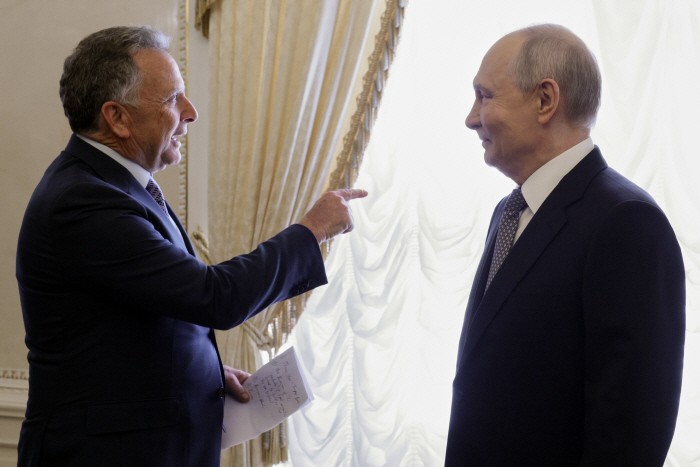 |
| U.S. presidential special envoy Steve Witkoff (left) gestures during a meeting with Russian President Vladimir Putin at the Konstantin Palace in Strelna, outside St. Petersburg, Russia, on Oct. 21 (local time). / Courtesy of the Kremlin, AP-Yonhap |
Putin maintains peace terms
The Kremlin's statement showed no change in President Vladimir Putin's previous position. The Kremlin said, "A just and lasting peace is possible only when the legitimate interests of the Russian Federation are fully and unconditionally taken into account."
Putin claimed that the confrontational policies of the European Union (EU) and the North Atlantic Treaty Organization (NATO) were prolonging the war. Russian Foreign Minister Sergei Lavrov also said the call had yielded nothing new.
European reactions were mixed. Ukrainian Foreign Minister Andrii Sybiha described the call as "the right approach," noting that it had been coordinated with Ukraine. He expressed hope that the localized ceasefire in Oleshky would lead to further steps toward peace negotiations.
In contrast, Danish Prime Minister Mette Frederiksen emphasized European unity, saying there was no indication that Russia wanted peace. Swedish Prime Minister Ulf Kristersson pointed out that other European leaders had not been informed in advance. Polish Prime Minister Donald Tusk also warned that caution was needed in engaging with Russia.
In response, Finnish President Alexander Stubb and Norwegian Prime Minister Jonas Gahr Støre explained that they had acted in their capacities as leaders of their respective countries, rather than on behalf of Europe as a whole, and had sufficiently consulted relevant partners.
Russia and Ukraine are scheduled to resume trilateral talks involving the United States in Abu Dhabi, United Arab Emirates (UAE), in early November. The talks will be the first trilateral meeting since February.
However, Russia continues to insist that Ukraine must cede the remaining approximately 20% of eastern Donetsk Oblast still under Ukrainian control before it will agree to halt hostilities.
A source close to the Kremlin said Putin welcomed European participation in the negotiations but maintained that the war must "end with realities on the ground taken into account." The source explained that this meant Russia was unwilling to compromise on its objective of taking control of the entire Donbas region in eastern Ukraine.
Austrian political analyst Gerhard Mangott described the Nordic leaders' calls as an attempt by Europe to establish a channel of communication with Russia. He interpreted Russia's indication that it might discuss European participation in peace negotiations as a shift from its previous position.
The implementation of the localized ceasefire in Oleshky, humanitarian relief operations and European participation in negotiations are key factors ahead of the trilateral talks in Abu Dhabi in early November. Amid Russia's territorial demands and Ukraine's opposition, disagreements over the core conditions for ending the war remain unresolved.
Ha Man-joo
Most Read
-
1
Celltrion nears additional contract with major U.S..

-
2
Putin proposes trilateral U.S.-China-Russia summit..

-
3
U.S. weighs dropping MOAB, world's most powerful n..

-
4
"Aren't those foreigners on welfare?": M..

-
5
Attention centers on APEC for possible Trump-Xi-Pu..

-
6
U.S., Israel plan to resume strikes on Iran after..

-
7
China tightens grip on boosting domestic demand an..

PEOPLE







-
Address : In-Young Bldg., 34, Uisadang-daero 1-gil, Yeongdeungpo-gu, Seoul
Copyright by ASIATODAY CO., LTD. All rights resereved