



Millions apply for China's civil service exam amid high youth unemployment
Oct 28, 2026, 10:01 am


An estimated 4 million people applied for China's national civil service examination, known as the Guokao, scheduled for late November this year, as youth unemployment in the country has become an increasingly serious problem. The competition ratio is estimated to be close to 100 applicants per position.
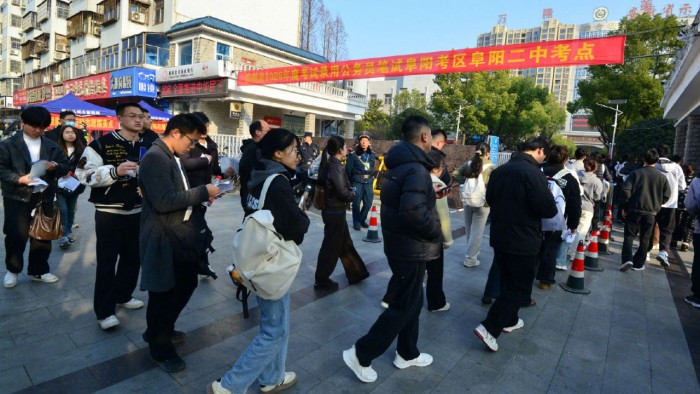 |
| Applicants for the Guokao examination held in a Chinese province in late November last year. / The Beijing News (Xin Jing Bao) |
According to a report by China's state-run Xinhua News Agency on Oct. 27, a total of 3.935 million people submitted online applications for the 2027 civil service recruitment examination for China's central government agencies and their directly affiliated institutions. The figure was estimated after online applications closed at 6 p.m. on Oct. 24. A total of 3.45 million applicants passed the qualification screening process, which continued through Oct. 26. As many as 485,000 applicants failed to qualify. This may explain why the number of applicants who passed the screening fell by approximately 270,000 from the previous year.
According to Xinhua, 35,691 people are expected to be recruited through this year's Guokao. This puts the competition ratio at a staggering 97 applicants per position, based on the number who passed the qualification screening, which was lower than in previous years. It would not be unreasonable to describe the ratio as virtually 100 to 1. Last year, when 3.718 million applicants passed the screening, the competition ratio reached 98 to 1.
Since last year, Chinese authorities have relaxed the upper age limits for national examinations, including the Guokao, raising the limit for bachelor's degree holders from 35 to 38 and for master's and doctoral degree holders from 40 to 43. This was precisely why the number of applicants for last year's Guokao reached an all-time high. However, only 2.831 million people actually took the examination last year, resulting in a competition ratio of just 74 to 1. This may have been due to the steady decline in recruitment numbers over the past several years. Stricter qualification verification, including real-name authentication, may also have contributed to the lower competition ratio. It is only natural to conclude that becoming a civil servant has become considerably more difficult.
Indeed, becoming a civil servant in China is no easy task. In recent years, more than 3 million people have flocked to the civil service examination annually. This is hardly surprising, given that economic uncertainty has grown amid sluggish domestic demand and a downturn in the property market since the COVID-19 pandemic, while the rising number of university graduates has further aggravated youth unemployment.
According to media reports, the unemployment rate among young people aged 16 to 24 in China's urban areas, excluding students enrolled in educational institutions, approached 20% in September. Moreover, the number of university graduates this year reached a record high of 12.7 million. With concerns also mounting over potential job losses resulting from advances in artificial intelligence (AI), it would not be an exaggeration to say that securing a civil service position in China has become almost as difficult as reaching for the stars.
Hong Soon-do
Most Read
-
1
Celltrion nears additional contract with major U.S..

-
2
Putin proposes trilateral U.S.-China-Russia summit..

-
3
U.S. weighs dropping MOAB, world's most powerful n..

-
4
"Aren't those foreigners on welfare?": M..

-
5
Attention centers on APEC for possible Trump-Xi-Pu..

-
6
U.S., Israel plan to resume strikes on Iran after..

-
7
China tightens grip on boosting domestic demand an..

PEOPLE







-
Address : In-Young Bldg., 34, Uisadang-daero 1-gil, Yeongdeungpo-gu, Seoul
Copyright by ASIATODAY CO., LTD. All rights resereved