



Houthis tighten pressure on Yemen's interim capital Aden
Nov 16, 2026, 09:38 am


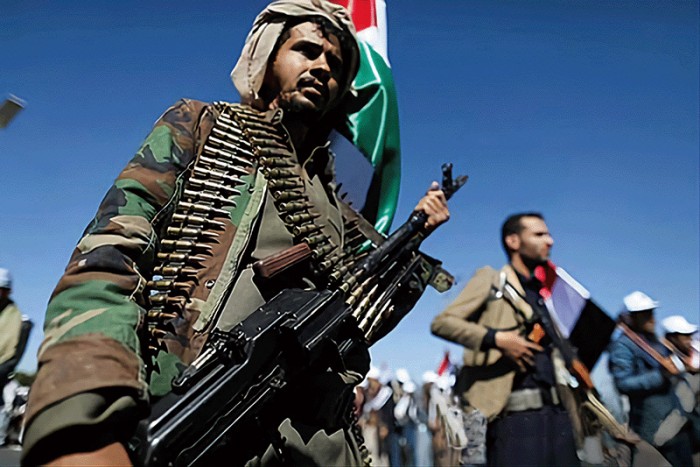 |
| Iran-backed Houthi rebels in Yemen. /Reuters-Yonhap News Agency |
Tensions are escalating on Yemen's southern front as the Iran-backed Houthi rebels intensify their offensive toward Aden, the temporary capital of the internationally recognized Yemeni government. With the defense of Aden under growing threat, Yemeni government forces have redeployed troops stationed around the Bab el-Mandeb Strait, at the entrance to the Red Sea. An operation launched last month to retake the area around the strait also appears to have effectively lost momentum.
According to AFP on Nov. 15 (local time), the Houthis launched a missile attack that day on a government forces' checkpoint in Lahj Governorate, which borders Aden. Military and government sources said the attack killed eight people and wounded 12 others.
In late October, the Houthis launched missile attacks on the presidential palace in Aden and an air base at the city's airport. Earlier this month, they also seized Al-Maqatirah, a strategic location connecting Taiz, Yemen's third-largest city, with Aden. Aden has served as the temporary capital of Yemen's internationally recognized government since the Houthis captured the capital, Sanaa, in 2014.
As pressure mounted on the southern front, the Southern Armed Forces, a major military organization supporting Yemeni government forces, announced that day that they would redeploy troops stationed at Dhubab Airport in western Taiz Governorate and around the Bab el-Mandeb Strait. The group explained that the move was intended to prioritize the security of Aden and neighboring governorates and reinforce the front lines.
However, some analysts view the move as a de facto retreat, with troops being withdrawn from the area around the strait and reassigned to defend Aden. According to Reuters, government forces relocated troops from near the Bab el-Mandeb Strait to al-Suqyah, about 150 kilometers west of Aden. Military sources said fighting was continuing to drive the Houthis out of coastal areas.
The redeployment demonstrates the limited success of Operation Dawn of Yemen, which government forces launched on Oct. 4. At the time, government forces and the Saudi-led coalition launched an offensive aimed at recapturing Houthi-held territory and regaining control of the Bab el-Mandeb Strait area.
In the early stages of the operation, government forces announced that they had recaptured key positions, including the Dhubab area overlooking the strait. However, they failed to drive the Houthis completely out of the surrounding area.
Reuters reported that Houthi advances around Taiz had also disrupted government forces' operation to retake Bab el-Mandeb. Fighting has intensified in western Taiz, while the International Organization for Migration (IOM) said the number of people internally displaced in Yemen by recent fighting had exceeded 340,000 since August.
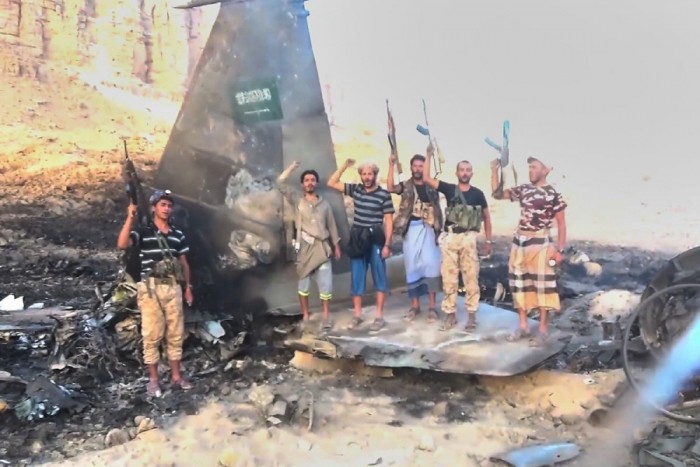 |
| A photograph released by the Houthi rebels. /AP-Yonhap News Agency |
Houthis continue attacks on Saudi territory, release 600 prisoners
The Houthi offensive has extended beyond southern Yemen into Saudi Arabian territory.
The Houthis claimed that they had attacked King Khalid International Airport and a financial center in the Saudi capital, Riyadh, with two ballistic missiles that day.
Turki al-Maliki, spokesperson for the Saudi-led coalition, said air defense systems had intercepted two ballistic missiles heading toward Riyadh, while three drones had been shot down in the country's eastern region and another near Medina.
According to Saudi authorities, Houthi missile and drone attacks have killed 26 people in Saudi Arabia since Sept. 23. The Houthis have also targeted major infrastructure, including oil pipelines and oil facilities.
Reuters reported that recent Houthi attacks had damaged an administrative building belonging to Saudi state oil company Aramco in Riyadh's financial district.
Mohammed al-Basha of the U.S.-based consultancy Basha Report told AFP that "the Houthis are dictating the pace and direction of the war."
He pointed out that government forces were trapped on the defensive, unable to open new fronts or disperse Houthi forces. He cited a lack of political will, a fragmented command structure, competition among factions and the problem of so-called "ghost soldiers" as contributing factors.
Amid intensifying fighting, the Houthis announced that day that they had unilaterally released 600 conflict-related detainees, including prisoners believed to be members of Yemeni government forces.
The International Committee of the Red Cross (ICRC) confirmed that authorities in Sanaa had released 600 people detained in connection with the conflict.
The ICRC explained that, before their release, it had interviewed the detainees individually, assessed their health and helped them return home. However, the release was carried out separately from the prisoner exchanges under the 2018 Stockholm Agreement.
The Houthis claimed that the move was the largest unilateral prisoner release in the history of the conflict and said that prisoner-related issues should be treated as humanitarian matters even as fighting intensifies.
Cheon Hyun-bin
Most Read
-
1
AMD's Lisa Su floated as potential Nvidia successo..

-
2
Southeast Asian auto parts makers hit hard by Chin..

-
3
U.S. links Myanmar peace efforts to rare earth acc..

-
4
Alice Huang, affair partner of Jensen Huang, repor..

-
5
Hegseth rejects calls for impeachment over Iran wa..

-
6
Democrats flip U.S. Congress in historic midterm s..

-
7
Xi secures fourth term as China reshuffles next-ge..

PEOPLE







-
Address : In-Young Bldg., 34, Uisadang-daero 1-gil, Yeongdeungpo-gu, Seoul
Copyright by ASIATODAY CO., LTD. All rights resereved