



China makes tactical retreat following fierce pushback from EU
Oct 12, 2026, 09:58 am


China announced that it reached an agreement with the European Union (EU) on hybrid electric vehicle trade issues following trade negotiations. The move is widely seen as a tactical retreat in the face of fierce pushback from the EU.
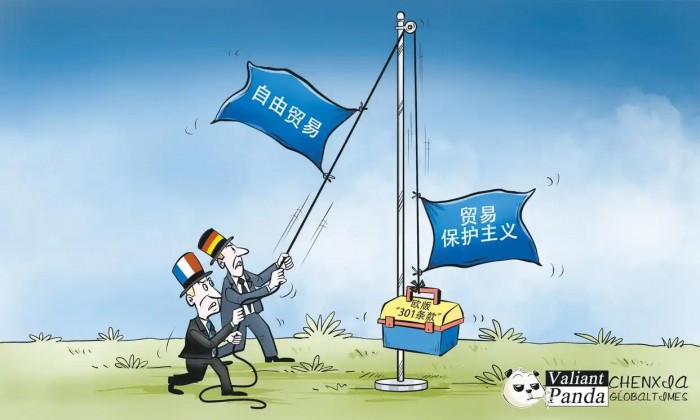 |
| A editorial cartoon from a media outlet depicting the EU's strong pushback against China's persistent low-price export blitz. Ultimately, China appears to have taken a step back in the face of the EU's resistance. / Global Times (Huanqiu Shibao) |
According to diplomatic sources in Beijing familiar with bilateral relations on the 10th, Chinese Commerce Minister Wang Wentao and EU Commissioner for Trade and Economic Security Maroš Šefčovič issued a joint statement on that day after holding the two-day "Second China-EU Economic and Trade Dialogue" in Beijing starting on the 8th.
According to the joint statement released by the Chinese side, both parties agreed to continue exploring the possibility of tariff reductions on certain goods within the World Trade Organization (WTO) framework. Furthermore, following intensive negotiations, they announced they had reached an understanding regarding trade in hybrid electric vehicles in a manner consistent with WTO rules.
Sources noted that at a press conference held immediately after the talks concluded, Commissioner Šefčovič stated, "We have reached a common understanding to regulate the export of Chinese-made hybrid electric vehicles (HEVs) and plug-in hybrid electric vehicles (PHEVs) to the EU. This opens the possibility of cutting Chinese exports by more than half." He added that China also agreed to reduce tariffs on selected EU goods, including automotive parts and olive oil.
Based on his remarks, the EU is estimated to save at least 225 million euros (roughly 338 billion won). If all points of agreement in the joint statement are upheld as planned, it represents a substantial diplomatic and economic outcome.
Until now, China's hybrid vehicle exports have served as the principal flashpoint in trade friction between the two sides. In 2024, the EU imposed definitive countervailing duties of up to 35.3% on Chinese battery electric vehicles (BEVs) to counter China’s surge in vehicle supply. However, standard baseline tariffs of 10% were left in place for hybrid and plug-in hybrid models. Taking advantage of this opening, Chinese-made hybrids accounted for a quarter of European sales this past August.
Ahead of these trade negotiations, the EU felt compelled to exert pressure on China, including floating potential safeguard measures in the press to curb internal imports of Chinese hybrid cars. Brussels also called on Beijing to implement voluntary export restraints on hybrid models. China, however, consistently pushed back, arguing such demands run counter to WTO rules.
Both sides stated that they will proceed with ongoing procedures regarding price undertakings and reassessments linked to the anti-subsidy investigation into electric vehicles. In addition, they concurred on the critical importance of enhancing the predictability and stability of global industrial and supply chains.
China and the EU also agreed to maintain dialogue on market access for medical devices. Demonstrating this consensus, the two sides committed to keeping lines of communication open, scheduling a ministerial-level virtual meeting for January of next year, followed by a formal regular meeting in March. Even so, it remains difficult to guarantee that smooth dialogue will continue unhindered down the road. If widespread analysis among Beijing diplomatic sources is any indication—viewing China's concession as taking one step back to prepare two steps forward—cautious skepticism is well warranted.
Hong Soon-do
Most Read
-
1
Trump shares map on social media labeling Strait o..

-
2
Kia Sportage outperforms Mazda CX-5 in German auto..

-
3
Houthis launch successive attacks on Saudi airport..

-
4
U.S. deploys carrier, 10,000 more troops to Middle..

-
5
Japan tracks Ukraine fiber-optic drones, bolsters..

-
6
Putin's ally visits China on the 8th ahead of APEC..

-
7
Chinese military support and training center opens..

PEOPLE






HEADLINE NEWS
- Trump slams Nobel Peace Prize snub, claiming he is 'preventing war' between the two Koreas
- China makes tactical retreat following fierce pushback from EU
- Japan openly opposes U.S. sanctions on ICC, fueling tensions with Washingto..
- Military service exemptions for artists and athletes under scrutiny at parl..

-
Address : In-Young Bldg., 34, Uisadang-daero 1-gil, Yeongdeungpo-gu, Seoul
Copyright by ASIATODAY CO., LTD. All rights resereved