



Japan tracks Ukraine fiber-optic drones, bolsters SDF electronic warfare
Sep 29, 2026, 10:29 am


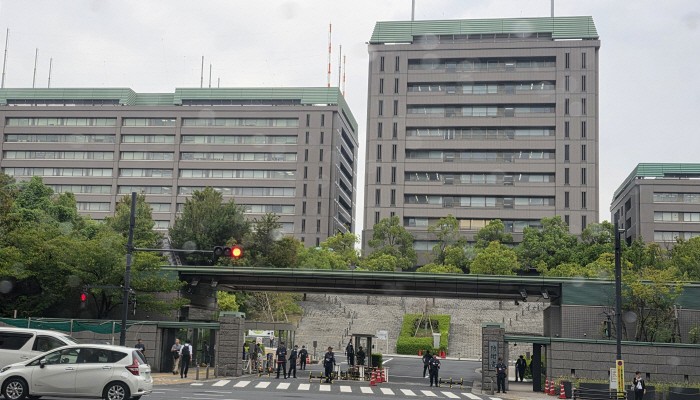 |
| Panoramic view of the Ministry of Defense building at 5-1 Ichigaya-honmuracho, Shinjuku Ward, Tokyo, Japan. / Tokyo Correspondent Choi Young-jae |
With fiber-optic drones spreading across the Russia-Ukraine war to evade signal jamming, Japan is accelerating efforts to strengthen its electronic warfare capabilities. As electronic warfare neutralizing wireless communications and the Global Positioning System (GPS) reshapes drone configurations and battlefield tactics, Japan's Ministry of Defense is focusing on simultaneously upgrading the Self-Defense Forces' communications and radar jamming, as well as their defense capabilities.
According to the Asahi Shimbun on the 28th, both Russia and Ukraine have increasingly deployed drones along the Ukrainian front lines that transmit control signals via optical fiber rather than wireless radio. This addresses the vulnerability of conventional drones, which become difficult to steer or locate once jammed. As electronic warfare intensifies, a cat-and-mouse contest between spear and shield is unfolding: new drones emerge to counter jamming, prompting the rapid development of countermeasures to neutralize them in turn.
Japan's Ministry of Defense also regards these shifts emerging from the Ukraine war as central to a new way of warfare. The 2026 Defense White Paper assessed that mass deployment of low-cost unmanned aerial vehicles alongside electronic warfare is transforming the character of war, noting that battlefield lessons and adaptations are swiftly reflected in equipment and tactics.
Accordingly, the Self-Defense Forces have designated the electromagnetic domain as a critical operational domain linked with land, sea, air, space, and cyber domains, expanding relevant capabilities. Through the Ground Self-Defense Force's Network Electronic Warfare System (NEWS), Japan detects and analyzes adversaries' communications and radar signals while bolstering its electronic warfare posture, and upgrades to NEWS performance are also underway. Japan's Ministry of Defense allocated 8.8 billion yen to procure one NEWS set and 4.7 billion yen for upgraded version development in its fiscal 2025 budget.
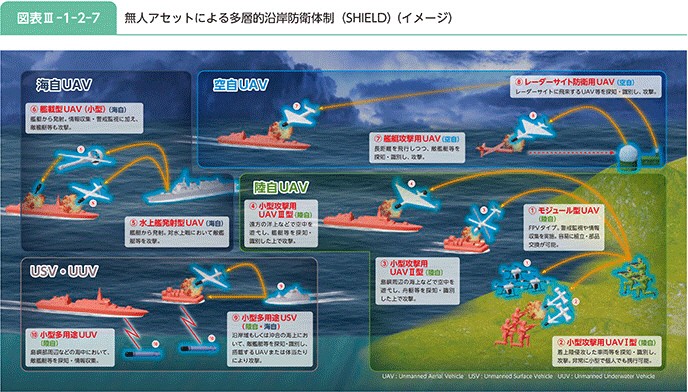 |
| Conceptual diagram of SHIELD, an unmanned asset-based multi-layered coastal defense system presented by Japan's Ministry of Defense in its 2026 Defense White Paper. It illustrates the coordinated operation of maritime, aerial, and ground unmanned assets. / Provided by Japan's Ministry of Defense |
In fiscal 2026, the reinforcement of electronic warfare capabilities took more concrete shape. The Ministry of Defense plans to procure additional Type 24 anti-aircraft electronic warfare systems and establish new anti-aircraft electronic warfare units at Camp Kengun in Kumamoto Prefecture and Camp Yonaguni in Okinawa Prefecture. The acquisition of RC-2 radio intelligence aircraft will also proceed. Research into laser systems to counter not only drones but also cruise missiles at low cost will be carried out across fiscal 2026 and 2027.
What Japan particularly watches with concern is the flow of battlefield experience from the war in Ukraine transferring through Russia to North Korea. In this year's Defense White Paper, Japan's Ministry of Defense noted that North Korean troops gained direct experience in operating unmanned systems, including drones, and in waging electronic warfare through their troop dispatch to Russia, highlighting the possibility that lessons learned on the battlefield could spread throughout the entire North Korean military. The white paper also included assessments that Russia has supplied short-range air defense systems and electronic warfare systems to North Korea since November 2024.
This presents a direct challenge to the South Korean military as well. South Korea's Ministry of National Defense also assessed this past June that drones have emerged as a core element of modern warfare in the Ukraine conflict and other theaters, stating plans to rapidly expand drone and counter-drone capabilities. It is pursuing the development of new counter-drone response systems such as lasers and high-power microwaves. The Defense Acquisition Program Administration announced that the South Korean military's Cheongwang laser anti-aircraft weapon system was deployed in late 2024 and achieved domestic production of key components this year.
This explains why the contest between drones and electronic warfare sparked by the Ukraine war extends beyond Japan's defense build-up and directly intersects with security on the Korean Peninsula. With North Korean forces accumulating real-world combat experience in drone and electronic operations in Russia, both South Korea and Japan are moving quickly to construct integrated response systems that account for signal jamming and unmanned aerial threats alongside conventional air defense networks.
Choi Young-jae
Most Read
-
1
Trump shares map on social media labeling Strait o..

-
2
Trump demands rates fall below 1% as Fed hikes for..

-
3
Celltrion seeks rheumatoid arthritis indication ex..

-
4
Chinese e-commerce giants AliExpress, Temu and She..

-
5
Trump warns countries not helping U.S. must pay re..

-
6
China expels No. 2 military official Zhang Youxia..

-
7
Houthi rebels release video claiming downing of Sa..

PEOPLE






HEADLINE NEWS
- N. Korea declares nuclear status irreversible and condemns S. Korea, U.S., Japan at UN
- Japan tracks Ukraine fiber-optic drones, bolsters SDF electronic warfare
- Wave of undocumented Chinese caught in Argentina after Brazil's visa-free m..
- France's far-right National Rally forms first-ever parliamentary group in S..

-
Address : In-Young Bldg., 34, Uisadang-daero 1-gil, Yeongdeungpo-gu, Seoul
Copyright by ASIATODAY CO., LTD. All rights resereved