



Military service exemptions for artists and athletes under scrutiny at parliamentary audit
Oct 12, 2026, 09:12 am


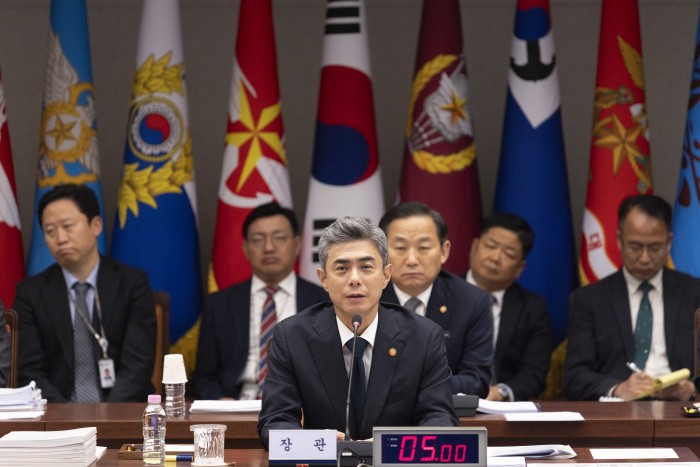 |
| Defense Minister Kang Shin-chul answers lawmakers' questions during a National Assembly National Defense Committee audit of the Ministry of National Defense, held at the ministry's headquarters in Yongsan-gu, Seoul, on the 7th. / National Assembly Press Corps |
The reform of the military service exemption system for arts and sports personnel—recently sparked by controversies over inappropriate remarks and behavior by Asian Games athletes—comes under intense parliamentary audit scrutiny before the National Assembly's National Defense Committee on the 12th. With the government signaling plans to phase out and ultimately abolish the system, specific timelines and reform blueprints are expected to take center stage.
According to political circles on the 11th, the National Defense Committee conducts an audit of the Military Manpower Administration (MMA) and an on-site inspection of the Agency for Defense Development (ADD) on the 12th. Questions during the MMA audit are expected to focus heavily on the fairness of the arts and sports service exemption and the broader direction of structural reform.
The Ministry of National Defense stated that it will reflect the reduction and phaseout of supplementary service personnel, including arts and sports personnel, in its Basic Defense Reform Plan. Defense Minister Kang Shin-chul also remarked in a prior audit hearing that "the ultimate goal is to progressively scale back military service exemptions and eventually abolish them." Minister of Culture, Sports and Tourism Choi Hwi-young maintained that the ministry will "gather input from the sports and arts sectors and consult with the Defense Ministry and the MMA to devise comprehensive measures."
Under the current system, athletes who finish third or higher at the Olympics or first at the Asian Games, as well as artists who place second or higher in designated international arts competitions or first in domestic competitions, qualify for transfer to arts and sports personnel. The program was designed to grant exemptions to individuals demonstrating distinguished achievements that enhance national prestige and promote culture.
Although technically structured as an alternative form of military service, public criticism has mounted following recent remarks by athletes, arguing that the program is effectively treated as an outright military exemption. Following their gold medal win at the 2026 Aichi-Nagoya Asian Games, certain members of the men's national soccer team made remarks such as "We're not going to the army" and "The military exemption was desperately needed." Controversy also erupted after the squad's youngest player, who logged only about 10 minutes on the pitch throughout the tournament, posted a photo of himself on social media wearing a discharge cap.
Above all, critics point out that unlike in 1973 when the program was first instituted, South Korea's international stature has grown significantly, necessitating stricter eligibility standards. Key issues center on whether granting exemptions for Asian Games gold medals—in addition to Olympic medals—remains appropriate, and how to address the sense of relative deprivation felt by young men completing mandatory military duty.
Lee Han-sol
Most Read
-
1
Trump shares map on social media labeling Strait o..

-
2
Kia Sportage outperforms Mazda CX-5 in German auto..

-
3
Houthis launch successive attacks on Saudi airport..

-
4
U.S. deploys carrier, 10,000 more troops to Middle..

-
5
Trump rejects Iran's offer to open Strait of Hormu..

-
6
N. Korea conducts first swarm attack drill with dr..

-
7
U.S.-China summit falls short on substance as Trum..

PEOPLE





HEADLINE NEWS
- Seoul dismisses Ukraine's claim of 'S. Korean support for Russia' as "inaccurate and inappropriate"
- S. Korea, Japan race to develop nuclear-powered submarines
- Henri Kagan, Kenso Soai win Nobel Prize in Chemistry for uncovering how mol..
- Vance says Alaska LNG cooperation will move forward with Seoul's current or..

-
Address : In-Young Bldg., 34, Uisadang-daero 1-gil, Yeongdeungpo-gu, Seoul
Copyright by ASIATODAY CO., LTD. All rights resereved