



N. Korea conducts first swarm attack drill with drones and missiles
Sep 28, 2026, 10:27 am


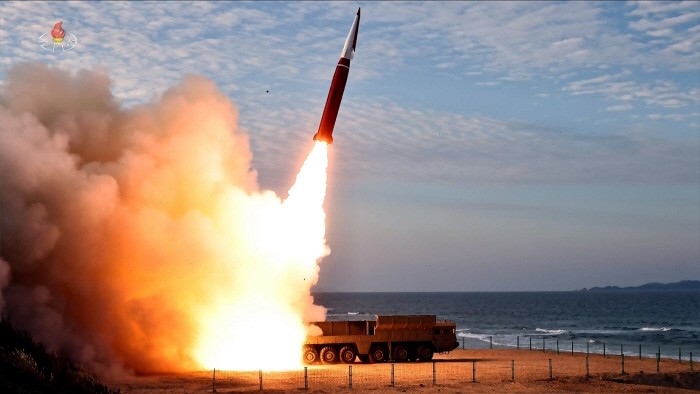 |
| North Korea's Missile Administration successfully conducted a test of a new weapon of significant importance in advancing weapon system technology on September 20 with State Affairs Commission President Kim Jong-un observing, Korean Central Television (KCTV) reported on the 22nd. / Capture from KCTV, Yonhap |
North Korea has begun training for multidimensional swarm attacks that combine unmanned systems with conventional weapons to overwhelm enemy air defense networks, U.S. daily The Wall Street Journal (WSJ) reported on the 27th local time.
Adopting swarm tactics demonstrated on battlefields in Ukraine and the Middle East, the exercises are assessed as a threat capable of tipping the military balance on the Korean Peninsula by exhausting an adversary's costly interceptor missiles at an early stage.
Experts warned that North Korea's enhanced drone capabilities, when paired with its nuclear and missile arsenal, could neutralize South Korea's air defense networks and increase the likelihood of success for subsequent strikes using tactical nuclear weapons.
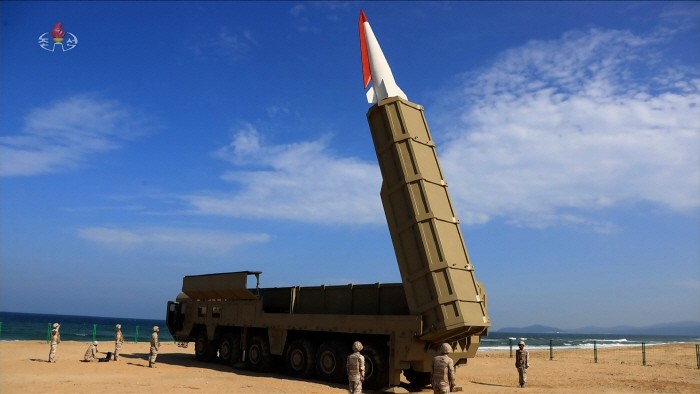 |
| North Korea's Missile Administration successfully conducted a test of a new weapon of significant importance in advancing weapon system technology on September 20 with State Affairs Commission President Kim Jong-un observing, Korean Central Television (KCTV) reported on the 22nd. / Capture from KCTV, Yonhap |
North Korea conducts first simultaneous strike test with drones, missiles, multiple rocket launchers, and long-range artillery to test concentrated firepower
North Korea conducted its first drill this month combining attack drones, nuclear-capable missiles, multiple rocket launchers, and long-range artillery to strike a single target. North Korean state media reported that the exercise was designed to master the capability to systematically and structurally destroy enemy forces through concentrated fire by integrating these weapon systems.
North Korea subsequently tested the speed and precision of individual weapons in succession. On the 20th, North Korea launched two missiles it claimed were hypersonic. Designed to fly at more than five times the speed of sound, hypersonic missiles can penetrate air defense networks due to their speed and in-flight maneuverability, the WSJ explained. North Korean State Affairs Commission President Kim Jong-un, who oversaw the test, claimed it was ultramodern technology.
North Korean state media also reported on the 24th that North Korea test-fired upgraded 240 mm multiple rocket launcher shells equipped with unmanned pinpoint guidance capabilities. This series of tests demonstrates a transition beyond developing individual weapons toward operating disparate weapon systems simultaneously.
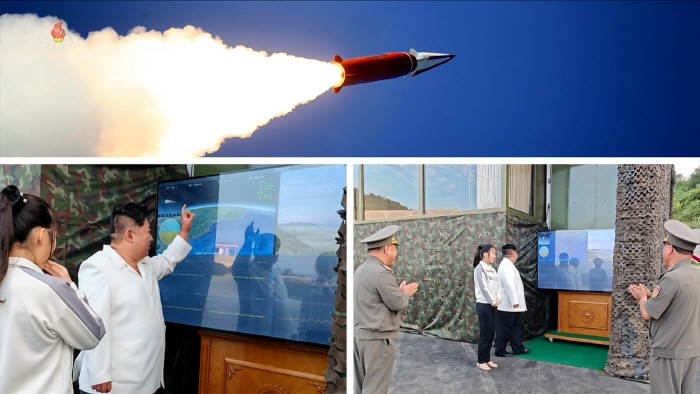 |
| North Korean State Affairs Commission President Kim Jong-un observes a test of a new weapon conducted by the Missile Administration on September 20 alongside his daughter Ju-ae, Workers' Party of Korea Central Committee First Vice Department Director Kim Jong-sik, and Missile Administration Director Jang Chang-ha. / Capture from KCTV, Yonhap |
U.S. experts say swarm tactics change air defense calculus while WSJ notes integrating weapons with differing speeds poses challenge even for North Korea
Deploying multiple weapons simultaneously in this manner is also referred to as a salvo, saturation attack, or mass precision strike. The attacking side creates numerous targets at once, straining the defending side's interception capabilities and interceptor stockpiles.
Ankit Panda, a senior fellow at the Carnegie Endowment for International Peace, assessed that such tactics could overwhelm even adversaries equipped with sophisticated defense systems, noting that they significantly alter the air defense calculus.
Fabian Hinz, a military analyst with the arms tracking organization Conflict Armament Research (CAR), explained that this method involves generating countless submunitions to multiply potential targets while simultaneously launching conventional ballistic missiles to overwhelm opposing air and missile defense networks.
However, executing such large-scale complex strikes is not a simple undertaking for North Korea either. Synchronizing the impact times of weapons flying at differing speeds requires a highly integrated command-and-control architecture. The WSJ noted that for North Korea, which faces financial constraints and lacks top-tier equipment across its military, such integrated operations present a particularly formidable challenge.
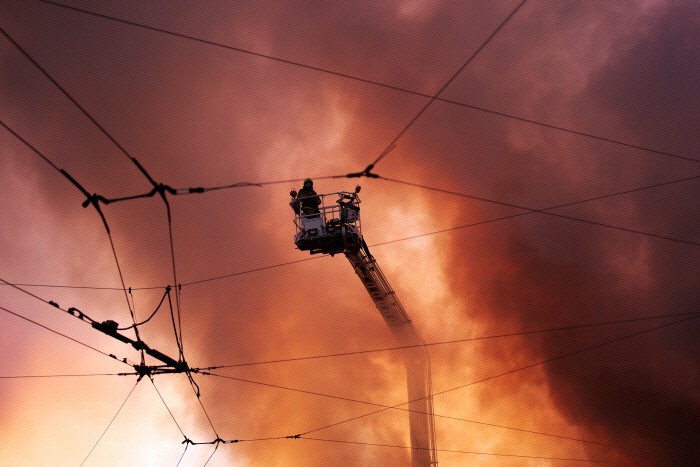 |
| Ukrainian firefighters extinguish a blaze caused by a Russian missile strike at a book market in Kyiv early in the morning on August 16 local time. / AP, Yonhap |
Ukraine interception rate drops from 24% to 10% as Iran mixes drones and missiles to deplete costly interceptors
The effectiveness and limitations of the tactics tested by North Korea are emerging first on the battlefields of Ukraine and the Middle East. According to the U.S. think tank Center for Strategic and International Studies (CSIS), Russia is on pace to fire 840 ballistic missiles into Ukraine this year, up nearly 50% from 2025.
CSIS analyzed that Russia's launches this year could near 1,000, driven in part by additional missile supplies from North Korea. With interceptors supplied by the U.S. and Europe running short, Ukraine's ballistic missile interception rate dropped from roughly 24% in 2025 to around 10% this year.
A similar pattern unfolded in the Middle East. Iran launched waves of relatively inexpensive Shahed drones in combination with ballistic missiles and other weapons, forcing the U.S. and regional allies to expend costly interceptors.
Iran's missile forces were also depleted over the course of the conflict. In response, Iran adjusted its tactics by employing cluster munitions and warheads that separate into multiple pieces upon atmospheric reentry, compelling the defense to expend even more interceptors. Analyst Hinz explained that the core of this approach is to overwhelm opposing air defense networks by deploying numerous submunitions alongside conventional ballistic missiles.
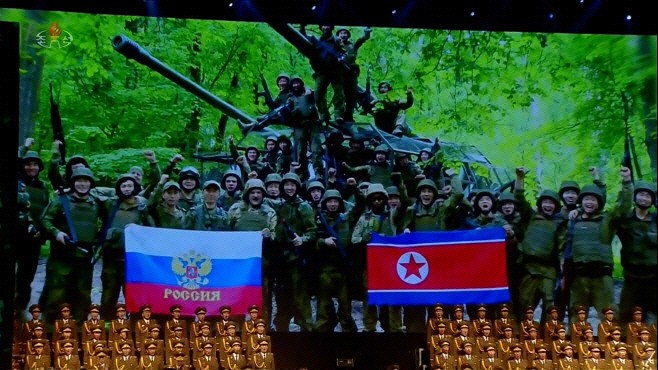 |
| Korean Central Television (KCTV) aired footage on the 30th showing photos of North Korean troops deployed to Russia on a stage backdrop during an artistic performance held at the April 25 House of Culture in Pyongyang on June 29, 2025, attended by visiting Russian Culture Minister Olga Lyubimova. / Capture from KCTV, Yonhap |
North Korea dispatches personnel to Russian drone facilities as Kim Jong-un pushes development of AI unmanned strike systems
The experience accumulated on the Ukrainian battlefield is tied to North Korea's military cooperation with Russia. While continuing to advance his nuclear weapons program, Kim Jong-un is also placing higher priority on modernizing Soviet-style conventional forces.
Kim and Russian President Vladimir Putin signed a mutual defense treaty in Pyongyang in June 2024. The WSJ assessed that this treaty paved the way for the deployment of North Korean troops to Russia later that year. Missiles supplied by North Korea have been used against Ukraine.
North Korea has also sent workers and technicians to Russian drone facilities. In February, while presenting new five-year military goals, Kim announced plans to develop new unmanned strike systems utilizing artificial intelligence (AI).
CSIS warns conflict involving North Korea or China would put greater strain on U.S. and allied stockpiles, with missile production speed seen as key variable
The issue is how quickly such prolonged mass attacks would exhaust the defense's interceptor stockpiles. Benjamin Jensen and Tobias Oestreich, co-authors of a CSIS report, analyzed that conflicts involving North Korea or China could place a heavier burden on U.S. and allied weapons stockpiles than the wars in Europe and the Middle East.
The two researchers noted that "massive salvoes of missiles and drones define modern warfare," predicting that future armed conflicts will increasingly depend on the competition between how fast one side can produce the missiles needed for multidimensional attacks and how quickly the opposing side can replenish its air defenses.
IISS Korea Chair says combining drones, nuclear weapons, and missiles could exhaust South Korean air defenses and raise likelihood of follow-up tactical nuclear strikes
Lami Kim, Korea Chair at the International Institute for Strategic Studies (IISS) in the U.K., analyzed that in the event of conflict on the Korean Peninsula, North Korea could deplete South Korean air defense assets by adding drones to its missile firepower.
Kim explained that, in such a scenario, North Korea could increase the likelihood of success for subsequent strikes using far more potent weapons, such as tactical nuclear arms. This does not suggest North Korea has already finalized a follow-up tactical nuclear strike architecture, but rather reflects an analysis premised on air defense assets being consumed first by combined drone and missile attacks.
Kim assessed that "the strengthening of North Korea's drone capabilities, when combined with its nuclear and missile capabilities, could alter the military balance on the Korean Peninsula."
Ha Man-ju
Most Read
-
1
Trump demands rates fall below 1% as Fed hikes for..

-
2
Celltrion seeks rheumatoid arthritis indication ex..

-
3
Chinese e-commerce giants AliExpress, Temu and She..

-
4
Trump warns countries not helping U.S. must pay re..

-
5
China expels No. 2 military official Zhang Youxia..

-
6
Houthi rebels release video claiming downing of Sa..

-
7
U.S. allows Iranian delegation to attend UN Genera..

PEOPLE







-
Address : In-Young Bldg., 34, Uisadang-daero 1-gil, Yeongdeungpo-gu, Seoul
Copyright by ASIATODAY CO., LTD. All rights resereved