



S. Korea, Japan race to develop nuclear-powered submarines
Oct 08, 2026, 09:38 am


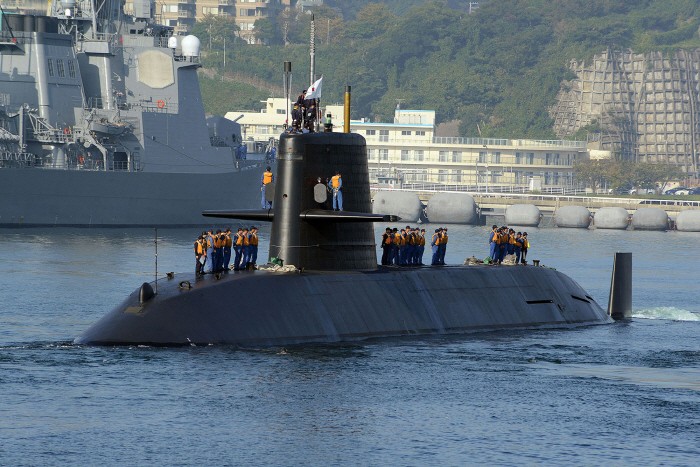 |
| The Japan Maritime Self-Defense Force's 598 Yaeshio-class diesel-electric submarine / JMSDF website |
With South Korea securing U.S. approval for the construction of nuclear-powered submarines and Japan pushing to specify the consideration of acquiring nuclear submarines in its national security policy, a competition between Seoul and Tokyo to secure nuclear submarines is coming into view.
While South Korea has entered follow-up consultations based on an agreement reached at the bilateral summit with the U.S., Japan remains at the stage of policy review to assess the feasibility of acquisition. Japan faces not only immense construction costs and the task of securing specialized personnel, but also the additional hurdle of domestic legal interpretations regarding the military use of nuclear energy.
According to the Yomiuri Shimbun on the 7th, the Japanese government is discussing plans to include a policy of reviewing the Self-Defense Forces' introduction of nuclear-powered submarines in three key security documents, including the National Security Strategy, scheduled for revision by the end of the year. This stems from the assessment that nuclear submarines capable of extended submerged operations are necessary to counter China's expansion into the Pacific. Specifying a "review of acquisition" would establish a policy foundation to advance research and feasibility studies.
However, this does not mean construction will begin immediately. The Japanese government plans to evaluate the feasibility of acquisition over several years, and with conflicting opinions emerging even within government expert panels, the final wording will require coordination.
South Korea is one step ahead in diplomatic agreements and follow-up discussions. The joint fact sheet released following the South Korea-U.S. summit in October last year stated that the U.S. approved South Korea's construction of nuclear-powered attack submarines and would work closely to advance project requirements, including nuclear fuel procurement options. Having secured official U.S. consent for its nuclear submarine initiative places South Korea at a different stage of progress compared to Japan.
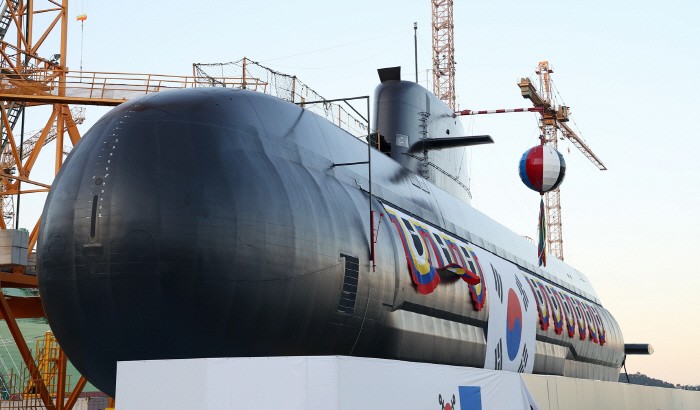 |
| The ROKS Anmu, the second ship of the Dosan Ahn Chang-ho-class (Jangbogo-III Batch-I), launched on November 10, 2020. By independently designing and constructing the 3,000-ton class Jangbogo-III Batch-I submarine (noted as 300t in the original text), South Korea enhanced its capabilities to develop indigenous nuclear-powered submarines. / Daewoo Shipbuilding & Marine Engineering |
Follow-up discussions are also underway. According to Reuters, South Korea and the United States held their first consultations on nuclear submarines and nuclear cooperation in June this year. However, because a separate agreement is required for the military application of submarine fuel, presidential approval alone does not entirely resolve the issue of nuclear fuel supply.
In Japan, the ruling party is pushing the discussion forward. The Liberal Democratic Party (LDP) proposed utilizing "next-generation propulsion" for submarines equipped with vertical launch systems (VLS) designed for long-range missiles. Nippon Ishin no Kai (Japan Innovation Party) is calling for the early introduction of nuclear submarines. Defense Minister Shinjiro Koizumi also stated on the 11th of last month that he would not rule out nuclear submarines as an option, though he maintained the stance that the review is not proceeding toward a predetermined conclusion.
The military appeal of nuclear-powered submarines lies in their submerged endurance and mobility. Leveraging a nuclear reactor for propulsion allows for prolonged underwater operations and travel to distant waters, thereby expanding the operational reach of surveillance patrols and long-range missiles. Nuclear submarines in this context refer to a propulsion classification and do not imply the deployment of nuclear weapons.
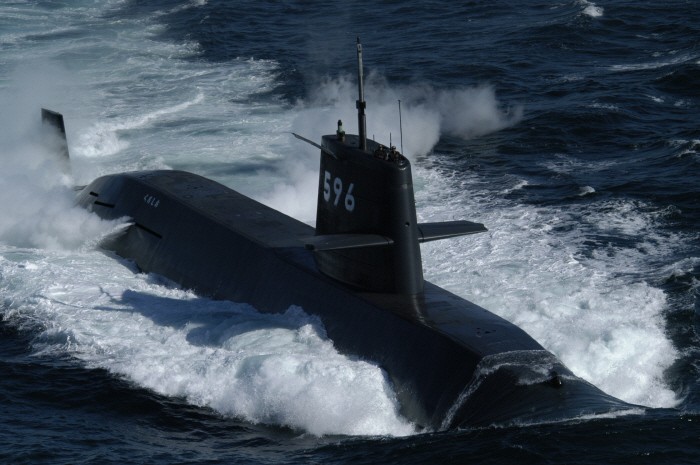 |
| The Japan Maritime Self-Defense Force's Kuroshio-class diesel-electric submarine / JMSDF website |
Japan's pursuit entails legal and policy burdens. The Atomic Energy Basic Act restricts the use of nuclear energy exclusively to peaceful purposes. The Japanese government has maintained its longstanding position in Diet responses that using nuclear power for Self-Defense Force vessels is not permissible as long as nuclear propulsion for ships remains uncommon. To proceed with an actual acquisition, Tokyo must reconcile its plans with this interpretation or establish legal and policy adjustments.
Costs and specialized personnel present additional hurdles. The Yomiuri Shimbun projected that the construction cost of a nuclear-powered submarine would be several times higher than that of a conventional submarine. Moreover, the maintenance, overhaul, and operation of a naval nuclear reactor demand specialized technical expertise. Defense Minister Koizumi likewise pointed to reactor costs, enlarged hull designs, and securing specialized personnel as major challenges.
The current landscape of "South Korea leading and Japan pursuing" is more accurately viewed as a divergence in policy implementation stages rather than a disparity in technological prowess. South Korea must translate its agreed cooperation with the United States into tangible nuclear fuel supplies and actual shipbuilding projects, while Japan must navigate domestic legal interpretations and political consensus before making an acquisition decision. The pace of the South Korea-Japan nuclear submarine race will depend not only on construction technology, but on how quickly both nations can overcome these institutional thresholds.
Choi Young-jae
Most Read
-
1
Trump shares map on social media labeling Strait o..

-
2
Kia Sportage outperforms Mazda CX-5 in German auto..

-
3
U.S. deploys carrier, 10,000 more troops to Middle..

-
4
Trump rejects Iran's offer to open Strait of Hormu..

-
5
N. Korea conducts first swarm attack drill with dr..

-
6
U.S.-China summit falls short on substance as Trum..

-
7
Japan tracks Ukraine fiber-optic drones, bolsters..

PEOPLE





HEADLINE NEWS
- Seoul dismisses Ukraine's claim of 'S. Korean support for Russia' as "inaccurate and inappropriate"
- S. Korea, Japan race to develop nuclear-powered submarines
- Henri Kagan, Kenso Soai win Nobel Prize in Chemistry for uncovering how mol..
- Vance says Alaska LNG cooperation will move forward with Seoul's current or..

-
Address : In-Young Bldg., 34, Uisadang-daero 1-gil, Yeongdeungpo-gu, Seoul
Copyright by ASIATODAY CO., LTD. All rights resereved