



Henri Kagan, Kenso Soai win Nobel Prize in Chemistry for uncovering how molecular asymmetry is amplified
Oct 08, 2026, 09:33 am


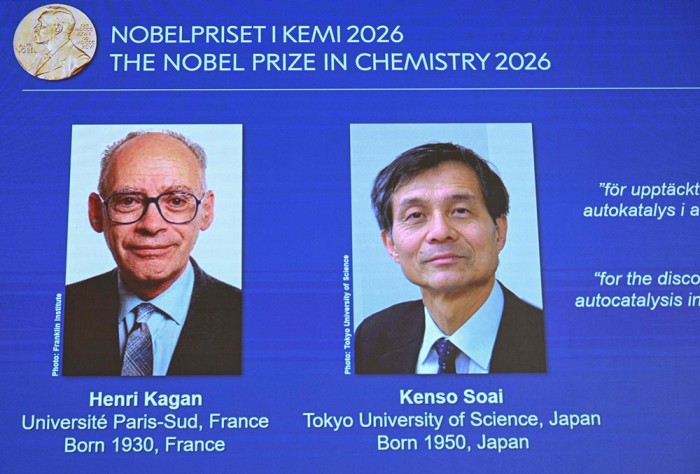 |
Photographs of this year's laureates, Professor Henri Kagan of France (left) and Professor Kenso Soai of Japan, are displayed on a screen during the announcement of the Nobel Prize in Chemistry at the Royal Swedish Academy of Sciences in Stockholm, Sweden, on the 7th (local time). / AFP, Yonhap
Professor Henri Kagan (96) of Paris-Sud University in France and Professor Kenso Soai (76) of the Tokyo University of Science in Japan have been named the winners of the 2026 Nobel Prize in Chemistry.
Announcing the two scholars as this year's laureates on the 7th (local time), the Nobel Committee at the Royal Swedish Academy of Sciences stated that they were recognized "for the discovery of non-linear effects and autocatalysis in asymmetric organic synthesis."
French-born organic chemist Professor Kagan is known as a pioneer in the field of asymmetric catalysis. He discovered and theorized the "non-linear effect," demonstrating that minute asymmetries can be amplified.
A graduate of the Sorbonne in Paris, he earned his doctorate from the Collège de France and served on the faculty at Paris-Sud University in Orsay for approximately 40 years before becoming professor emeritus, acting as a mentor to fellow chemists.
Born in Hiroshima, Japan, Professor Soai graduated from the Department of Chemistry at the University of Tokyo, where he also obtained his master's and doctoral degrees. After working as a fellow at the Japan Society for the Promotion of Science, he took up a professorship at the Tokyo University of Science.
He is widely renowned for research that realized the asymmetric amplification of molecules via autocatalysis into an actual "autocatalytic reaction." He discovered the "Soai reaction," which selectively generates one molecular handedness by using autocatalytic processes to amplify subtle asymmetries existing in enantiomers.
Kim Hyun-min |
Most Read
-
1
Trump shares map on social media labeling Strait o..

-
2
Kia Sportage outperforms Mazda CX-5 in German auto..

-
3
U.S. deploys carrier, 10,000 more troops to Middle..

-
4
Trump rejects Iran's offer to open Strait of Hormu..

-
5
N. Korea conducts first swarm attack drill with dr..

-
6
U.S.-China summit falls short on substance as Trum..

-
7
Japan tracks Ukraine fiber-optic drones, bolsters..

PEOPLE





HEADLINE NEWS
- Seoul dismisses Ukraine's claim of 'S. Korean support for Russia' as "inaccurate and inappropriate"
- S. Korea, Japan race to develop nuclear-powered submarines
- Henri Kagan, Kenso Soai win Nobel Prize in Chemistry for uncovering how mol..
- Vance says Alaska LNG cooperation will move forward with Seoul's current or..

-
Address : In-Young Bldg., 34, Uisadang-daero 1-gil, Yeongdeungpo-gu, Seoul
Copyright by ASIATODAY CO., LTD. All rights resereved