



Seoul dismisses Ukraine's claim of 'S. Korean support for Russia' as "inaccurate and inappropriate"
Oct 08, 2026, 09:11 am


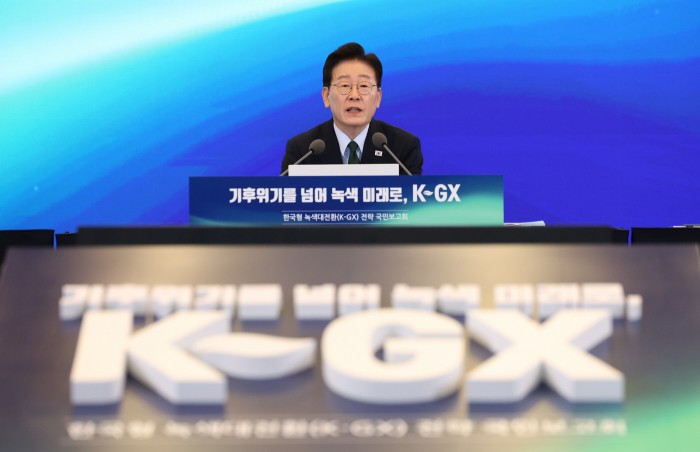 |
| President Lee Jae-myung speaks at the national presentation for the Korean Green Transformation (K-GX) strategy, held at a conference hall in Seoul on the 7th. / Yonhap News |
Seoul pushed back on the 7th against remarks by an official from Ukraine's presidential office alleging that South Korea helped alleviate the impact of Russia's fuel shortages and loss of refining capacity, calling the claim "inaccurate and inappropriate."
Senior Presidential Spokesperson Kang Yu-jung stated in a written briefing that "since Russia's invasion of Ukraine, our government has consistently implemented sanctions and export controls against Russia in close coordination with the international community, and there has been no change to our government's fundamental stance."
Kang emphasized that the government had already clearly communicated this position regarding recent foreign media reports covering fuel shipments from South Korea to Russia.
"Nonetheless, for a Ukrainian presidential official to cite a report from The Guardian—based on individual transactions where key facts such as trading entities, countries of origin, and end-buyers have not been verified—and publicly suggest that South Korea helped mitigate Russia's fuel shortages and loss of refining capacity, thereby acting contrary to existing sanctions policies against Russia, is factually inaccurate and inappropriate," Kang said.
She added, "The government is currently working through relevant agencies to closely verify the facts and matters related to export controls," noting, "Should any issues be confirmed, necessary measures will be taken."
She urged, "We hope the Ukrainian side will refrain from public remarks that could distort South Korea's relevant policies or damage international trust without adequate fact-checking."
Seoul also stressed that it has steadily tightened export controls against Russia since the invasion of Ukraine.
An official from the National Security Office explained, "The government operates a transparent and predictable export control system in line with multilateral coordination, including the four major multilateral export control regimes: the Wassenaar Arrangement, the Nuclear Suppliers Group, the Australia Group, and the Missile Technology Control Regime."
The official added, "Following Russia's invasion of Ukraine, we completely banned exports of strategic items to Russia and phased in tighter controls on non-strategic goods that carry potential for military diversion."
Items subject to catch-all controls expanded from 57 in March 2022 to 798 in April 2023, 1,159 in February 2024, and reached 1,402 in June of that year.
Under these export controls, South Korea's exports to Russia dropped 60 percent, falling from $10 billion in 2021 to $4 billion last year. Over the same period, Russia's share of South Korea's total exports declined from 1.5 percent to 0.6 percent.
The government noted that major exports to Russia are currently limited to general manufactured goods and humanitarian items, such as passenger vehicles, cosmetics, and medical devices.
The security official remarked, "The government implemented export controls on Russia despite the economic burden on our citizens and enterprises in order to join the international community's peace efforts," adding, "We will continue to work toward ending the war and achieving peaceful recovery."
Park Young-hoon
Most Read
-
1
Trump shares map on social media labeling Strait o..

-
2
Kia Sportage outperforms Mazda CX-5 in German auto..

-
3
U.S. deploys carrier, 10,000 more troops to Middle..

-
4
Trump rejects Iran's offer to open Strait of Hormu..

-
5
N. Korea conducts first swarm attack drill with dr..

-
6
U.S.-China summit falls short on substance as Trum..

-
7
Japan tracks Ukraine fiber-optic drones, bolsters..

PEOPLE





HEADLINE NEWS
- Seoul dismisses Ukraine's claim of 'S. Korean support for Russia' as "inaccurate and inappropriate"
- S. Korea, Japan race to develop nuclear-powered submarines
- Henri Kagan, Kenso Soai win Nobel Prize in Chemistry for uncovering how mol..
- Vance says Alaska LNG cooperation will move forward with Seoul's current or..

-
Address : In-Young Bldg., 34, Uisadang-daero 1-gil, Yeongdeungpo-gu, Seoul
Copyright by ASIATODAY CO., LTD. All rights resereved