



U.S.-China summit falls short on substance as Trump’s humiliation draws attention
Sep 28, 2026, 10:43 am


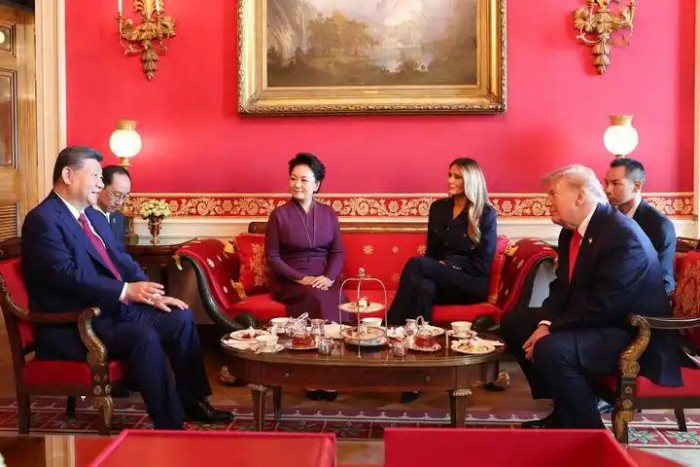 |
| U.S. President Donald Trump and Chinese General Secretary and State President Xi Jinping converse over tea following their summit at the White House in Washington, D.C., on the 24th local time. / People's Daily |
The summit between the United States and China, held on the 24th local time at the White House in Washington, D.C. under the eyes of the entire world, is being analyzed as having concluded without significant achievements, contrary to initial hopes and expectations. In short, it would not be far off to say that the meeting proved the old saying, "Much cry and little wool."
That the second face-to-face meeting in four months between President Donald Trump and General Secretary and State President Xi Jinping was style over substance becomes clear upon reviewing the fact sheet released right after the summit alongside related news reports. Synthesizing reports on the 27th from foreign media and Chinese outlets, including state-run Xinhua News Agency, the two sides announced after the summit that their leaders reached consensus on as many as eight outcomes. They even attached great significance to it, stating they "agreed to build a constructive, strategically stable U.S.-China relationship based on respect, fairness, and reciprocity."
Taking the fact sheet at face value, one might describe it as having achieved major results. Yet a closer look at what actually saw full agreement paints quite a different picture. Consensus on mutual tariff reductions and an extension of the trade war truce exemplifies this. Compared to conditions just before the summit, little appears to have changed.
In particular, expectations ahead of the talks pegged the truce extension at anywhere from six months to a year, but it ended up lasting merely two months. It can only be assessed as securing nothing more than a stopgap measure. Furthermore, when recalling that both nations reaffirmed substantial differences on core issues such as Taiwan, rare earths, and artificial intelligence (AI), the weight of the eight-point agreement is considerably diminished.
A look at Chinese media coverage immediately following the talks also suggests this assessment is by no means unfounded. A prime example is the heavy coverage of two pandas departing for the U.S. and President Xi framing them as "goodwill ambassadors between the two nations." Further elaboration is hardly necessary given that state outlets showered praise on the trip by highlighting peripheral details, such as Peng Liyuan speaking English with First Lady Melania Trump, and framing it as a symbol of soft power.
This assessment is mirrored by Wang Yi, member of the CPC Central Committee Political Bureau, Minister of Foreign Affairs, and Director of the Office of the Central Commission for Foreign Affairs, who evaluated the summit by noting that "properly managing disputes and differences while seeking common ground and shelving differences (求同存異) is the inherent essence of a constructive and strategically stable China-U.S. relationship."
Nevertheless, President Trump offered a self-serving assessment that the talks were productive, claiming that "tremendous things are going to happen." He went a step further regarding differences over Taiwan and other issues, remarking that "President Xi understands my views very well." There is ample reason why Beijing diplomatic circles unanimously assess this meeting as an encounter marked by a "feast of words."
Moreover, while facing a reputation for being exceptionally ruthless toward allies, he invited controversy by extending lavish, almost flattering hospitality toward President Xi. This explains why Senate Armed Services Committee Chairman Roger Wicker, known for steadfast loyalty to Trump and the Republican Party, took the unusual step of criticizing his approach. It seems there are clear reasons why both sides are predictably assessing that the balance of dynamics in U.S.-China relations, where the two leaders are slated to meet twice more this year alone, has tilted considerably in China's favor.
Hong Soon-do
Most Read
-
1
Trump demands rates fall below 1% as Fed hikes for..

-
2
Celltrion seeks rheumatoid arthritis indication ex..

-
3
Chinese e-commerce giants AliExpress, Temu and She..

-
4
Trump warns countries not helping U.S. must pay re..

-
5
China expels No. 2 military official Zhang Youxia..

-
6
Houthi rebels release video claiming downing of Sa..

-
7
U.S. allows Iranian delegation to attend UN Genera..

PEOPLE






-
Address : In-Young Bldg., 34, Uisadang-daero 1-gil, Yeongdeungpo-gu, Seoul
Copyright by ASIATODAY CO., LTD. All rights resereved