



Oil prices sink 17%, but Gulf tanker attacks keep shipping risks elevated
Nov 09, 2026, 09:43 am


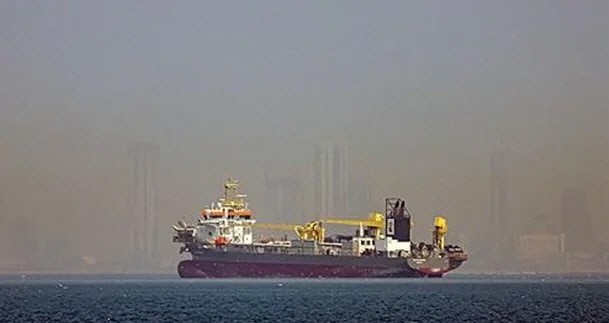 |
| Ships are anchored off the coast of Dubai, United Arab Emirates (UAE), amid instability in the Middle East. /EPA-Yonhap |
International oil prices have plunged amid growing expectations that U.S. President Donald Trump will pursue an exit strategy from the war with Iran following the U.S. midterm elections. However, tensions in the Strait of Hormuz, a vital artery for global oil shipments, show little sign of easing.
While financial markets are already pricing in the possibility of a negotiated end to the conflict between Washington and Tehran, tanker attacks and explosions continue in Gulf waters. This has raised concerns that a significant gap could emerge between the end of the war and the restoration of normal maritime trade.
According to Reuters, Brent crude futures settled at $98.32 a barrel Friday. Prices fell 16.9% over the week, their steepest weekly decline since April 2020, during the early stages of the COVID-19 pandemic. West Texas Intermediate (WTI) crude also declined 13.2% over the same period.
The sell-off reflected growing expectations that Washington and Tehran could enter negotiations after the Democrats' victory in the November midterm elections gave them control of Congress, increasing political pressure on the Trump administration to end the war.
Falling spot premiums for Middle Eastern crude, weakening demand and concerns about oversupply also weighed on oil prices.
Conditions at sea, however, stand in stark contrast to the market's optimism.
Reuters reported that the tanker MT Velos Sapphire was struck by an explosion believed to have been caused by a missile in Gulf waters Thursday, killing one crew member.
The Marshall Islands-flagged vessel was sailing empty toward Bahrain when the incident occurred. Although the crew managed to extinguish a fire on board, a missing crew member was later found dead.
The incident occurred in the Gulf rather than within the Strait of Hormuz itself, but it underscored concerns that the risks associated with the war could spread to surrounding waters.
Incident reports published by the United Kingdom Maritime Trade Operations (UKMTO) also point to persistent tensions in the region.
On Nov. 5, a tanker was reportedly struck by two unidentified projectiles in waters north of Qatar. The following day, an explosion was reported at the waterline of a tanker sailing out of the Strait of Hormuz, east of Khasab, Oman. All crew members were confirmed safe in the latter incident.
Military tensions surrounding passage through the strait also remain high, with Iran's Islamic Revolutionary Guard Corps (IRGC) claiming that some vessels had struck naval mines after using unauthorized shipping routes.
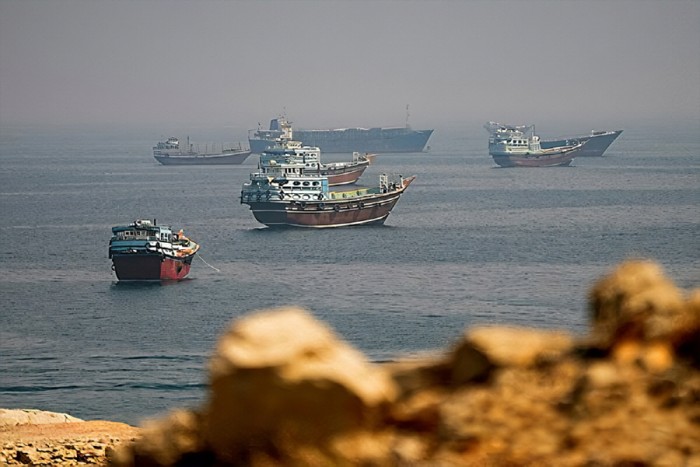 |
| Ships sail through waters near the Strait of Hormuz. /AP-Yonhap |
Shipping risks remain high despite falling oil prices
The biggest challenge facing the maritime shipping industry is the difficulty of ensuring vessel safety.
To pass through the Strait of Hormuz, shipowners and cargo owners must accept the risks associated with the war, while insurers demand additional premiums to cover those risks.
In July, insurance broker Marsh reported that additional war-risk premiums for vessels transiting the strait had surged to between 7.5% and 10% of a ship's insured value.
In September, an official from the UAE's state-owned oil company ENOC said cargo insurance premiums for oil tankers could reach 5% to 6% of the cargo's value, while additional war-risk costs could amount to as much as 10%.
Some shipping costs reportedly climbed to between $10 million and $20 million per voyage.
Higher shipping costs mean that even when crude oil prices decline, the actual cost of importing oil for refiners may not fall as quickly.
A shortage of available vessels and longer shipping schedules can push up freight rates and the cost of maintaining inventories.
This can be particularly burdensome for long-distance shipments involving very large crude carriers (VLCCs), where competition to secure vessels can itself put additional strain on supply chains.
A Reuters report that U.S. refiners are gaining an advantage over their Asian competitors by using Canadian crude and securing long-term vessel charter contracts also illustrates this shift.
Shipping traffic through the Strait of Hormuz remains well below normal levels.
According to maritime monitoring data based on Automatic Identification System (AIS) vessel tracking, traffic through the strait in early November was significantly lower than usual.
Some vessels may not be captured in the data because they have switched off their location signals or experienced GPS interference. Even allowing for these limitations, however, normal commercial shipping operations appear far from restored.
According to the International Energy Agency (IEA), an average of approximately 20 million barrels of crude oil and petroleum products passed through the Strait of Hormuz each day in 2025.
As a critical shipping route carrying a substantial share of global oil consumption, prolonged disruptions to traffic through the strait could put further pressure on global oil supplies.
South Korea cuts Middle East crude dependence to 55.6%, but supply security remains uncertain
South Korea is also vulnerable to disruptions in Gulf shipping.
According to the Korea Customs Service, Middle Eastern crude accounted for 55.6% of South Korea's total crude oil imports from March through September this year, down 15.3 percentage points from 70.9% during the same period last year.
The decline reflects efforts to diversify crude oil suppliers to countries and regions including the United States, Canada and Africa.
Nevertheless, South Korea still relies on the Middle East for more than half of its crude oil imports. Prolonged disruptions to maritime logistics in Gulf waters could therefore increase feedstock procurement costs for domestic refiners and undermine the stability of their oil supplies.
The recent decline in international oil prices may prove temporary, driven largely by expectations that the U.S.-Iran war could come to an end.
In other words, markets have already factored political changes in the United States and the possibility of a peace agreement into oil prices.
Yet the shipping operations, insurance premiums and crude oil transportation networks that determine the actual cost of importing oil remain vulnerable to military threats.
Even if peace negotiations make rapid progress and normal life resumes, it could take additional time to restore safe passage through the Strait of Hormuz and stabilize shipping costs.
Cheon Hyun-bin
Most Read
-
1
Ukraine halts strikes on Russian oil refineries un..

-
2
China's fifth plenum to conclude amid expectations..

-
3
Southeast Asian auto parts makers hit hard by Chin..

-
4
ASEAN to discuss Myanmar's return next month

-
5
Hegseth rejects calls for impeachment over Iran wa..

-
6
U.S. links Myanmar peace efforts to rare earth acc..

-
7
Democrats flip U.S. Congress in historic midterm s..

PEOPLE







-
Address : In-Young Bldg., 34, Uisadang-daero 1-gil, Yeongdeungpo-gu, Seoul
Copyright by ASIATODAY CO., LTD. All rights resereved