



USFK commander cites interoperability gaps, urges allied 'Kill Web'
Oct 30, 2026, 09:17 am


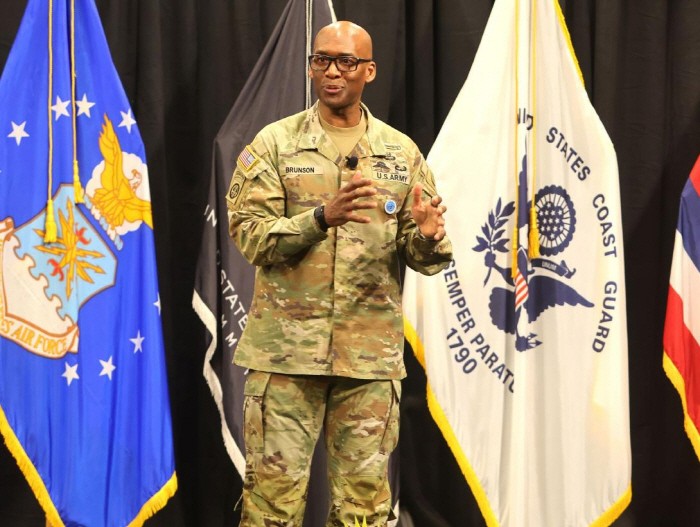 |
| Gen. Xavier T. Brunson, commander of U.S. Forces Korea (USFK), delivers a keynote address at AFCEA International's TechNet Indo-Pacific 2026 in Honolulu, Hawaii, on Oct. 27 (local time). / Screenshot from AFCEA website |
[Article Summary]
1. Gen. Xavier T. Brunson, commander of USFK, said combined military systems on the Korean Peninsula frequently encounter problems, attributing them not to a lack of willingness to cooperate but to shortcomings in human, procedural and technical interoperability.
2. Brunson emphasized the need for data-centric security systems that would allow missile information detected by South Korean radars to be shared within milliseconds, as well as an allied "kill web" connecting intelligence, surveillance and reconnaissance assets, command-and-control systems and strike capabilities.
3. The U.S. Army demonstrated real-time integration of firepower through a combined communications network with Japanese and Australian forces. Meanwhile, the U.S. Air Force has rotationally deployed F-22 and F-15C fighter jets to Japan, while the U.S. Marine Corps is operating MQ-9A drones in the Philippines.
Gen. Xavier T. Brunson, commander of U.S. Forces Korea, said combined military systems on the Korean Peninsula frequently encounter problems due to shortcomings in human, procedural and technical interoperability during a keynote address at AFCEA International's TechNet Indo-Pacific 2026 in Honolulu, Hawaii, on Oct. 27 (local time).
He stressed the need to improve security systems so that missile information detected by South Korean forces can be shared with U.S. forces in real time. Declaring that "the era of going it alone is over," he also called for the establishment of a "kill web" linking the intelligence, surveillance, command-and-control and strike systems of Indo-Pacific allies.
Brunson cites frequent problems in combined systems on Korean Peninsula, blames interoperability gaps rather than lack of cooperation
Brunson, who also commands United Nations Command (UNC) and Combined Forces Command (CFC), specifically highlighted problems involving information sharing and system integration in combined South Korea-U.S. operations.
"When combined systems break down — and to be clear, there are many such breakdowns on the Korean Peninsula — most of the time, it is not because of a lack of willingness to cooperate," he said. "These breakdowns occur because of insufficient interoperability at the human, procedural and technical levels."
Brunson pointed to the difficulties faced by the closely allied South Korean and U.S. militaries when personnel in the same joint operations center must make the same operational decisions despite viewing different information on their screens.
He emphasized that even delays caused by a staff officer manually transferring radar tracking information into a chat window on a U.S. communications network were unacceptable. In particular, he said that when a South Korean radar detects an incoming missile, the tracking data must be validated, processed and transmitted to the combined fires network within milliseconds.
"'Katchi Kapshida' ('We go together') is not just a bumper sticker slogan. It is an operational necessity," Brunson said, stressing that allied forces must accelerate the sharing of information and their response to threats.
He argued that addressing these problems would require fundamental changes in how military systems are designed. The traditional approach of developing sophisticated systems exclusively for U.S. use and adding connections for allies only after contracts have been signed cannot meet the requirements of combined operations.
"We must design for coalition operations from the first line of code," Brunson said.
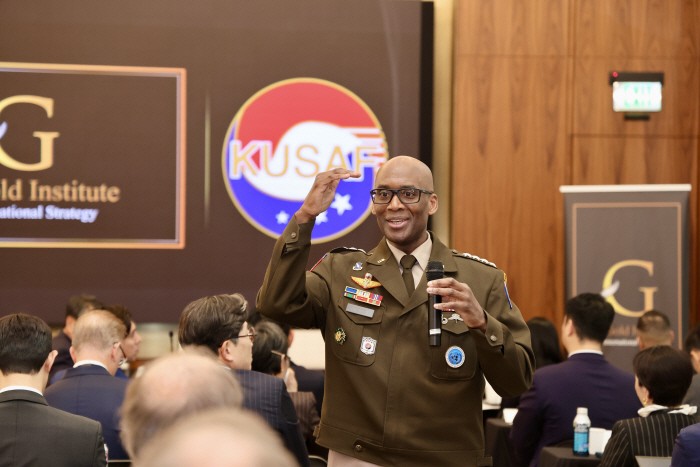 |
| Gen. Xavier T. Brunson, commander of U.S. Forces Korea (USFK), speaks at the Indo-Pacific Summit jointly hosted by the Gold Institute (GI) and the Korea-U.S. Alliance Foundation in Washington, D.C., on Oct. 14 (local time). / Photo by Ha Man-joo, Washington Correspondent |
Brunson says data sovereignty and information sharing are mutually reinforcing
Brunson identified traditional security systems built around closed networks as another obstacle to information sharing among allies.
He noted that for more than 30 years, military information security had centered on closed networks designed to block external access and perimeter-based defenses. Under this approach, sharing information with allies requires connecting or establishing separate communications networks, making rapid information exchange difficult.
Brunson said closed networks restrict information sharing among allied forces and create operational information gaps, emphasizing the need to "shift from network-centric perimeter security to data-centric security."
"Tag the payload, not the pipe," he said. The idea is to assign security classifications and access conditions to individual pieces of data rather than segregating entire communications networks, allowing allied forces to share information more quickly.
Brunson stressed that such information sharing does not conflict with individual nations' data sovereignty.
"National data sovereignty and allied data sharing are not competing priorities. They reinforce each other," he said. "South Korea, like the United States, has sovereign information and data that it must protect."
However, he emphasized that "withholding data until a crisis has passed is not the solution," calling for national information protection to be pursued alongside the sharing of information necessary for combined operations.
"Today, I declare that the era of going it alone is over," Brunson said, stressing that interoperability among allies is no longer merely a technical convenience or a secondary concern, but an essential requirement for achieving information superiority.
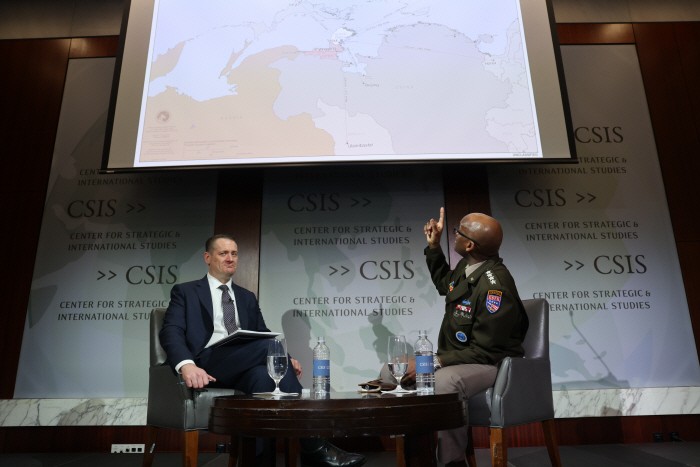 |
| Gen. Xavier T. Brunson, commander of U.S. Forces Korea (USFK) (right), points to a map highlighting South Korea's strategic importance during a discussion at the Center for Strategic and International Studies (CSIS) in Washington, D.C., on Oct. 13 (local time). / Photo by Ha Man-joo, Washington Correspondent |
Brunson warns of daily electronic attacks on Korean Peninsula, calls for more resilient communications networks
Brunson also emphasized the urgency of improving allied communications networks, citing the electronic warfare environment on the Korean Peninsula.
He described the Korean Peninsula as one of the world's most heavily contested regions in the electromagnetic spectrum, saying, "Our adversaries practice electronic attacks every single day," according to a report by U.S. defense outlet Breaking Defense on Oct. 28. He added that adversaries "jam GPS signals in the Yellow Sea and attempt to disable our servers, sensors and networks."
Brunson warned that "equipment relying on perfect satellite communications, unlimited bandwidth and uninterrupted fiber-optic backbone networks would not survive 48 hours on the Korean Peninsula."
He emphasized the need for redundant communications capabilities to maintain command and control even if major networks are disabled by enemy electronic attacks. USFK is developing high-frequency (HF) communications networks, low Earth orbit satellite communications and terrestrial mesh networks for this purpose, he explained.
Brunson also called on the defense industry to develop technologies that would improve the survivability of these communications networks. In particular, he urged the development of jam-resistant communications technologies that are less likely to be detected or intercepted by adversaries. He also called for open application programming interfaces (APIs) and forward-deployed sensors that can connect to coalition mission networks without relying on proprietary technologies controlled by individual vendors.
Brunson calls for reducing kill chain to milliseconds, highlights strategic triangle of Seoul, Tokyo and Manila
Brunson linked interoperability challenges on the Korean Peninsula to the broader need for information integration among Indo-Pacific allies.
"Time is decisive in modern warfare, and time makes the difference between life and death," he said, emphasizing the need to shorten the kill chain, from target detection to engagement, from hours or minutes to milliseconds.
A kill web is a system that connects multiple intelligence and surveillance assets, command-and-control systems and weapons systems through a network, enabling them to share targeting information and select appropriate strike capabilities according to the situation.
Referring to a map of the Indo-Pacific, Brunson identified Vladivostok in Russia, Beijing in China and Pyongyang in North Korea. He then highlighted a "strategic triangle" formed by Seoul, Tokyo and Manila, the capitals of South Korea, Japan and the Philippines, which have mutual defense treaties with the United States, emphasizing South Korea's geopolitical advantages.
He noted that across the Demilitarized Zone (DMZ) lies a nuclear-armed adversary that has constitutionally designated South Korea as its principal enemy, saying, "There is no 10-minute luxury in the Korean theater of operations."
Brunson also emphasized that artificial intelligence (AI) and superintelligence (SI) should not replace commanders' judgment and that humans must remain involved in the decision-making process, according to an Oct. 27 report by SIGNAL Media, AFCEA's official publication.
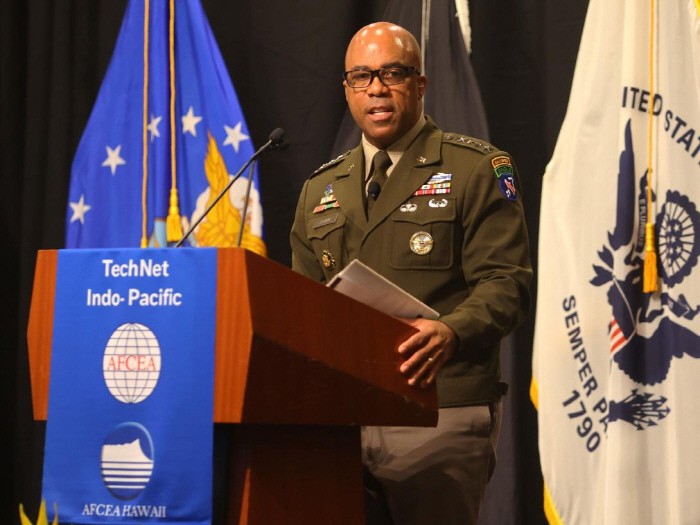 |
| Gen. Ronald Clark, commanding general of U.S. Army Pacific (USARPAC), delivers a keynote address at AFCEA International's TechNet Indo-Pacific 2026 in Honolulu, Hawaii, on Oct. 27 (local time). / Screenshot from AFCEA website |
U.S., Japanese and Australian forces integrate firepower in real time through allied network
The same AFCEA event also showcased a practical example of improved communications interoperability among allied forces.
Gen. Ronald Clark, commanding general of U.S. Army Pacific, announced on Oct. 27 that U.S., Japanese and Australian forces had operated the PACOM Mission Network (PMN) during the combined military exercise Yama Sakura 91.
PMN is a multilayered, resilient mesh network that enables the three countries' forces to share targeting-quality data in real time.
On the fifth day of the nine-day exercise, the three countries' forces achieved real-time combined fires integration and optimized the digital kill chain. On the sixth day, they generated 200 digital fire messages.
Clark emphasized that a redundant, zero-trust security architecture could shorten the kill chain from hours to seconds.
He recalled that just two years earlier, participating forces had been forced to pass a radio microphone back and forth to communicate by voice because their communications systems were incompatible.
"You cannot surge trust in a crisis," Clark said.
The presentation did not indicate that South Korea or the Philippines had participated in PMN during the exercise.
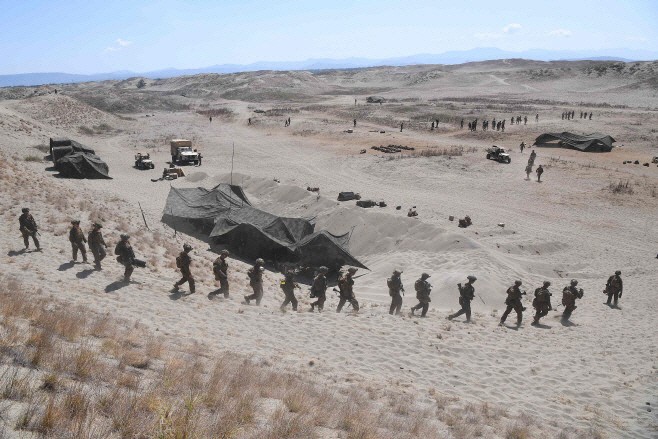 |
| U.S. Marines walk down a sand dune after conducting a live-fire exercise against a simulated "invasion force" during Balikatan, the annual joint military exercise between the United States and the Philippines, in Laoag on the northwestern coast of Luzon Island, Philippines, on May 6, 2024 (local time). / AFP-Yonhap |
U.S. Air Force rotates F-22 fighters into Japan
The U.S. military is operating air combat and surveillance assets in Japan and the Philippines, two countries that Brunson identified as part of a strategic triangle.
Air & Space Forces Magazine reported on Oct. 28 that F-22 Raptor fighters from the 525th Expeditionary Fighter Squadron, based at Joint Base Elmendorf-Richardson in Alaska, and F-15C Eagle fighters from the 122nd Expeditionary Fighter Squadron, based at Naval Air Station Joint Reserve Base New Orleans in Louisiana, had been rotationally deployed to Kadena Air Base in Okinawa, Japan.
Kadena is the closest U.S. Air Force base to Taiwan. The U.S. Air Force plans to retire its aging F-15C/D fighters and begin deploying 36 F-15EX Eagle II fighters in phases starting in fiscal 2027.
The rotational deployments of F-22 and F-15C fighters are intended to maintain air combat capabilities during the transition to the new aircraft.
In the Philippines, a detachment of the U.S. Marine Corps' Marine Unmanned Aerial Vehicle Squadron 1 (VMU-1) is operating MQ-9A Reaper drones from Antonio Bautista Air Base in Puerto Princesa, Palawan Province, USNI News reported on Oct. 28.
VMU-1 has deployed drones to the Philippines since 2024 at the request of the Philippine government. The Palawan detachment represents an expansion of its existing operational bases. The MQ-9A can monitor Chinese military activities in the South China Sea.
Ben Lewis, founder of the independent research organization PLA Tracker, explained that launching drones from Palawan rather than Basa Air Base on Luzon Island reduces the flight distance to Second Thomas Shoal from more than 400 nautical miles (741 kilometers) to less than 200 nautical miles (370 kilometers). This could increase the time the drones can remain over the target area by approximately three hours per sortie.
Ryan Claffey, a researcher at the Center for a New American Security (CNAS), a U.S. think tank, assessed that the Marine Corps' drone deployment to Palawan demonstrates Washington's commitment to supporting the Philippines in the South China Sea. He predicted that the United States would expand intelligence sharing and joint patrols with the Philippines and increase deployments of long-range missiles.
Ha Man-joo
Most Read
-
1
Putin proposes trilateral U.S.-China-Russia summit..

-
2
Attention centers on APEC for possible Trump-Xi-Pu..

-
3
U.S., Israel plan to resume strikes on Iran after..

-
4
China tightens grip on boosting domestic demand an..

-
5
China's fifth plenum to conclude amid expectations..

-
6
Amid health rumors, Chinese President Xi Jinping i..

-
7
ASEAN to discuss Myanmar's return next month

PEOPLE







-
Address : In-Young Bldg., 34, Uisadang-daero 1-gil, Yeongdeungpo-gu, Seoul
Copyright by ASIATODAY CO., LTD. All rights resereved