



U.S. sanctions 10 people, one entity over N. Korean IT schemes
Oct 29, 2026, 10:13 am


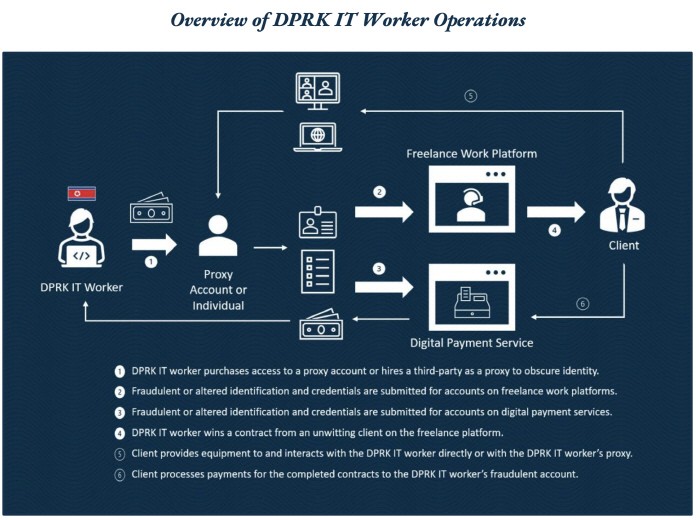 |
| A diagram released by the U.S. Treasury Department illustrates how North Korean information technology (IT) workers obtain jobs under false identities and receive payments. The workers conceal their identities through proxy accounts or third parties and use forged or altered identification documents and credentials to create accounts on freelance job platforms and digital payment services. They then enter into contracts with unsuspecting clients, receive equipment and perform work before collecting payments through accounts registered under false identities. / Screenshot from U.S. Treasury Department materials |
[Article Summary]
1. The U.S. Treasury Department imposed additional sanctions on 10 individuals and one entity involved in fraudulent employment schemes by North Korean IT workers and fundraising for illicit weapons development.
2. Russian national Voikov exchanged and converted $3.5 million in cryptocurrency for a North Korean IT organization, while six IT workers affiliated with a North Korean-controlled organization generated more than $750,000.
3. As the United States, Australia and the European Union (EU) imposed sanctions on North Korea's illicit revenue networks and North Korea-Russia cooperation, 11 countries, including South Korea, the United States and Japan, along with the EU, reaffirmed their commitment to North Korea's denuclearization.
4. President Donald Trump wants to resume dialogue with North Korea but has played down the possibility of meeting North Korean leader Kim Jong-un in China next month, Reuters reported.
The U.S. Treasury Department's Office of Foreign Assets Control (OFAC) imposed additional sanctions on 10 North Korean and Russian nationals and one entity on Oct. 28 (local time) for their involvement in fraudulent employment schemes involving North Korean information technology (IT) workers and efforts to raise funds for illicit weapons development. North Korea placed IT workers at companies in the United States and allied countries under false identities, then collected most of their wages and used hundreds of millions of dollars to finance the development of weapons of mass destruction (WMD) and ballistic missiles, according to the Treasury Department.
In a joint statement issued the same day, the 11 countries participating in the Multilateral Sanctions Monitoring Team (MSMT), including South Korea, the United States and Japan, along with the European Union (EU), announced additional sanctions against North Korea by the United States, Australia and the EU and called for denuclearization and compliance with United Nations Security Council resolutions.
U.S. Treasury sanctions eight North Koreans, two Russians; Bessent condemns weaponization of sensitive data
OFAC designated eight North Korean nationals, two Russian nationals and one North Korean-controlled entity for sanctions. North Korea used forged documents, stolen identities and fictitious personas to place IT workers at companies in the United States and allied countries. The networks generated and transferred millions of dollars through cryptocurrency transactions, money laundering and artificial intelligence (AI) tools. The IT workers also installed malware on corporate networks to steal sensitive data and proprietary information, according to the Treasury Department.
Treasury Secretary Scott Bessent criticized the North Korean regime, saying it was exploiting American companies through fraudulent activities by overseas IT operatives and weaponizing sensitive data to extort substantial sums of money. He emphasized that the United States would use every available tool to protect American businesses and hold those responsible accountable.
Under the sanctions, all property and interests in property belonging to the designated individuals and entities that are located in the United States or held or controlled by U.S. persons are blocked and must be reported to OFAC. The asset freeze also applies to entities owned 50% or more, directly or indirectly, individually or in the aggregate, by one or more blocked persons. Foreign nationals may also face penalties if they cause U.S. persons to violate sanctions or engage in sanctions evasion. Financial institutions may likewise face sanctions risks if they engage in transactions involving designated parties. The Treasury Department said the latest action followed its March 12 sanctions against a separate North Korean IT network.
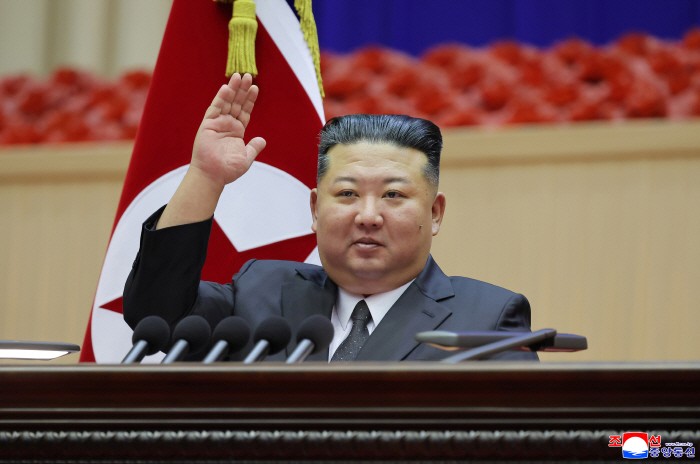 |
| North Korean leader Kim Jong-un presided over the Korean People's Army's Third Conference of Company Commanders in Pyongyang on Oct. 22 and 23 and delivered a speech titled "Building a Strong Army in the New Era and the Duties of Company Commanders," the Korean Central News Agency (KCNA) reported on Oct. 24. / KCNA-Yonhap |
Four North Korean and Russian facilitators support IT revenue network through cryptocurrency exchanges and fund transfers
Russian national Ilya Aleksandrovich Voikov supported Alis, a company linked to North Korean IT workers, by exchanging and converting $3.5 million (approximately 4.7 billion won) in cryptocurrency and monitoring transactions since 2024.
Another Russian national, Vitold Viktorovich Obertas, exchanged nearly $2 million (approximately 2.69 billion won) in cryptocurrency for North Korean officials and processed at least $1.25 million (approximately 1.68 billion won) in transactions involving other currencies since January 2025. He also facilitated transactions for the Amnokgang Technology Development Company, which was sanctioned in March.
North Korean national Kim Ki-hyok led a delegation of North Korean IT workers associated with Alis operating in Russia and oversaw efforts to meet revenue targets. He transferred nearly $500,000 (approximately 672 million won) in cryptocurrency since 2024. Kim Hyo-dong supported logistics and sanctions evasion activities for a separate delegation under Jinyong Information Technology Cooperation Company and facilitated transfers of more than $100,000 (approximately 134 million won) in financial assets. The Office of Foreign Assets Control (OFAC) sanctioned the four individuals under Executive Order 13687 for supporting the North Korean government or sanctioned companies.
North Korean-controlled financial technology center uses superintelligence tools; six IT workers generate $750,000
The First Financial Technology Development Center (FFTDC), which was designated for sanctions, is a North Korean-controlled organization established in January 2024 and based in Vladivostok, Russia. According to the Treasury Department, the organization has used North Korean IT workers to generate millions of dollars for the North Korean regime since at least 2024.
FFTDC dispatched highly trained IT workers to Russia, where they used Super Intelligence (SI) tools and sophisticated money laundering methods, including complex cryptocurrency transfers. Six North Korean nationals affiliated with the organization — Kim Kyong-ju, Ri Tae-chol, So Hyong-jin, Han Yu-song, Kim Song-gwan and Hyon Se-il — generated more than $750,000 (approximately 1.01 billion won) in revenue since 2025. OFAC sanctioned FFTDC for its involvement in deploying North Korean workers overseas and the six IT workers who supported it under Executive Order 13722.
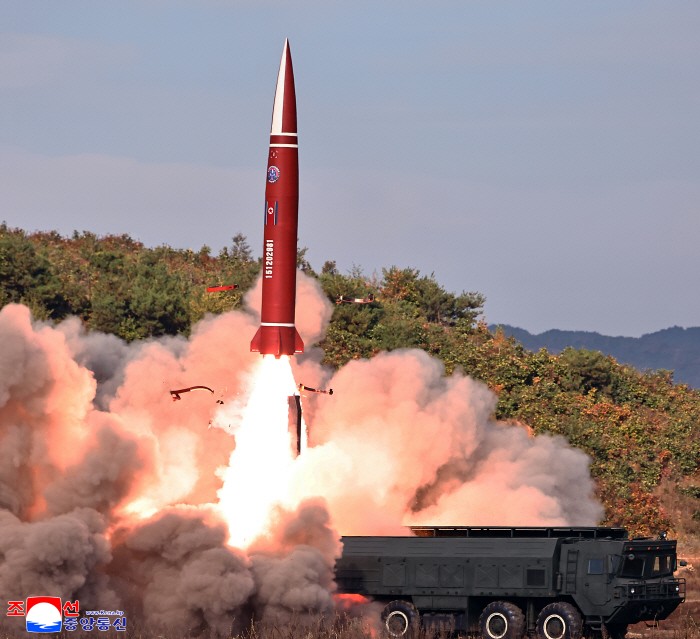 |
| North Korea announced that it had conducted a tactical ballistic missile test launch on Oct. 12. The Korean Central News Agency (KCNA) reported on Oct. 13 that "the Missile Administration conducted a test launch of a tactical ballistic missile on Oct. 12 to verify the results of technological upgrades to key components." / KCNA-Yonhap |
Most Read
-
1
Putin proposes trilateral U.S.-China-Russia summit..

-
2
U.S. weighs dropping MOAB, world's most powerful n..

-
3
Attention centers on APEC for possible Trump-Xi-Pu..

-
4
U.S., Israel plan to resume strikes on Iran after..

-
5
China tightens grip on boosting domestic demand an..

-
6
Amid health rumors, Chinese President Xi Jinping i..

-
7
ASEAN to discuss Myanmar's return next month

PEOPLE






-
Address : In-Young Bldg., 34, Uisadang-daero 1-gil, Yeongdeungpo-gu, Seoul
Copyright by ASIATODAY CO., LTD. All rights resereved