



U.S. Fed holds rates at 3.75–4.00%
Oct 29, 2026, 09:50 am


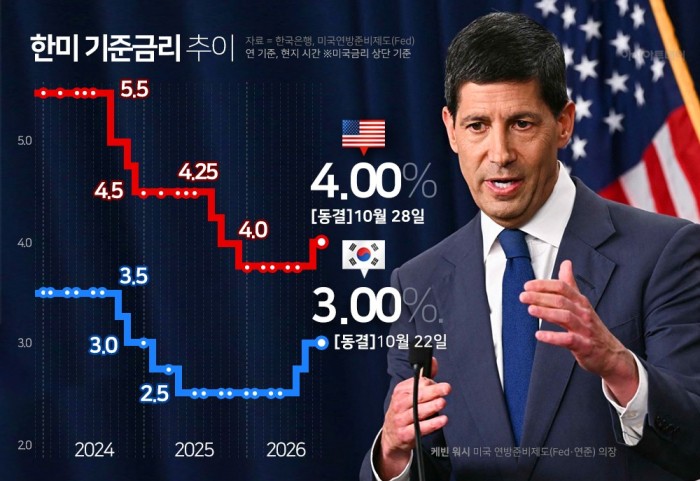 |
| Sources: Bank of Korea, U.S. Federal Reserve and Yonhap News Agency / Graphic by Park Jong-kyu |
[Article Summary]
1. The U.S. Federal Reserve held its benchmark interest rate steady at 3.75–4.00%. Two of the 12 voting members called for a 0.25-percentage-point increase.
2. As rising energy prices driven by the war in Iran and expanding AI investment fueled inflation, the Fed reaffirmed its commitment to bringing inflation under control.
3. Six days before the midterm elections, Fed Chair Kevin Warsh denied any political influence on the decision. The probability of a December rate hike rose to 85%.
4. The Fed decided to reduce the number of interest rate votes to seven in 2027 and six in 2028.
The U.S. Federal Reserve held its benchmark interest rate steady at 3.75–4.00% on Oct. 28 (local time). Amid mounting inflationary pressures from soaring energy prices caused by the war in Iran and a boom in artificial intelligence (AI) investment, two of the 12 Federal Open Market Committee (FOMC) members called for another rate hike. Following the decision, made six days before the Nov. 3 midterm elections, the market-implied probability of a December rate hike rose to 85%.
Fed holds rates in 10-2 vote, says inflation remains elevated
The Fed voted 10-2 to hold interest rates steady at its two-day FOMC meeting that ended Wednesday. Fed Governor Lisa Cook and Cleveland Federal Reserve Bank President Beth Hammack called for an additional 0.25-percentage-point increase. Cook's dissent was her first in more than four years on the FOMC, while Hammack had also called for a rate hike in July, The Wall Street Journal (WSJ) reported.
In its statement, the Fed said economic activity was "expanding at a strong pace," offering a positive assessment of domestic spending, productivity growth and capital investment. It said job growth was keeping pace with labor force growth and that the unemployment rate had changed little. However, the Fed stressed that "inflation remains elevated" and said it would use additional economic data to determine the appropriate policy stance to bring inflation back to its 2% target.
Bloomberg reported that the Fed had upgraded its assessment of economic activity from "solid" at its previous meeting to "a strong pace" this time. The Fed cut interest rates three times in 2024, in September, November and December, and another three times last year, in September, October and December. This year, it held rates steady for five consecutive meetings before raising them last month for the first time in three years and two months, shifting toward monetary tightening. The WSJ reported that most Fed officials had expected at least one additional rate hike this year when they met in September.
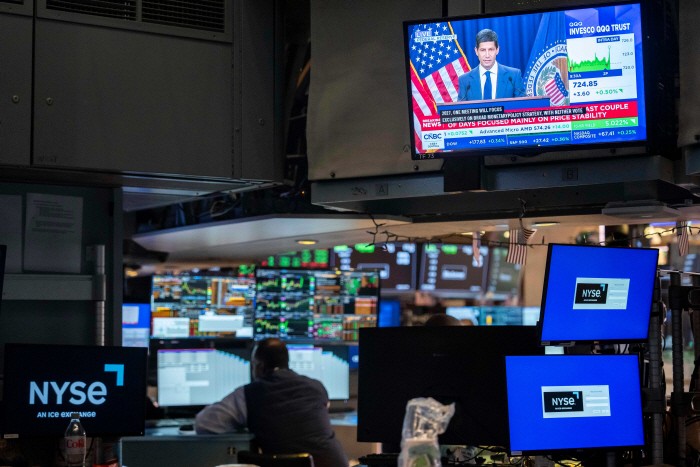 |
| A screen on the trading floor of the New York Stock Exchange (NYSE) in New York shows a news conference by Federal Reserve Chair Kevin Warsh on Oct. 28 (local time). / AP, Yonhap |
Iran war and AI investment boom fuel inflation pressures
The Financial Times (FT) reported that soaring gasoline and diesel prices driven by the war in Iran, along with expanding AI investment, were accelerating inflation.
The latest reading of the personal consumption expenditures (PCE) price index, the Fed's preferred inflation gauge, showed an inflation rate of 3.4%. The FT expected the September figures, scheduled for release on Oct. 29, to show a further increase. Bloomberg reported that September's consumer price index (CPI) inflation rate had reached a five-month high, with price pressures spreading across goods and services.
At a news conference, Fed Chair Kevin Warsh said, "Bringing inflation down is our responsibility," stressing that the Fed would prevent recent energy price increases from spreading to prices across the broader economy. He said the Fed was "prepared to act as circumstances require," but did not specify the conditions or timing for another rate hike. He also said the Fed would continue its "new monetary medicine" to bring inflation under control after more than five years above its target. He emphasized that the Fed would not accept an inflation rate in the 2% range as its new target.
The Wall Street Journal (WSJ) reported that massive AI investment in data centers, semiconductors and power infrastructure was boosting both economic growth and inflationary pressures. Warsh rejected the argument that AI companies were insulated from interest rate increases because of their substantial cash reserves and intense investment competition, saying, "Interest rates affect almost everything, directly or indirectly." He said financial conditions had tightened compared with earlier periods but stopped short of describing them as restrictive overall.
Former Dallas Federal Reserve Bank President Robert Kaplan warned that a prolonged supply shock could no longer be considered temporary. He explained that the Fed could reduce demand to slow the spread of rising diesel prices to other goods, according to the WSJ.
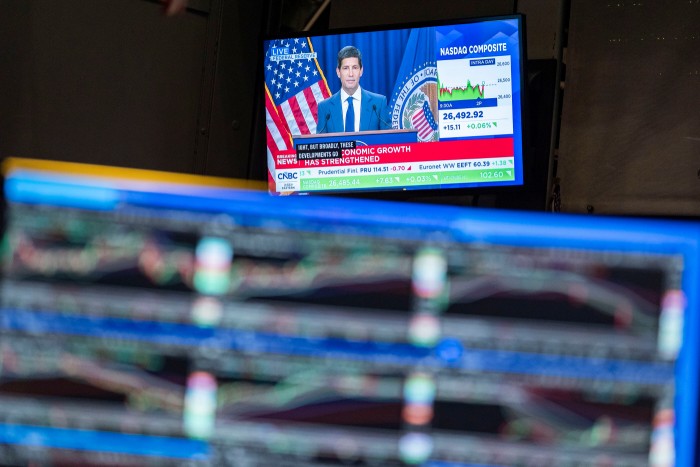 |
| A screen displays a news conference by Federal Reserve Board Chairman Kevin Warsh on the floor of the New York Stock Exchange, Wednesday, Oct. 28, 2026, in New York. (AP Photo/Yuki Iwamura) |
Fed holds rates six days before midterms despite Trump's calls for cuts
President Donald Trump has repeatedly called on the Fed to sharply cut interest rates. However, the Fed raised rates last month and declined to cut them again this time. Fed Chair Kevin Warsh stressed that "politics played no role in this decision." The Financial Times (FT) reported that some economists had pointed to the political pressure the Fed would face if it raised rates immediately before the midterm elections.
The Wall Street Journal (WSJ) noted that the Fed had also raised rates shortly before an election in 2022, but that move had been well telegraphed to markets. It said an unexpected rate hike this time could have exposed the Fed to political controversy. Bloomberg reported that Democrats were likely to win a majority in the House of Representatives and were also leading in polls in several key Senate battlegrounds.
Fed Governor Lisa Cook has been fighting Trump's attempt to remove her over allegations of mortgage fraud since August last year. Cook has denied the allegations, and the Supreme Court allowed her to remain in office while litigation continued in June. The White House had planned a related hearing for early November, but Cook's representatives said she would be unable to attend because of overseas travel on Fed business, according to the WSJ.
December rate hike probability rises to 85%
According to the FT, the probability of a December rate hike implied by CME Group's federal funds futures rose from 78% the previous day to 85% following the Oct. 28 meeting. The yield on two-year U.S. Treasury notes fell 0.04 percentage points to 4.7%. Bloomberg reported that markets maintained expectations of a December rate hike while lowering expectations for additional increases in 2027.
The probability of another rate hike in October, which had exceeded 70% immediately after September's increase, fell below 30% following cautious remarks from other Fed officials. It dropped to less than 10% before Wednesday's meeting.
Kay Haigh, global co-head of fixed income at Goldman Sachs Asset Management, predicted that the Fed would resume raising rates in December, according to the FT. Former Fed economist Ricardo Trezzi estimated that the annualized pace of monthly core PCE inflation in September could reach 4% and criticized the decision to hold rates as overly accommodative. By contrast, former senior Fed economist William English said further rate hikes might be necessary but saw no reason to rush.
The WSJ reported that borrowing costs for households remained high despite the Fed's decision to hold rates steady, including rates on credit cards, auto loans and mortgages. Long-term Treasury yields fell last week as investors bought government bonds amid a sell-off in technology stocks, after reaching their highest levels in more than 20 years earlier this month.
The interest rate gap between South Korea, where the benchmark rate stands at 3.00%, and the United States remained at 1.00 percentage point based on the upper end of the U.S. target range. Markets are watching the September PCE price index and third-quarter gross domestic product (GDP) figures, both scheduled for release on Oct. 29. Economists expect third-quarter economic growth of 3.2% at an annualized rate, according to Bloomberg.
Fed to reduce interest rate votes to seven in 2027 and six in 2028
The Fed will maintain its eight regularly scheduled FOMC meetings each year but reduce the number of meetings with interest rate votes to seven in 2027 and six in 2028. At the remaining meetings, officials will discuss monetary policy strategy without voting on interest rates or issuing policy statements. The FT described the move as a departure from a practice dating back to 1981, when Paul Volcker chaired the Fed.
Warsh emphasized the need to assess short-term economic conditions regularly while also allowing time for deliberation on long-term strategy. The WSJ reported that the change would give officials more time to comprehensively review economic data but could delay monetary policy responses to rapidly changing economic conditions.
Ha Man-joo
Most Read
-
1
Putin proposes trilateral U.S.-China-Russia summit..

-
2
U.S. weighs dropping MOAB, world's most powerful n..

-
3
Attention centers on APEC for possible Trump-Xi-Pu..

-
4
U.S., Israel plan to resume strikes on Iran after..

-
5
China tightens grip on boosting domestic demand an..

-
6
Amid health rumors, Chinese President Xi Jinping i..

-
7
ASEAN to discuss Myanmar's return next month

PEOPLE







-
Address : In-Young Bldg., 34, Uisadang-daero 1-gil, Yeongdeungpo-gu, Seoul
Copyright by ASIATODAY CO., LTD. All rights resereved