



Le Pen's presidential bid shakes up France
Oct 26, 2026, 10:23 am


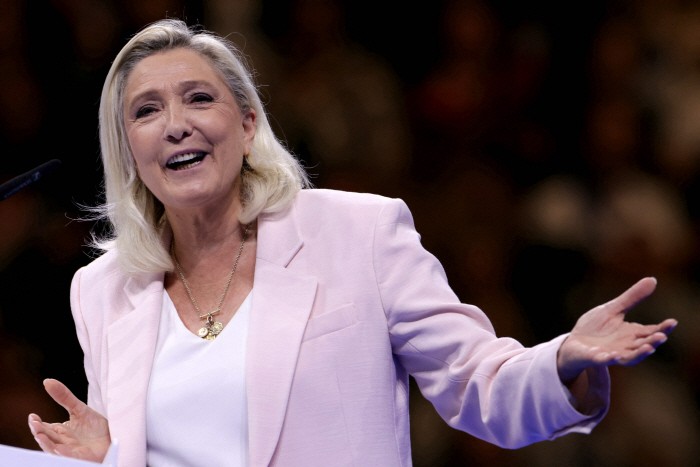 |
| Marine Le Pen, the far-right National Rally (RN) party's candidate for France's 2027 presidential election, delivers a speech at a party congress and presidential campaign launch event in Orléans, central France, on Oct. 25 (local time). / AFP, Yonhap |
[Article summary]
1. The eurozone's composite Purchasing Managers' Index (PMI) fell to 51.9 in October amid weakness in France's services sector, while yields on French government bonds surpassed 5% for the first time in 24 years.
2. Far-right leader Marine Le Pen formally launched her presidential campaign and maintained her lead in opinion polls, but tensions between her spending cuts, tax reductions and pension pledges have emerged as a key issue.
3. France's fiscal instability has spilled over into the selection of the next European Central Bank (ECB) president, with crisis management capabilities and conditions for intervention in government bond markets emerging as key considerations.
Marine Le Pen, 58, the far-right National Rally (RN) party's presidential candidate, formally launched her campaign for next year's French presidential election in Orléans on Oct. 25 (local time). Her announcement came as France's fiscal and political instability weighed on eurozone business activity in October and pushed yields on French 10-year government bonds to their highest level in 24 years. With high debt, sluggish growth and political deadlock over fiscal reforms putting pressure on the European economy, crisis management capabilities have also emerged as a key factor in the European Central Bank's (ECB) monetary policy and the selection of its next president.
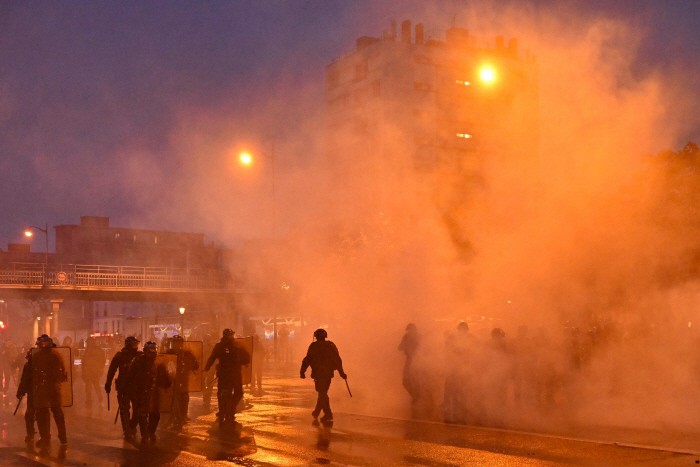 |
| French police confront protesters demanding greater purchasing power, protection of public services, and tax and social justice near Porte de Vincennes in Paris on Oct. 24 (local time). Participants in nationwide demonstrations that day included former Yellow Vest movement protesters, labor union members, and high school and university students. The French government deployed approximately 70,000 security personnel amid concerns over possible violence and looting. / AFP, Yonhap |
French 10-year bond yield tops 5% for first time in 24 years
France's 10-year government bond yield briefly exceeded 5% last week for the first time since 2002 and reached a 24-year high on Oct. 22. The yield spread between French and German 10-year government bonds, known as le spread in France, also widened to approximately 1.5 percentage points, its highest level since the 2012 eurozone debt crisis.
The Wall Street Journal (WSJ) reported that France has emerged as the biggest casualty of the global rise in government bond yields. As strong U.S. economic performance pushed inflation and interest rates higher, investors began identifying countries and companies vulnerable to rising borrowing costs. France, which had accumulated substantial debt during an era of ultra-low interest rates, came under scrutiny. Although U.S. Treasury yields fell sharply last week, French government bond yields failed to follow suit.
According to the International Monetary Fund's (IMF) 2026 projections, France's net debt-to-GDP ratio stands at 111.28%, its fiscal deficit at 5.35% of GDP, and its nominal growth rate at 2.15%. Although France's net debt ratio is lower than those of Italy and Japan, its fiscal deficit is higher than those of Germany, Britain and Italy. Its nominal growth rate is the lowest among the Group of Seven (G7) countries. France's gross public debt amounts to approximately 120% of GDP, according to Britain's Financial Times (FT).
The WSJ projected that France would continue to run an annual fiscal deficit equivalent to approximately 5% of GDP, while nominal economic growth would reach no more than 3%. It explained that the country's interest burden continues to rise as government bonds issued during the ultra-low interest rate era mature and are refinanced through new bonds carrying higher yields.
The problem is that reaching political agreement on fiscal reform remains difficult. The WSJ reported that France is approaching a fiscal limit on its ability to increase tax revenue through higher taxes, while also facing political constraints as voters reject both tax increases and spending cuts. Government revenue, including taxes, amounts to approximately 52% of GDP, higher than in any other advanced economy except Norway and Finland. Government spending also stands at 57.3% of GDP, among the highest levels in the Western world alongside Finland, according to the FT.
The WSJ emphasized that France needs to develop a credible medium-term plan to reduce its fiscal deficit to ease concerns in the government bond market. Jean Tirole, a professor at the Toulouse School of Economics and the 2014 Nobel laureate in economics, said financial markets are concerned that the government is failing to take action to address the fiscal crisis.
Tirole argued that painful preventive measures aimed at achieving a balanced budget would be the best course of action. He warned that allowing large fiscal deficits to persist could lead to a financial crisis, forcing France to adopt austerity measures like Greece or risk defaulting on its debt like Argentina. He also said that if France chose to default, it might have to leave the eurozone and return to the French franc. He added that he did not believe Germany would be willing to support France's persistent fiscal deficits and relatively low retirement age.
However, the WSJ assessed that France has not yet entered a financial crisis. During the 2012 eurozone debt crisis, the yield spread between Italian and German government bonds widened to as much as 5.5 percentage points. The WSJ noted that Europe's crisis management mechanisms have improved since then and suggested that the European Central Bank (ECB) could begin purchasing French government bonds before market turmoil becomes severe. Because France cannot issue euros independently, it would need support from the ECB if its fiscal crisis deepens.
 |
| Major stores in central Paris, including Boucheron, Uniqlo, Chopard, Louis Vuitton, Foot Locker and Longchamp, are seen closed with their entrances and display windows boarded up on Oct. 24 (local time) ahead of nationwide protests. / AFP, Yonhap |
Eurozone composite PMI falls to 51.9 in October
France's economic weakness was also reflected in eurozone business activity indicators. The eurozone's composite Purchasing Managers' Index (PMI), compiled by S&P Global, fell to 51.9 in October from 53.1 in September. The reading was also below the market forecast of 52.7 reported by Bloomberg on Oct. 23.
The index remained above the 50-point threshold separating expansion from contraction, indicating that the private sector continued to expand overall. However, weakness in France caused the pace of expansion to slow much more sharply than expected. The detailed October readings were 51.89 for the composite PMI, 52.43 for manufacturing and 51.72 for services.
Chris Williamson, chief business economist at S&P Global Market Intelligence, said that "a key drag on growth was a renewed drop in business activity in the French service sector," suggesting that strikes and unrest may have disrupted some local economies.
While France performed significantly worse than expected, Germany's PMI remained above 50 for a fourth consecutive month, supported by unexpectedly strong manufacturing activity.
The eurozone economy has continued to expand despite the war in Iran and surging energy prices. However, elevated commodity prices and tighter financial conditions are simultaneously weighing on business activity. The European Central Bank (ECB) has raised interest rates twice this year in response to inflation running above its target.
Williamson explained that companies were raising selling prices to protect their profit margins as input costs began rising sharply again. David Powell, senior eurozone economist at Bloomberg Economics, predicted that the dual shock of rising commodity prices and tighter financial conditions would prompt the ECB to hold interest rates steady in October, raise them once more in December and then end its monetary tightening cycle.
France is scheduled to release its preliminary third-quarter gross domestic product (GDP) figures on Oct. 30. Market analysts expect growth of just 0.1% in the third quarter, following zero growth in the second quarter. Credit rating agency Moody's maintained France's credit rating on Oct. 23 but warned that widespread protests could constrain efforts to restore fiscal discipline.
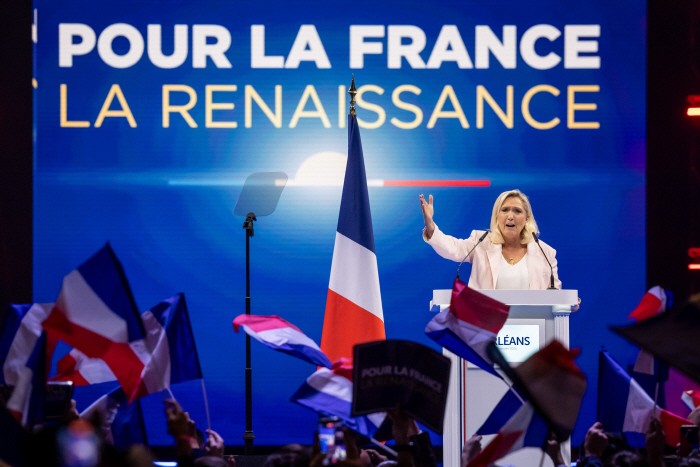 |
| Marine Le Pen, the far-right National Rally (RN) party's candidate for France's presidential election, delivers a speech at her presidential campaign launch at the Co'Met Arena in Orléans, central France, on Oct. 25 (local time). / EPA, Yonhap |
Le Pen vows to "restore rule of law"
France's political instability has coincided with far-right candidate Marine Le Pen's presidential campaign. Protests that began last month with high school students demanding better educational conditions have expanded amid growing dissatisfaction over rising living costs and deteriorating public services. Some demonstrators engaged in looting and arson during protests on Oct. 17.
France's Interior Ministry estimated that 410,000 people participated in nationwide demonstrations on Oct. 24. With the government deploying 70,000 police officers and other security personnel, the number of arrests fell to 1,314, roughly half the 2,628 recorded on Oct. 17. Protest groups and labor unions have announced further demonstrations for Oct. 31 and a nationwide strike for Nov. 5.
Le Pen formally launched her fourth presidential bid before approximately 8,500 supporters in Orléans, the city where Joan of Arc broke an English siege. "We will restore the rule of law," she declared. Addressing her political opponents, she said, "This is not the end of the world, but the end of their world."
Le Pen pledged to adopt a zero-tolerance approach to law enforcement, restore border controls and automatically deport foreign criminals. She also outlined plans for a national unity government with RN President Jordan Bardella as prime minister. "I am neither right nor left. I am a bird," she said, referring to the two wings of a bird, according to The Wall Street Journal (WSJ).
Le Pen could also face the possibility of campaigning while wearing an electronic ankle monitor if her conviction in a European Parliament funds embezzlement case is upheld on appeal. However, enforcement of her sentence has been suspended pending the outcome of her final appeal.
Le Pen continues to lead opinion polls, although her support levels and changes in those figures vary among polling organizations. An Ifop-Fiducial survey of 1,928 voters conducted from Oct. 17 to 19 put her projected first-round vote share at 36.0%.
Far-left politician Jean-Luc Mélenchon received 16.5%, center-left politician Raphaël Glucksmann 13.5%, and former Prime Minister Édouard Philippe 12.0%. Le Pen's support rose 2.0 percentage points from a survey conducted Oct. 12–14, before the protests intensified, while Philippe's fell 2.0 percentage points, according to German business newspaper Handelsblatt.
By contrast, an Ipsos survey of 1,500 adults conducted Oct. 21–22 put Le Pen's projected first-round vote share at 32–33.5%. The WSJ noted that the poll showed little change in her support before and after the unrest.
In a separate Odoxa-Backbone survey of 1,005 adults conducted Oct. 21–22, 47% of respondents identified Le Pen as a candidate capable of restoring order and preventing unrest. Bruno Retailleau followed at 29%, Philippe at 25%, Mélenchon at 19%, Glucksmann at 18% and Gabriel Attal at 17%.
However, even a presidential election victory would not automatically give Le Pen a parliamentary majority. The division of France's parliament among three rival political blocs could constrain the next government's ability to implement fiscal reforms.
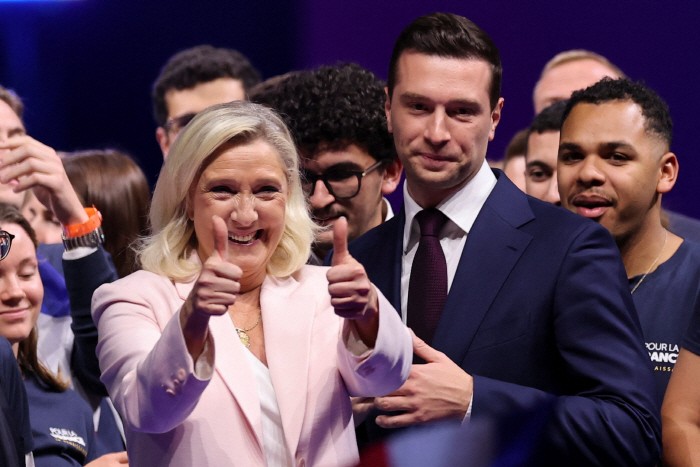 |
| Marine Le Pen (left), the far-right National Rally (RN) party's candidate for France's 2027 presidential election, and RN President Jordan Bardella attend a presidential campaign launch event following a party congress in Orléans, France, on Oct. 25 (local time). / Reuters, Yonhap |
Le Pen's economic platform combines fiscal austerity with tax cuts and increased spending. She has proposed cutting spending by €140 billion (approximately 20.8 trillion won) over the next five years and substantially reducing new borrowing. At the same time, she has pledged to lower the retirement age to 60 or 62, reversing President Emmanuel Macron's increase from 62 to 64, which was subsequently frozen. She has also promised to cut corporate taxes and inheritance taxes.
Eric Dor, a professor at France's IÉSEG School of Management, criticized Le Pen's fiscal plan, saying it systematically overestimated new tax revenues and spending savings while underestimating additional expenditures.
German business newspaper Handelsblatt reported that Le Pen's strategy of appealing to voters with differing political orientations has led to contradictions in her economic pledges. Janette Süß, a political scientist at the French Institute of International Relations (Ifri), warned that abandoning protectionist policies could make Le Pen appear overly liberal and progressive, potentially alienating her core supporters.
The composition of parliament also presents a major constraint. The Wall Street Journal (WSJ) and Financial Times (FT) reported that even if Le Pen wins the presidency, she could struggle to push through spending cuts or tax reforms without securing a parliamentary majority.
Potential fiscal disputes with the European Union pose another challenge. France is the EU's second-largest net contributor. Although Le Pen does not advocate leaving the bloc, she intends to reduce France's financial contributions, limit the powers of the European Commission and press the European Central Bank (ECB) to help finance large-scale borrowing, according to the FT.
Handelsblatt noted that a substantial reduction in France's EU contributions could lead to cuts in spending under the Common Agricultural Policy, which benefits French farmers.
Le Pen has also said she would end France's financial assistance to Ukraine within six months of taking office, arguing that the country can no longer afford the cost of such support.
The FT raised the possibility that Le Pen could adopt a more moderate approach after taking office, similar to Italian Prime Minister Giorgia Meloni. However, experts noted that differences in France's and Italy's financial interests within the EU and their political checks and balances make it difficult to expect a similar shift.
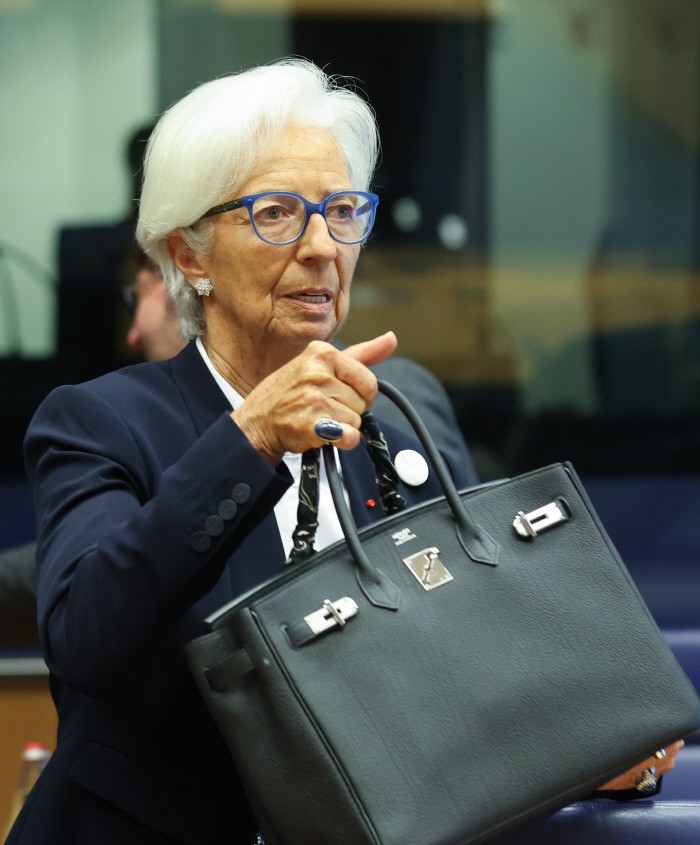 |
| European Central Bank (ECB) President Christine Lagarde attends a meeting of eurozone finance ministers, known as the Eurogroup, in Luxembourg on Oct. 8 (local time). European finance ministers discussed the macroeconomic situation, European capital market integration and the effectiveness of member states' fiscal policies. / EPA, Yonhap |
ECB succession race hinges on ability to tackle French bond crisis
France's fiscal instability is also influencing the selection of the next president of the European Central Bank (ECB). With ECB President Christine Lagarde having signaled the possibility of stepping down early, speculation is mounting within the eurozone that she could leave office in January next year, Bloomberg reported on Oct. 25. However, no departure date has been confirmed.
The leading candidates to succeed Lagarde are Klaas Knot, 59, former governor of the Dutch central bank, and Pablo Hernández de Cos, 54, general manager of the Bank for International Settlements (BIS). Either would become the youngest ECB president in the institution's history at the time of taking office. Bloomberg reported that turmoil in the French government bond market has prompted governments to place greater emphasis on candidates' crisis management capabilities and credibility, alongside their monetary policy preferences.
Both candidates have experience leading central banks and participating in ECB monetary policy decisions. Knot was previously known for favoring tighter monetary policy but adopted a more pragmatic approach during periods of crisis. Hernández de Cos is generally regarded as more dovish. However, some analysts believe there is little difference between their monetary policy views.
In a report published this month by the Peterson Institute for International Economics in the United States, Knot explained the ECB's Transmission Protection Instrument (TPI). He said the ECB had embraced the new crisis management tool because allowing financial fragmentation to disrupt monetary policy transmission or threaten the singleness of the euro would be incompatible with its price stability mandate.
Hernández de Cos also emphasized in a speech this month that central banks should intervene when market dysfunction threatens financial stability or monetary policy transmission. However, he warned that when government debt and public-sector financing needs are substantial, even well-designed interventions could be perceived as financial support for governments.
Differences among eurozone member states over ECB intervention in government bond markets will also pose a challenge for the next president. Bloomberg reported that France places greater emphasis on a willingness to actively deploy available policy tools during crises, while Germany and other countries that prioritize fiscal discipline demand strict conditions for intervention.
Peter Praet, former ECB chief economist, said, "When financial markets collapse, central banks have to intervene, but the question is how and how quickly." He emphasized the need for strict conditions to prevent monetary policy from becoming subordinate to government fiscal policy or undermining central bank independence.
Former ECB President Mario Draghi warned that an open debate within France over potential ECB support could actually make intervention more difficult. He said the ECB would not want to become involved in a particular country's internal political disputes.
If turmoil in the French government bond market intensifies, the ECB will have to balance market stability, fiscal discipline and central bank independence. Amid differences between France and Germany over the conditions for intervention, the next ECB president's crisis management capabilities and the criteria for intervention in government bond markets remain key issues.
Ha Man-joo
Most Read
-
1
Celltrion nears additional contract with major U.S..

-
2
Putin proposes trilateral U.S.-China-Russia summit..

-
3
U.S. weighs dropping MOAB, world's most powerful n..

-
4
"Aren't those foreigners on welfare?": M..

-
5
Attention centers on APEC for possible Trump-Xi-Pu..

-
6
U.S., Israel plan to resume strikes on Iran after..

-
7
Saudi Arabia, Iran hold first diplomatic talks to..

PEOPLE







-
Address : In-Young Bldg., 34, Uisadang-daero 1-gil, Yeongdeungpo-gu, Seoul
Copyright by ASIATODAY CO., LTD. All rights resereved