



S. Korea walks tightrope between U.S. and Iran with expanded naval operations
Nov 10, 2026, 09:37 am


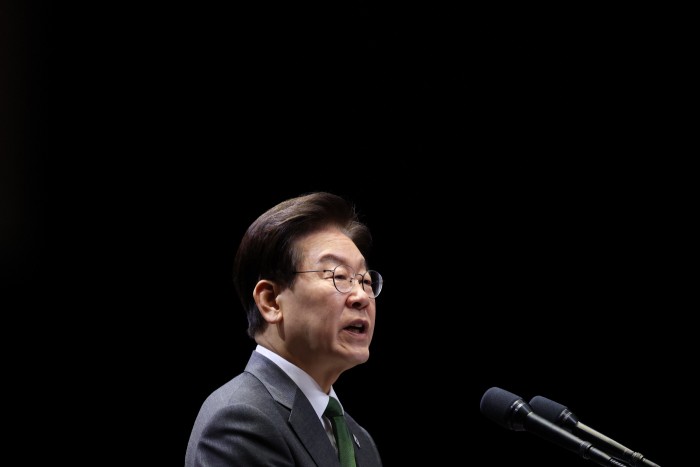 |
| South Korean President Lee Jae Myung delivers a commemorative address at a ceremony marking the 64th Firefighters' Day in Sejong on Nov. 9, 2026. /Yonhap |
South Korean President Lee Jae Myung faces a diplomatic challenge as his administration moves to expand the operational area of the Cheonghae naval unit while balancing maritime security cooperation with the United States and relations with Iran.
With Washington seeking greater contributions to maritime security, Seoul must respond to its ally's requests while maintaining its principle of non-involvement in the war. Attention is therefore turning to how the government will manage potential domestic and international controversy over the unit's expanded mission and operational scope.
According to government officials on Monday, a revised motion to extend the Cheonghae Unit's deployment and expand its operational area is awaiting Cabinet review.
The government plans to submit the motion to the National Assembly after Cabinet deliberation and approval, followed by presidential authorization.
The proposal would expand the unit's operational area from the Gulf of Aden off Somalia to the open waters south of Oman.
The expansion would roughly double the unit's existing operational range, extending it to the southern end of Oman's Port of Duqm, approximately 650 kilometers from the Strait of Hormuz.
The government maintains that the move is intended to protect South Korean nationals and vessels amid increasing pirate activity.
However, the addition of a mission to "support the restoration of freedom of navigation along international sea routes" has prompted speculation that the unit could also contribute to efforts to stabilize the Strait of Hormuz, as Washington has requested.
One security expert said, "Following his defeat in the midterm elections, President Trump may seek to offset domestic political constraints by achieving results in foreign and security policy."
Another key variable is how much the United States will expect its allies to contribute to maritime security.
Managing Iran's response will also be a challenge for Seoul.
Even if the Cheonghae Unit does not enter the Strait of Hormuz itself, increasing military assets in nearby waters could provoke objections from Tehran.
The South Korean government has emphasized that it will not become involved in the war and will maintain an independent chain of command.
It also plans to prohibit maritime patrol aircraft from conducting surveillance over Iranian territory and territorial waters or inside the Strait of Hormuz.
Controversy is also expected during the National Assembly's review of the deployment proposal.
Some parties broadly aligned with the ruling bloc, including the Rebuilding Korea Party and the Progressive Party, have raised concerns that the expansion could effectively lead to South Korea's involvement in the war.
A diplomatic source said, "Given the uncertainty surrounding the Trump administration's future military operations against Iran, the Cheonghae Unit should avoid entering Iranian waters even if its operational area is expanded."
"Seoul needs to manage the situation diplomatically by demonstrating its willingness to cooperate with the United States on maritime security while quietly reassuring Iran that it will not participate in hostile actions," the source added.
Park Young-hoon
Most Read
-
1
Ukraine halts strikes on Russian oil refineries un..

-
2
China's fifth plenum to conclude amid expectations..

-
3
Southeast Asian auto parts makers hit hard by Chin..

-
4
U.S. links Myanmar peace efforts to rare earth acc..

-
5
Hegseth rejects calls for impeachment over Iran wa..

-
6
Democrats flip U.S. Congress in historic midterm s..

-
7
USFK commander cites interoperability gaps, urges..

PEOPLE







-
Address : In-Young Bldg., 34, Uisadang-daero 1-gil, Yeongdeungpo-gu, Seoul
Copyright by ASIATODAY CO., LTD. All rights resereved