



After midterm defeat, Trump concedes immigration stance was 'too tough'
Nov 10, 2026, 09:11 am


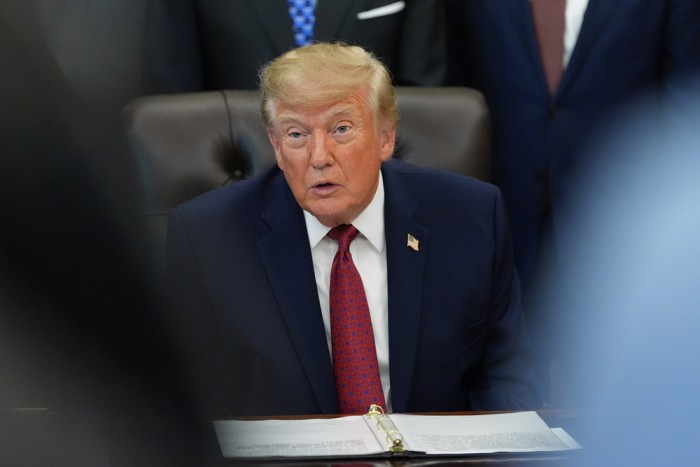 |
| U.S. President Donald Trump speaks to reporters in the Oval Office at the White House in Washington, D.C., on Sept. 30, 2026. /AP-Yonhap |
U.S. President Donald Trump defended his key policies on Sunday despite his party's crushing defeat in the midterm elections, while signaling that some adjustments may be necessary.
Attention is now turning to whether the election results will prompt changes to his administration's overall policy direction as he enters the second half of his term.
Appearing on CBS's 60 Minutes, broadcast Sunday, Trump assessed his policies in light of the Nov. 3 midterm election results and outlined his approach going forward.
Trump acknowledges immigration crackdown may have been too tough
Asked whether his immigration policies had contributed to the Republican Party's defeat, Trump acknowledged that his administration's approach may have been overly aggressive.
He said immigration had both helped and hurt his party in the election, while giving himself an A+ for securing the border.
Trump argued that his administration had received high marks for deporting people he described as dangerous, but that removing immigrants who had steady jobs and whose only offense was entering the country illegally had hurt him politically.
He added that Americans were divided over the issue.
Some believed such immigrants should be deported, he said, while others thought people who worked hard in landscaping, hotels or other industries, and in some cases paid taxes, should be allowed to remain in the United States.
Trump defends military operation against Iran
Trump also addressed the war with Iran, which has been cited as a factor in the Republican Party's election defeat.
He argued that although the war had drawn criticism for driving up oil prices in the short term, it would ultimately be viewed positively because it had weakened Iran's nuclear capabilities.
Vice President JD Vance had identified the Iran war as a major reason for the Republican defeat in a social media post on Nov. 4, the day after the midterm elections.
Trump said he did not disagree with the vice president's assessment, but believed Vance had overlooked one important point.
He argued that if he were asked whether he would attack Iran again, his answer would be an emphatic yes.
Trump cited the weakening of Iran's conventional military capabilities and setbacks to its nuclear program as reasons for his position.
He said the operation would be regarded as a highly successful decision in historical terms, even if it might not appear beneficial in the immediate future.
Trump stressed that he had to act in what he considered the best interests of the United States.
He also argued that he would have faced far greater criticism if Iran had acquired nuclear weapons during his presidency.
CBS News
Trump blames poor messaging for negative views of the economy
Trump also defended his administration's economic record.
He claimed that the United States was delivering unprecedented economic results, pointing in particular to record-high balances in 401(k) retirement savings accounts, a widely used employer-sponsored retirement plan for American workers.
However, exit polls from the midterm elections showed that approximately three-quarters of voters rated economic conditions as poor or not good.
Voters expressed particular concern about the cost of gasoline, food, utilities and healthcare.
Around two-thirds also believed Trump's tariff policies had negatively affected the U.S. economy.
Trump attributed the negative assessments to his administration's failure to communicate its achievements effectively.
He argued that the economic results had not been sufficiently publicized.
Trump also predicted that his policies would lead to growth in manufacturing employment and that Americans would begin to see the benefits within the next two to three months, or four months at most.
Kim Hyun-min
Most Read
-
1
Ukraine halts strikes on Russian oil refineries un..

-
2
China's fifth plenum to conclude amid expectations..

-
3
Southeast Asian auto parts makers hit hard by Chin..

-
4
U.S. links Myanmar peace efforts to rare earth acc..

-
5
Hegseth rejects calls for impeachment over Iran wa..

-
6
Democrats flip U.S. Congress in historic midterm s..

-
7
USFK commander cites interoperability gaps, urges..

PEOPLE







-
Address : In-Young Bldg., 34, Uisadang-daero 1-gil, Yeongdeungpo-gu, Seoul
Copyright by ASIATODAY CO., LTD. All rights resereved