



Jensen Huang targeted in alleged Chinese espionage plot
Nov 10, 2026, 09:07 am


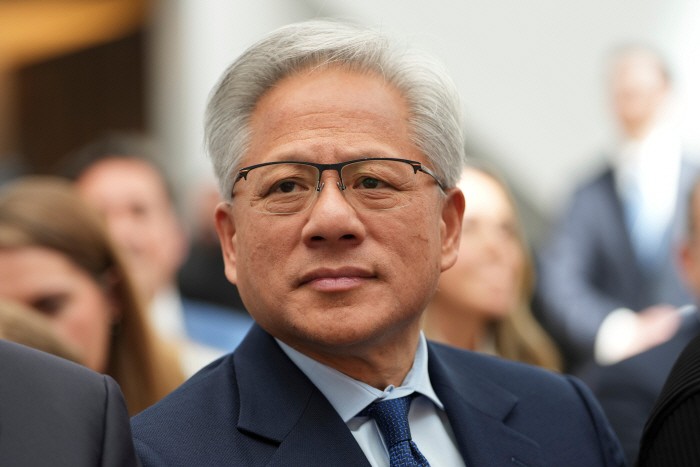 |
| Nvidia CEO Jensen Huang listens to U.S. President Donald Trump's speech at an event held at the U.S. Institute of Peace (USIP) in Washington on Oct. 8, 2026. /AP-Yonhap |
Nvidia CEO Jensen Huang, widely known as the "AI king," has found himself embroiled in allegations involving Chinese economic espionage.
As the U.S.-China rivalry for technological dominance spreads across advanced industries, including semiconductors, aviation and artificial intelligence (AI), economic espionage cases involving critical technologies and skilled personnel continue to emerge.
The latest allegations have drawn particular attention because they involve the head of a company that leads the global AI semiconductor market.
According to Reuters and the Associated Press (AP) on Sunday, Nvidia's board of directors has launched an independent investigation following reports that Huang may have been targeted by a foreign intelligence operation.
At the center of the allegations is Alice Huang, a former senior executive at Megaspeed, a Singapore-based data center company.
U.S. intelligence authorities reportedly believe that China's Ministry of State Security (MSS) recruited Alice Huang to approach Jensen Huang in an effort to obtain AI semiconductor technology and information about Nvidia's business strategy.
In a message to employees, Huang acknowledged that he had been unfaithful to his wife and apologized to his family and colleagues.
He also pledged to cooperate with the board's investigation into the national security concerns.
However, Huang has not admitted to any links with Chinese intelligence agencies or to disclosing confidential company information.
Nvidia's board also said it had no reason to believe that national security or company secrets had been compromised.
The Chinese government has denied the allegations.
 |
| A screenshot from footage aired by Taiwan's CTI TV and obtained by AFPTV on Nov. 9, 2026, shows Alice Huang (second from right), a Chinese executive at data center company Megaspeed. /AFP-Yonhap |
Micron DRAM, GE aircraft engines and Google AI: A history of economic espionage cases
Allegations of Chinese economic espionage have repeatedly surfaced across advanced industries in the United States.
In 2018, a case emerged involving the alleged theft of DRAM technology from U.S. semiconductor company Micron Technology. Former employees of Micron's Taiwanese subsidiary were accused of transferring DRAM design and manufacturing information to Taiwan's United Microelectronics Corporation (UMC) for use in memory chip development by Chinese state-owned semiconductor company Fujian Jinhua.
In 2020, UMC pleaded guilty to trade secret theft and agreed to pay a $60 million fine.
That same year, Yanjun Xu, an officer with China's Ministry of State Security (MSS), was arrested on charges of attempting to obtain aircraft engine technology by approaching engineers at GE Aviation and others.
He was sentenced to 20 years in prison by a U.S. court in 2022, and his conviction and sentence were upheld on appeal in 2024.
Former Google engineer Linwei Ding was also indicted on charges of stealing thousands of pages of confidential information related to artificial intelligence (AI).
In January this year, a jury found him guilty. However, in August, a federal judge acquitted him of the economic espionage charges, ruling that prosecutors had failed to prove he intended or knew that his actions would benefit the Chinese government. His convictions for theft of trade secrets remained intact.
Although the methods differed, these cases involved insiders or key personnel with access to advanced technologies.
The latest case involving Nvidia CEO Jensen Huang differs in that the alleged target of the intelligence operation is the head of the world's leading AI semiconductor company.
The controversy has therefore extended beyond researchers and engineers who work directly with specific technologies to a corporate leader who oversees both technological development and broader business strategy.
Nvidia supplies AI chips that serve as critical infrastructure for the global AI industry. Huang has frequently traveled between the United States and China and spoken publicly about semiconductor policies in both countries.
Since the United States began restricting exports of advanced AI chips to China in 2022, Huang has repeatedly emphasized the importance of the Chinese market and called for easing those restrictions.
Recently, however, the situation has become more complicated.
Even after the United States permitted exports of Nvidia's H200 chips to China, Beijing continued to restrict large-scale imports while stepping up efforts to develop its domestic AI semiconductor industry.
At the same time, demand for Nvidia chips among Chinese companies remains strong.
China therefore faces the challenge of securing Nvidia's advanced technology for AI development while reducing its dependence on American technology.
Huang stands at the intersection of these competing priorities: U.S. technology export controls targeting China and Beijing's push for technological self-reliance.
The allegations surrounding the suspected intelligence operation have attracted particular attention because Huang leads a company that must manage not only advanced semiconductor technology but also its China business and U.S. export restrictions.
Cheon Hyun-bin
Most Read
-
1
Ukraine halts strikes on Russian oil refineries un..

-
2
China's fifth plenum to conclude amid expectations..

-
3
Southeast Asian auto parts makers hit hard by Chin..

-
4
U.S. links Myanmar peace efforts to rare earth acc..

-
5
Hegseth rejects calls for impeachment over Iran wa..

-
6
Democrats flip U.S. Congress in historic midterm s..

-
7
USFK commander cites interoperability gaps, urges..

PEOPLE







-
Address : In-Young Bldg., 34, Uisadang-daero 1-gil, Yeongdeungpo-gu, Seoul
Copyright by ASIATODAY CO., LTD. All rights resereved