



Russian covert network weaponized French unrest to fuel division and distrust, EU report says
Nov 10, 2026, 10:51 am


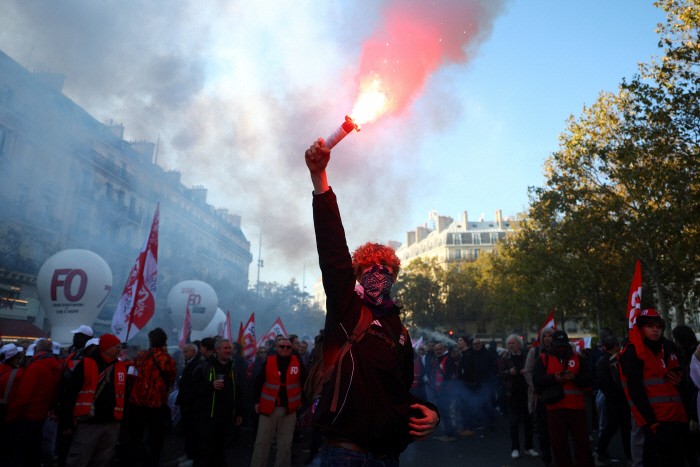 |
| A masked protester holds a red flare during nationwide strikes and demonstrations over wages, inflation and public services, led by French labor unions and joined by students, in Paris, France, on Nov. 5, 2026. /Reuters-Yonhap |
Evidence has emerged suggesting that Russia attempted to influence public opinion through social media amid widespread unrest that began across France in October and has continued since.
According to an internal European Union (EU) assessment, a covert Russian network known as "Operation Overload" circulated videos impersonating major Western news outlets to shape public perceptions of the French protests.
The network spread content linking the unrest to uncontrolled immigration and portraying the French government as having lost control of the situation, Reuters reported Monday.
EU analysts said they found no evidence that Russia had directly organized or escalated the protests. Instead, they identified what they described as the "opportunistic exploitation of unrest" for political purposes.
The analysts also warned that such activities were intended to undermine public trust in national governments and shape voters' perceptions ahead of elections.
According to the EU report, Operation Overload, which began in September 2023, has targeted prominent Western figures, institutions and media organizations in an effort to weaken public support for Ukraine and spread pro-Russian content.
In particular, the network has promoted the argument that European governments prioritize Ukraine over domestic concerns, seeking to erode support for Ukraine across Europe.
In a report published last year, the Institute for Strategic Dialogue (ISD), a British think tank, described Operation Overload as a large-scale information operation that impersonates credible sources to fuel social division, confusion and distrust.
A separate internal report prepared by France's Foreign Ministry found that accounts linked to the U.S. Make America Great Again (MAGA) movement, as well as Israeli officials and influencers, had also spread hostile narratives about the unrest.
These accounts linked the French protests to radical Islamism and immigration.
According to the report, between Oct. 16 and 18, the 10 most-viewed posts about the French unrest from pro-Russian accounts received approximately 2.8 million views.
By comparison, the 10 most-viewed posts from MAGA-linked accounts attracted more than 49 million views, while the 10 most-viewed posts from Israeli-linked accounts received more than 35 million views during the same period.
Experts see these activities as part of a long-term competition to shape public opinion.
Elina Treyger, a senior researcher at the U.S.-based RAND Corporation, said such online activities could fuel anti-immigration sentiment and deepen political polarization among voters.
French government officials, meanwhile, referred to remarks by President Emmanuel Macron, who said there had been no evidence of direct foreign involvement behind the protests since October, but that "foreign manipulation of information" had taken place.
Lee Jeong-eun
Most Read
-
1
Ukraine halts strikes on Russian oil refineries un..

-
2
China's fifth plenum to conclude amid expectations..

-
3
Southeast Asian auto parts makers hit hard by Chin..

-
4
U.S. links Myanmar peace efforts to rare earth acc..

-
5
Hegseth rejects calls for impeachment over Iran wa..

-
6
Democrats flip U.S. Congress in historic midterm s..

-
7
USFK commander cites interoperability gaps, urges..

PEOPLE






-
Address : In-Young Bldg., 34, Uisadang-daero 1-gil, Yeongdeungpo-gu, Seoul
Copyright by ASIATODAY CO., LTD. All rights resereved