



S. Korean banks face persistent margin pressure in Q4
Nov 10, 2026, 10:45 am


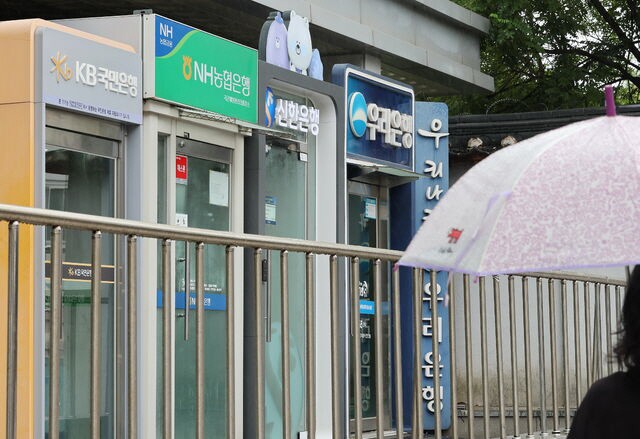 |
| /Yonhap |
South Korea's commercial banks are seeing a sharp influx of corporate funds, but the increase is putting pressure on their profitability.
Companies are placing more money in relatively high-interest time deposits, driving up banks' funding costs.
At the same time, intense competition in corporate lending is making it difficult for banks to widen their lending margins, raising concerns that defending their net interest margins (NIMs) will remain challenging in the fourth quarter.
However, some analysts believe that further declines in margins could be limited, as banks have already secured funding in advance.
According to financial industry sources on Monday, corporate time deposits at South Korea's four major commercial banks — KB Kookmin, Shinhan, Hana and Woori — rose 14% over four months, from 441.4165 trillion won at the end of June to 502.9999 trillion won at the end of October.
By contrast, demand deposits fell 9.5% over the same period, from 295.5037 trillion won to 267.5693 trillion won.
As a result, the share of time deposits increased by 5.4 percentage points, from 59.9% to 65.3%.
An increase in time deposits is unfavorable for banks' profitability.
While demand deposits pay little or no interest, time deposits generally carry higher interest rates.
This shift in banks' funding structure is therefore putting pressure on their earnings.
In the third quarter, the four major banks saw their NIMs decline by an average of 0.041 percentage points from the previous quarter.
KB Kookmin Bank's NIM fell by 0.02 percentage points, from 1.74% to 1.72%, while Shinhan Bank's declined by 0.03 percentage points, from 1.61% to 1.58%.
Hana Bank's NIM dropped by 0.04 percentage points, from 1.61% to 1.57%, and Woori Bank's fell by 0.072 percentage points, from 1.506% to 1.434%.
Commercial banks cited declining household deposits and growing reliance on corporate deposits as major factors behind higher funding costs and shrinking margins.
"Outflows of retail deposits have forced us to rely more heavily on corporate deposits for funding, increasing our funding costs," said Seo Ki-won, chief financial officer of KB Kookmin Bank, during the bank's third-quarter earnings conference call.
Competition to attract corporate deposits is also pushing up funding costs.
"Corporate deposits tend to be large, and competition over interest rates is intense, so banks often offer higher rates than they do on retail deposits," a banking industry official said.
"Since banks also need to consider revenue generated from other transactions with corporate clients, they have strong incentives to maintain those relationships even if funding costs are high."
Meanwhile, intense interest rate competition in corporate lending, particularly for financially sound companies, is making it difficult for banks to pass higher funding costs on to borrowers through higher lending rates.
Banks are also facing additional costs as they raise funds in advance to prepare for maturing corporate deposits.
Net issuance of bank bonds reached a record 14.7 trillion won in October.
This comes as banks face a heavy bond maturity schedule in the fourth quarter.
A record 26.7 trillion won in bank bonds is set to mature in November.
With market interest rates rising, banks could face higher interest expenses if they refinance maturing bonds at rates above those on the existing debt.
However, some analysts expect the impact on fourth-quarter funding costs to be limited because banks have already secured funds in advance.
"Banks have been raising funds since the second quarter in anticipation of rising interest rates," a financial industry official said.
"As the need for additional funding declines in the fourth quarter, NIMs may remain around third-quarter levels rather than falling further."
Lee Bo-ra
Most Read
-
1
Ukraine halts strikes on Russian oil refineries un..

-
2
China's fifth plenum to conclude amid expectations..

-
3
Southeast Asian auto parts makers hit hard by Chin..

-
4
U.S. links Myanmar peace efforts to rare earth acc..

-
5
Hegseth rejects calls for impeachment over Iran wa..

-
6
Democrats flip U.S. Congress in historic midterm s..

-
7
USFK commander cites interoperability gaps, urges..

PEOPLE







-
Address : In-Young Bldg., 34, Uisadang-daero 1-gil, Yeongdeungpo-gu, Seoul
Copyright by ASIATODAY CO., LTD. All rights resereved