



[Market Power] Hankook & Company and Sinokor units face steeper fines
Nov 10, 2026, 10:30 am


 |
 |
South Korea's Fair Trade Commission (FTC) has significantly strengthened penalties against companies that repeatedly violate corporate disclosure requirements.
Amid growing concerns that frequent disclosure violations undermine market transparency, the commission has introduced rules allowing fines to be increased by up to 50% for repeat offenders.
It has also eliminated penalty reductions based on the length of reporting delays and abolished the maximum fine limits previously applied to small companies. These changes mean that companies, including listed firms, will need to exercise greater caution in managing their disclosure obligations.
Subsidiaries of Hankook & Company Group and Sinokor Merchant Marine Group are among those that could face a 50% increase in fines if further violations are detected.
In particular, the family of Hankook & Company Chairman Cho Hyun-bum has been found to have repeatedly violated disclosure requirements, including late and false disclosures, while operating family-affiliated companies.
Companies affiliated with HL Group, Hanjin Group, Jungheung Construction, Harim Group and Kyobo Life Insurance have also accumulated records of past violations.
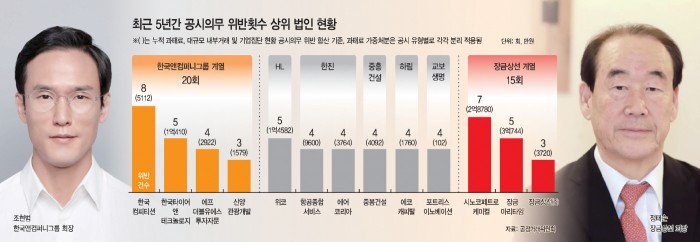
According to the FTC on Tuesday, four subsidiaries of Hankook & Company Group had committed at least three violations of disclosure requirements concerning large-scale internal transactions and business group information over the past five years, the highest number of subsidiaries among the groups examined.
Sinokor Merchant Marine Group followed with three subsidiaries.
Within Hankook & Company Group, racing team affiliate Hankook Competition recorded the highest number of violations, with eight cases and cumulative fines of 51.12 million won.
In 2023, when the company was still operating under the name AtlasBX Motorsport, it committed three violations, resulting in fines totaling 23.46 million won.
These included two cases involving transactions of goods and services that were neither approved by the board of directors nor disclosed, resulting in fines of 15.64 million won, and one case of delayed disclosure, resulting in a fine of 7.82 million won.
After changing its name to Hankook Competition, the company committed five additional violations in 2024 and 2025, with fines totaling 27.66 million won.
In 2024, it was fined 20.46 million won for three delayed disclosures of goods and services transactions and 3.2 million won for one omission of information about board operations.
In 2025, it was fined another 4 million won for one case of false disclosure concerning board operations.
Hankook Tire & Technology, a core subsidiary of the group, recorded five violations and cumulative fines of 104.1 million won.
In 2021, the company was fined 50.4 million won for failing to obtain board approval and disclose a goods and services transaction.
In 2022, it was fined 10.5 million won for two delayed disclosures of goods and services transactions and 40 million won for one transaction conducted without board approval.
In 2024, it was fined another 3.2 million won for omitting information on board operations from its business group disclosures.
The list also included several unlisted affiliates with substantial ownership by the controlling family or frequent internal transactions.
FWS Investment Advisory, whose largest shareholder until 2024 was Hankook & Company Chairman Cho Hyun-bum, was cited for four cases of delayed disclosure involving financial transactions, resulting in fines totaling 29.22 million won.
These consisted of one violation in 2021, carrying a fine of 2.65 million won, and three violations in 2024, carrying fines totaling 26.57 million won.
Shinyang Tourism Development, a family-owned company linked to Cho Hyun-bum and other family members, including Cho Hyun-sik, Cho Hee-kyung and Cho Hee-won, was fined a total of 15.79 million won for three violations.
These included one delayed disclosure of a financial transaction in 2021, resulting in a fine of 8.59 million won, and two cases involving omitted or false disclosures of board operations in 2024 and 2025, resulting in fines totaling 7.2 million won.
Together, the four Hankook & Company affiliates recorded 20 disclosure violations and cumulative fines of 200.23 million won.
Over the same period, three affiliates of Sinokor Merchant Marine Group received fines totaling 632.44 million won for 15 disclosure violations.
Sinokor Petrochemical, an international cargo shipping company specializing in tanker operations, committed seven violations over the past five years and received fines totaling 287.8 million won.
In 2023, the company was fined 7.8 million won for three delayed disclosures of financial transactions.
It was subsequently fined 160 million won for one violation in 2024 and 120 million won for three violations in 2025 involving goods and services transactions between affiliates that were disclosed late and conducted without prior board approval.
Sinokor Maritime committed five disclosure violations and received cumulative fines of 307.44 million won, the highest total for any individual company examined.
The violations included one delayed disclosure of an asset transaction in 2021, resulting in a fine of 27.44 million won.
Like Sinokor Petrochemical, it was also found to have conducted goods and services transactions without board approval and disclosed them late, resulting in fines of 160 million won for one violation in 2024 and 120 million won for three violations in 2025.
Sinokor Merchant Marine Co., which effectively serves as the group's holding company, was also identified as subject to the 50% penalty increase for future violations.
The company committed three violations and received cumulative fines of 37.2 million won.
These included one case of failing to obtain board approval for a goods and services transaction in 2021, resulting in a fine of 28 million won, and two delayed disclosures of financial transactions in 2025, resulting in fines totaling 9.2 million won.
HL, Hanjin and other conglomerates also face increased penalties
Other business groups could also face fines increased by 50% because of repeated disclosure violations by their affiliates.
Wico, an affiliate of HL Group, was cited for five violations and fined a total of 145.82 million won.
In 2021, the company committed four violations involving goods and services transactions that were neither approved by the board nor disclosed, resulting in fines totaling 128.8 million won.
It was also fined 17.02 million won for one delayed disclosure in 2022.
Two Hanjin Group affiliates, Korea Airport Service and Air Korea, were fined 96 million won and 37.64 million won, respectively.
Each company committed four violations in 2021 and 2022 by conducting goods and services transactions with affiliates without obtaining board approval.
Jungbong Construction, an affiliate of Jungheung Construction, committed four violations in 2022 and was fined a total of 40.92 million won.
These included three delayed disclosures of financial transactions, resulting in fines totaling 28.6 million won, and one delayed disclosure of a goods and services transaction, resulting in a fine of 12.32 million won.
Eco Capital, an affiliate of Harim Group, was cited for four cases of false disclosure concerning transactions with related parties in 2022, resulting in fines totaling 17.6 million won.
Fortress Innovation, an affiliate of Kyobo Life Insurance, committed four violations and was fined a total of 1.02 million won.
These included one delayed disclosure of a related-party transaction in 2022, resulting in a fine of 320,000 won, and three cases involving goods and services transactions conducted without board approval or disclosed late between 2023 and 2024, resulting in fines totaling 700,000 won.
The FTC has traditionally released the results of its annual reviews of business groups' compliance with disclosure requirements toward the end of each year.
It is therefore expected to announce the results of this year's review next month.
The commission identifies violations by cross-checking disclosures filed through the Data Analysis, Retrieval and Transfer System (DART) against information submitted directly by business groups.
Park I-sak
#Hankook & Company #Sinokor #FTC #Disclosure system
Copyright by Asiatoday
Most Read
-
1
Ukraine halts strikes on Russian oil refineries un..

-
2
China's fifth plenum to conclude amid expectations..

-
3
Southeast Asian auto parts makers hit hard by Chin..

-
4
U.S. links Myanmar peace efforts to rare earth acc..

-
5
Hegseth rejects calls for impeachment over Iran wa..

-
6
Democrats flip U.S. Congress in historic midterm s..

-
7
USFK commander cites interoperability gaps, urges..

PEOPLE







-
Address : In-Young Bldg., 34, Uisadang-daero 1-gil, Yeongdeungpo-gu, Seoul
Copyright by ASIATODAY CO., LTD. All rights resereved