



Trump warns Iran at U.N. to reach deal or face ‘annihilation’
Sep 23, 2026, 10:05 am


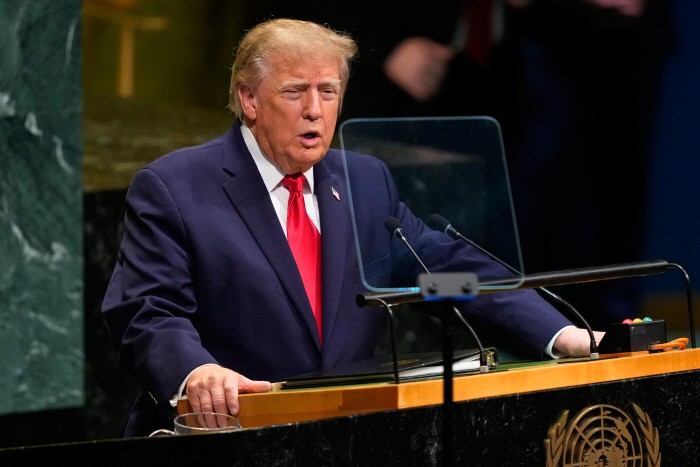 |
| U.S. President Donald Trump addresses the 81st session of the UN General Assembly at the United Nations headquarters in New York on the 22nd (local time). / AP, Yonhap |
U.S. President Donald Trump, in his address to the United Nations General Assembly at UN headquarters in New York on the 22nd (local time), presented Iran with the dual possibilities of an agreement or being "annihilated," while rejecting international regulations on artificial intelligence (AI).
After declaring that the U.S. would reassert its military strength in the Western Hemisphere, President Trump signed a trilateral security agreement with Danish Prime Minister Mette Frederiksen and Greenland's Premier Jens Frederik Nielsen, centered on expanding the U.S. military presence in Greenland.
During his roughly 37-minute speech, President Trump broadly addressed the war with Iran, policies toward Cuba and Venezuela, AI competition, and the war in Ukraine. However, he did not mention North Korea once, despite recent attention surrounding the potential resumption of U.S.-North Korea dialogue.
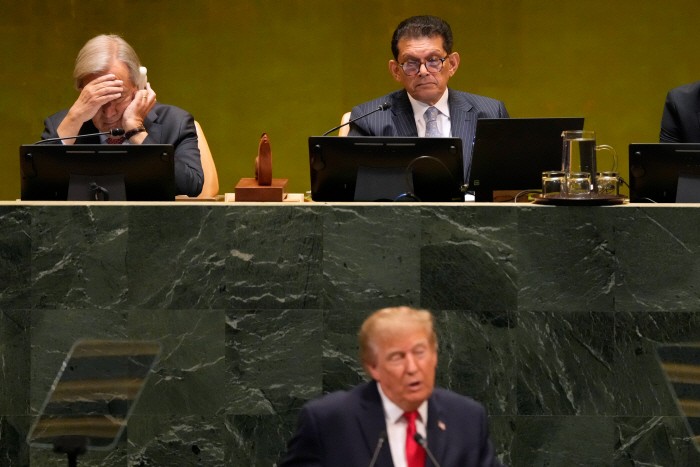 |
| UN Secretary-General António Guterres (top left) and Khalilur Rahman, Bangladesh's Minister of Foreign Affairs and President of the 81st UN General Assembly (top right), listen to U.S. President Donald Trump's address at the 81st session of the UN General Assembly at the United Nations headquarters in New York on the 22nd (local time). / AP, Yonhap |
Trump presents Iran with two choices: deal or annihilation, predicts agreement after midterms
President Trump devoted the most time to the Iran issue. Saying "a big decision has to be made," he stated he must decide whether to reach a deal that allows Iran to rebuild its nation, or to swiftly "annihilate" the Islamic Republic.
He followed by asking, "Or do we drive them into hell so there's never a chance of survival, never a chance of future greatness or hope for their posterity?" While defending the legitimacy of the war against Iran launched alongside Israel, he also kept the door open for additional military action.
Even so, he left room for negotiations. Noting his belief that Iran is holding off on a deal until the U.S. midterm elections in November, President Trump said, "I believe that right after the election, a deal will be made."
He asserted that once a deal is struck, "oil prices are going to plummet." He thus linked the war with Iran directly to energy prices ahead of the midterms.
President Trump stressed that he will never allow Iran to possess nuclear weapons. Stating that "Iran was the bully of the Middle East, but they're not the bully anymore," he urged nations to join in the complete economic isolation of Iran until it halts attacks on commercial shipping, its nuclear ambitions, and support for terrorism.
Explaining this foreign policy stance, President Trump highlighted his decisive leadership. "While others have talked, I have acted," he emphasized. "When others talked about peace, I made peace. When others looked away from threats, I confronted them."
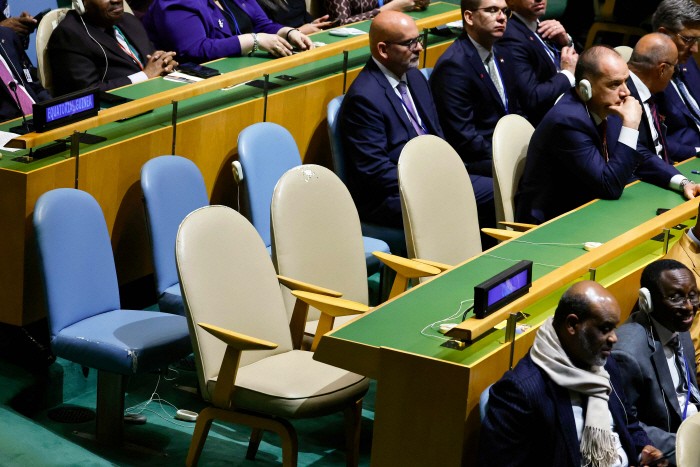 |
| U.S. President Donald Trump addresses the 81st session of the UN General Assembly at the United Nations headquarters in New York on the 22nd (local time), with the Cuban delegation's seats left empty. / AFP, Yonhap |
Trump warns Cuba will collapse as four delegates walk out during address
President Trump’s hardline message carried over to the Western Hemisphere. Stating that he is seeking "fundamental change" in Cuba's situation, he assessed that the communist regime is facing the greatest pressure it has ever experienced.
Defining Cuba as a "totally failed state," President Trump said it is "failing worse than ever before, and they're going to fall."
He then revealed that U.S. Secretary of State Marco Rubio is handling negotiations with Cuba. Noting that Secretary Rubio is conducting "deep negotiations," Trump said, "Let's see what happens."
As President Trump continued his criticism of the Cuban regime, four members of the Cuban delegation rose from their seats and walked out of the hall, according to The New York Times. Following the walkout, Cuban Foreign Minister Bruno Rodríguez took to social media platform X to push back, asserting that Cuba is an independent sovereign state and poses no threat to the U.S.
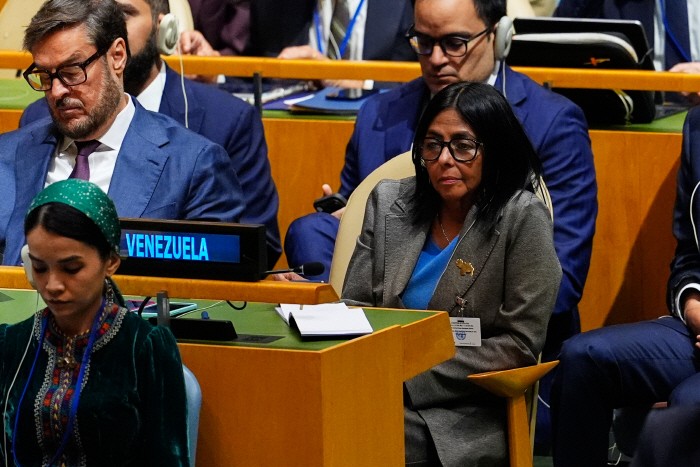 |
| Venezuela's Acting President Delcy Rodríguez (right) listens to U.S. President Donald Trump's address at the 81st session of the UN General Assembly at the United Nations headquarters in New York on the 22nd (local time). / AP, Yonhap |
President Trump highlighted Venezuela as a success of U.S. policy in the Western Hemisphere. Pointing to the ouster of President Nicolás Maduro last January and U.S. military counternarcotics operations carried out across the Caribbean and Eastern Pacific, he remarked, "To the victor belong the spoils."
"We are reasserting American power, including military power, where necessary," he said, stressing that he would not permit any threat against the U.S. to establish a foothold anywhere in the Western Hemisphere.
President Trump is scheduled to meet with at least 11 heads of state and leaders, including Venezuelan Acting President Delcy Rodríguez, who appeared at the UN General Assembly hall that day, and Ukrainian President Volodymyr Zelenskyy, Reuters reported.
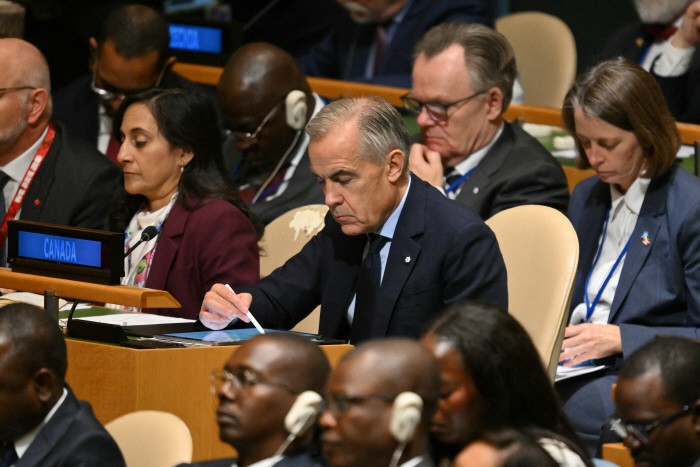 |
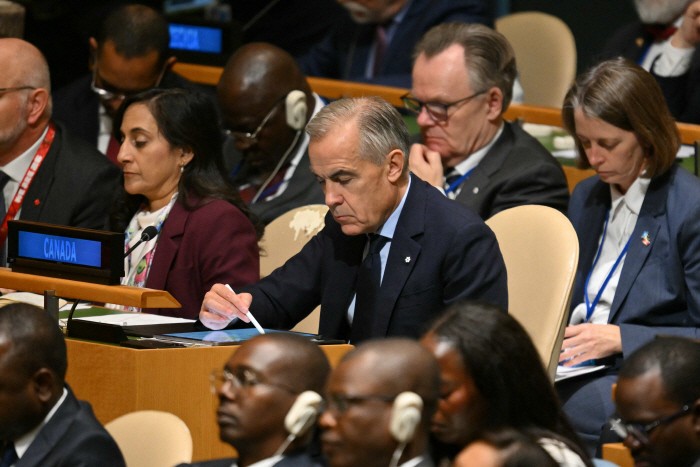
| Canadian Prime Minister Mark Carney listens to U.S. President Donald Trump's address at the 81st session of the UN General Assembly at the United Nations headquarters in New York on the 22nd (local time). / AFP, Yonhap |
Trump rejects international AI regulation, says U.S. leads China in super intelligence
Turning from military and foreign affairs, President Trump drew a firm line against international control over AI. He declared that "the U.S. totally rejects any attempt to create a globalist scheme to control AI."
Stating that the growth of AI will bring changes larger than the Industrial Revolution, he pledged not to hold back technological development. While law enforcement will intervene if necessary, he noted that "we will encourage, not suppress, Super Intelligence."
President Trump announced that U.S. government documents will use the term "super intelligence" instead of "AI." Arguing that "super" is a more precise descriptor, he contended that the word "artificial" makes intelligence sound fake.
He also directly addressed the U.S.-China tech rivalry. "Whoever wins in AI, whoever wins in super intelligence, wins," he remarked, emphasizing that the U.S. remains ahead of China and other nations and will maintain this lead.
President Trump's stance stood in stark contrast to the warning delivered earlier by UN Secretary-General António Guterres during his final opening address before leaving office. Secretary-General Guterres urged the establishment of international guardrails, warning that AI is advancing faster than humanity's ability to understand its consequences.
"Killer robots must have no place in our future," Guterres said, underscoring the need for international dialogue, transparency, trust, and cooperation regarding AI.
President Trump also directly assailed the International Criminal Court (ICC). Denouncing the ICC as a "rogue" and "out-of-control" institution, he called on member states to withdraw immediately.
On the Russia-Ukraine war, Trump stated he is working closely with the leaders of both nations and claimed that it would be resolved "faster than people think."
However, North Korean issues, directly relevant to South Korea, were omitted from the address. Throughout his roughly 37-minute speech, President Trump did not mention North Korea or North Korean leader Kim Jong-un even once.
 |
| U.S. President Donald Trump (left) holds up a signed Greenland security agreement alongside Danish Prime Minister Mette Frederiksen (center) and Greenland Premier Jens-Frederik Nielsen in New York, where the UN General Assembly was held, on the 22nd (local time). / AP, Yonhap |
Trump rejects international AI regulation, says U.S. leads China in super intelligence
Turning from military and foreign affairs, President Trump drew a firm line against international control over AI. He declared that "the U.S. totally rejects any attempt to create a globalist scheme to control AI."
Stating that the growth of AI will bring changes larger than the Industrial Revolution, he pledged not to hold back technological development. While law enforcement will intervene if necessary, he noted that "we will encourage, not suppress, Super Intelligence."
President Trump announced that U.S. government documents will use the term "super intelligence" instead of "AI." Arguing that "super" is a more precise descriptor, he contended that the word "artificial" makes intelligence sound fake.
He also directly addressed the U.S.-China tech rivalry. "Whoever wins in AI, whoever wins in super intelligence, wins," he remarked, emphasizing that the U.S. remains ahead of China and other nations and will maintain this lead.
President Trump's stance stood in stark contrast to the warning delivered earlier by UN Secretary-General António Guterres during his final opening address before leaving office. Secretary-General Guterres urged the establishment of international guardrails, warning that AI is advancing faster than humanity's ability to understand its consequences.
"Killer robots must have no place in our future," Guterres said, underscoring the need for international dialogue, transparency, trust, and cooperation regarding AI.
President Trump also directly assailed the International Criminal Court (ICC). Denouncing the ICC as a "rogue" and "out-of-control" institution, he called on member states to withdraw immediately.
On the Russia-Ukraine war, Trump stated he is working closely with the leaders of both nations and claimed that it would be resolved "faster than people think."
However, North Korean issues, directly relevant to South Korea, were omitted from the address. Throughout his roughly 37-minute speech, President Trump did not mention North Korea or North Korean leader Kim Jong-un even once.
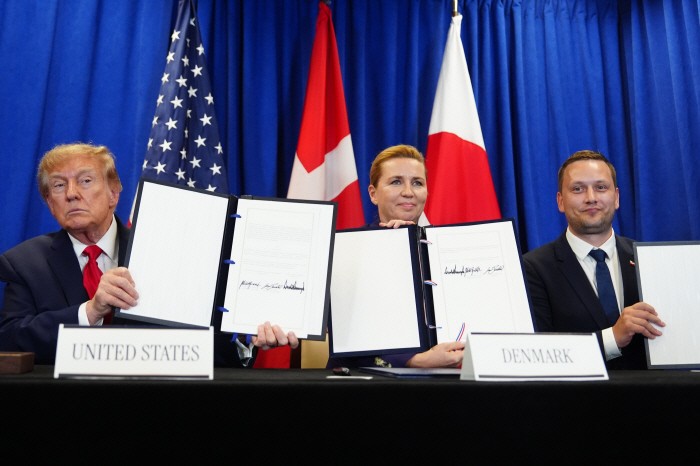 |
| U.S. President Donald Trump (left) holds up a signed Greenland security agreement alongside Danish Prime Minister Mette Frederiksen (center) and Greenland Premier Jens-Frederik Nielsen in New York, where the UN General Assembly was held, on the 22nd (local time). / AP, Yonhap |
U.S., Denmark, and Greenland sign security pact as Trump announces construction of two U.S. military bases in Greenland
President Trump's push to expand military power led immediately to the signing of a security agreement on Greenland following his address. Alongside Prime Minister Frederiksen and Premier Nielsen, he signed a trilateral accord aimed at bolstering security across the Arctic and North Atlantic.
The agreement authorizes the U.S. to station troops and expand its military operations in Greenland.
However, it stopped short of incorporating Greenland into U.S. territory—a demand previously raised by President Trump—leaving Danish sovereignty and the Greenlandic people's right to self-determination intact.
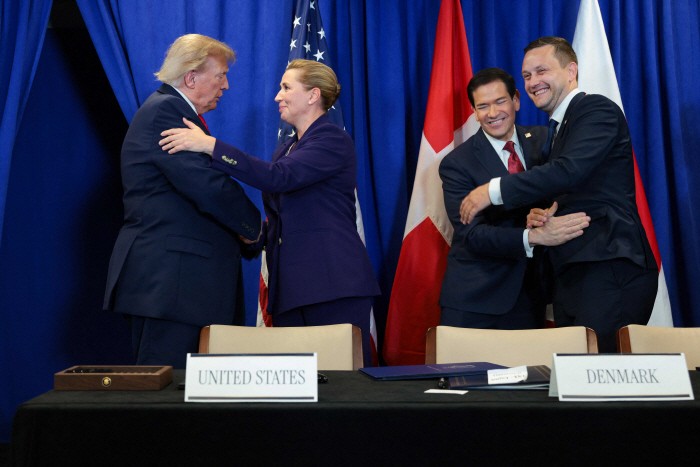 |
| U.S. President Donald Trump (from left), Danish Prime Minister Mette Frederiksen, U.S. Secretary of State Marco Rubio, and Greenland Premier Jens-Frederik Nielsen embrace after signing a security agreement on Greenland in New York, where the 81st session of the UN General Assembly was held, on the 22nd (local time). / AFP, Yonhap |
President Trump described Greenland as the northern frontier of North America during his UN address. He asserted that the agreement reached with the Kingdom of Denmark and the people of Greenland grants the U.S. permanent control over Greenland's security and other essential needs.
President Trump went on to announce that the U.S. will soon build two very major military bases in Greenland.
Prime Minister Frederiksen hailed the pact as a deal that can last forever, describing it as a beneficial agreement for the U.S., Greenland, Denmark, NATO, and Europe alike.
Premier Nielsen also underscored the agreement's collaborative nature, remarking that it was a deal reached with us, not about us, reflecting the rights, livelihoods, and national development of the people of Greenland.
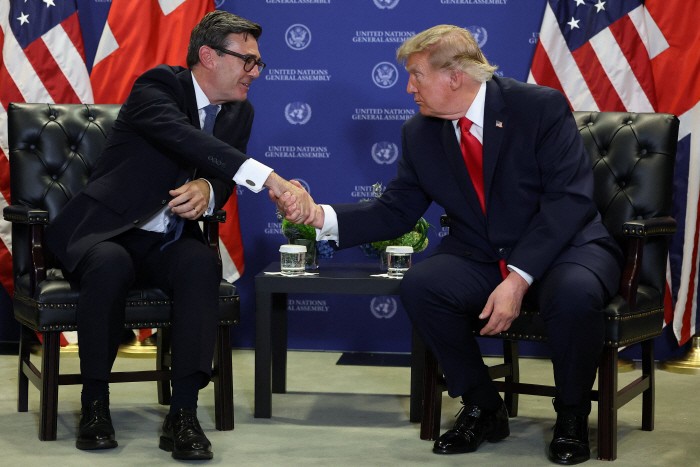 |
| U.S. President Donald Trump (right) and British Prime Minister Andy Burnham shake hands in New York, where the 81st session of the UN General Assembly was held, on the 22nd (local time). / Reuters, Yonhap |
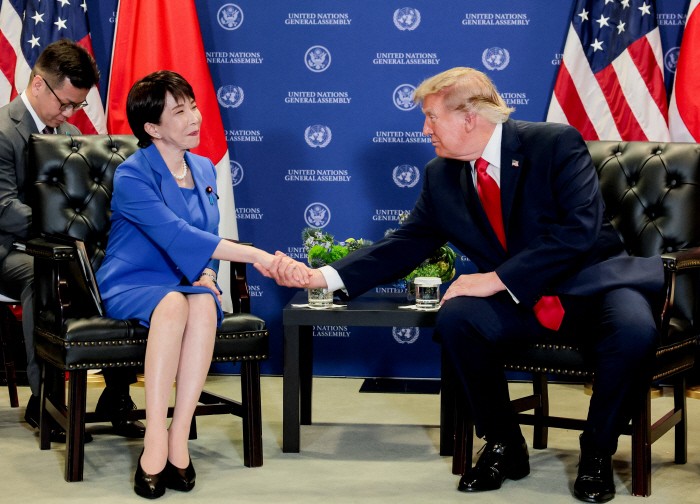 |
| U.S. President Donald Trump (right) and Japanese Prime Minister Sanae Takaichi shake hands in New York, where the 81st session of the UN General Assembly was held, on the 22nd (local time). / Reuters, Yonhap |
Foreign media highlights dual focus on peace and military might as Trump prepares to host Xi Jinping on state visit
Major international news outlets took note of President Trump delivering the contrasting messages of peace and military force at the same time. The Wall Street Journal, a U.S. daily, analyzed that President Trump framed himself as a peacemaker while threatening to annihilate Iran, directing his remarks more toward U.S. voters weary of war and energy prices than toward the world leaders gathered at the UN General Assembly.
The New York Times assessed that President Trump projected his own strength while launching a series of attacks on nations and bodies he routinely criticizes, including Iran, Cuba, Venezuela, and the International Criminal Court.
Reuters reported that while President Trump reiterated his previous criticisms of the United Nations, he did not announce unexpected fresh attacks or additional withdrawals from international organizations, leading UN diplomats to likely breathe a sigh of relief.
Bloomberg News characterized the address as a largely defensive speech, analyzing that unlike last year, President Trump highlighted American power and his diplomatic accomplishments amid the political pressures of the upcoming midterm elections.
Following a round of summit diplomacy on the sidelines of the UN General Assembly that day, President Trump will host Chinese President Xi Jinping on a state visit beginning on the 23rd. President Xi is scheduled to skip the UN General Assembly and meet with President Trump in Washington, D.C.
Ha Man-ju
Most Read
-
1
Celltrion’s Omlyclo gains ground in major European..

-
2
Trump demands rates fall below 1% as Fed hikes for..

-
3
Trump makes $1 trillion bet ahead of midterm elect..

-
4
Iran resumes ballistic missile production, assembl..

-
5
Trump warns countries not helping U.S. must pay re..

-
6
Apple launches first foldable, 1 million won prici..

-
7
Turkish Airlines named main club partner of Liverp..

PEOPLE







-
Address : In-Young Bldg., 34, Uisadang-daero 1-gil, Yeongdeungpo-gu, Seoul
Copyright by ASIATODAY CO., LTD. All rights resereved