



KOSPI retreats near 8,000 as AI reshapes market
May 12, 2026, 07:54 pm


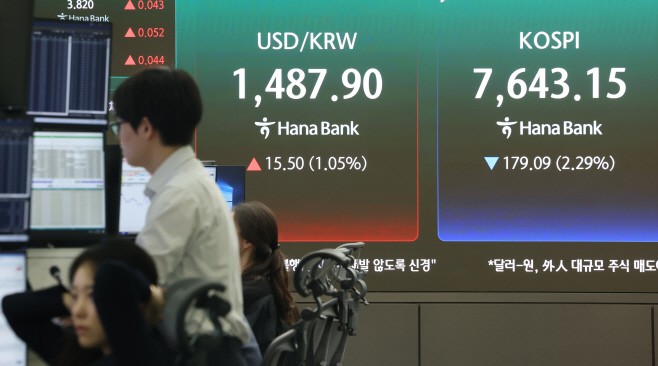 |
| An electronic board at the dealing room of Hana Bank in central Seoul shows the benchmark KOSPI index on May 12. The KOSPI closed at 7,643.15, down 179.09 points, or 2.29%, from the previous session, marking its first decline in six trading days. /Yonhap |
South Korea’s benchmark KOSPI index plunged after approaching the 8,000-point mark during intraday trading, as profit-taking in semiconductor shares and renewed Middle East geopolitical tensions weighed on investor sentiment. Despite the sharp correction, the market’s strong rally this year has triggered major changes in market capitalization rankings, led by AI semiconductor and power infrastructure stocks.
According to the Korea Exchange on May 12, the KOSPI closed at 7,643.15, down 179.11 points, or 2.29%, from the previous session. The index opened at 7,953.41 and climbed as high as 7,999.67 during the session, fueling expectations of a breakthrough above the 8,000 threshold. However, the market reversed course around 10:15 a.m. and later fell to an intraday low of 7,421.71.
Among the top 10 companies by market capitalization, shares of Samsung Electronics fell 2.28%, while SK hynix declined 2.39%. Preferred shares of Samsung Electronics dropped 4.05%, while SK Square lost 5.14%. LG Energy Solution fell 5.34%, Doosan Enerbility slipped 1.87%, and Samsung C&T declined 3.76%.
In contrast, HD Hyundai Heavy Industries rose 3.21%, while Samsung Electro-Mechanics gained 5.44%. Shares of Hyundai Motor ended little changed.
Analysts attributed the decline to profit-taking in semiconductor stocks and renewed geopolitical concerns in the Middle East. Lee Kyung-min, an analyst at Daishin Securities, said recent gains in the KOSPI had been concentrated in semiconductor stocks, leading to selling pressure as investors locked in profits. He also noted that comments by U.S. President Donald Trump regarding the possible resumption of military action had revived concerns over regional instability, weakening risk appetite.
Although the KOSPI closed lower on the day, the index has still risen more than 81% since the beginning of the year, resulting in noticeable shifts in market capitalization rankings.
HD Hyundai Electric climbed to 18th place in market value from 21st at the start of the year, while LS ELECTRIC surged from 44th to 21st as demand for AI-related power infrastructure boosted investor interest. Doosan Enerbility rose from 10th to seventh place, and Samsung C&T advanced from 14th to eighth.
AI semiconductor-related stocks also maintained strong momentum. Samsung Electronics and SK hynix retained the top two spots by market capitalization, while SK Square climbed from eighth to fourth on expectations of benefits from AI semiconductor investments. Samsung Electronics preferred shares also held onto a top-three ranking amid continued optimism over high-bandwidth memory and AI memory demand.
Meanwhile, traditional biotech and platform companies lost ground. Samsung Biologics dropped from fourth to 12th place in market capitalization, while Celltrion fell out of the top 20. NAVER also slipped out of the top-20 rankings.
Brokerages largely viewed the latest pullback as a short-term correction, maintaining expectations for further gains in the KOSPI. Analysts said improving earnings in the semiconductor sector driven by AI investment and normalization of valuations would remain key factors determining the market’s direction.
Kim Jae-seung, an analyst at Hyundai Motor Securities, said the KOSPI bull market could continue if earnings growth and valuation recovery in the semiconductor sector persist alongside expanding AI investment. He raised his year-end target for the KOSPI to 9,750 points and added that the index could potentially climb to 12,000 if hyperscalers continue increasing capital expenditure and signing long-term supply agreements, reinforcing confidence in semiconductor earnings sustainability.
#KOSPI #South Korea stock market #AI semiconductor #power infrastructure #Samsung Electronics
Copyright by Asiatoday
Most Read
-
1
Celltrion’s Omlyclo gains ground in major European..

-
2
Trump demands rates fall below 1% as Fed hikes for..

-
3
Trump makes $1 trillion bet ahead of midterm elect..

-
4
Iran resumes ballistic missile production, assembl..

-
5
Trump warns countries not helping U.S. must pay re..

-
6
Apple launches first foldable, 1 million won prici..

-
7
Turkish Airlines named main club partner of Liverp..

PEOPLE




-
Address : In-Young Bldg., 34, Uisadang-daero 1-gil, Yeongdeungpo-gu, Seoul
Copyright by ASIATODAY CO., LTD. All rights resereved