



UAE exits OPEC after 60 years, cracks Saudi-led cartel
Apr 29, 2026, 09:03 am


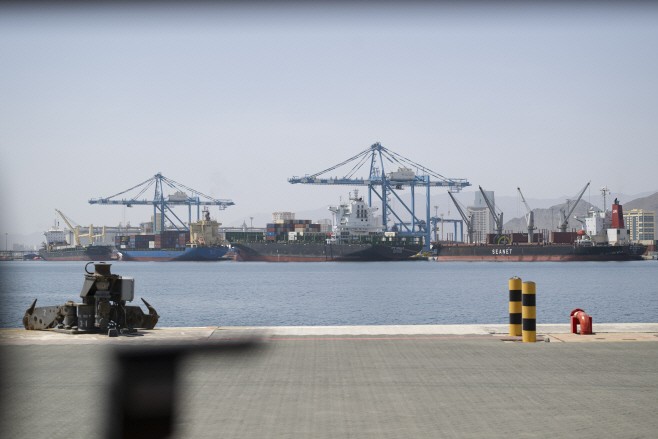 |
| An image of Fujairah Port in the United Arab Emirates, photographed on April 17, provided by the UAE presidential office. / EPA-Yonhap |
The United Arab Emirates (UAE) has officially announced it will withdraw from OPEC and OPEC+ effective May 1, marking its first departure since joining in 1967.
The announcement, delivered through the state-run WAM news agency on April 28, signals a major shift in the global energy landscape. As the third-largest oil producer within OPEC—accounting for roughly 12% of the group’s total supply—the UAE’s exit is being described as one of the most serious challenges to the organization’s survival since its founding.
The decision comes amid heightened geopolitical tensions, including the ongoing war involving Iran, the United States, and Israel, which has led to the closure of the Strait of Hormuz and triggered a historic supply shock in global oil markets.
Ahead of a scheduled OPEC+ virtual meeting on May 3, the UAE made a surprise declaration to abandon the group’s production quota system.
In an official statement, the government said it would continue to supply additional oil to the market “in a gradual and cautious manner” based on demand and market conditions, while remaining committed to market stability and cooperation with both producers and consumers.
UAE Energy Minister Suhail Mohamed Al Mazrouei stated in an interview with The New York Times, “The world needs more energy and resources, and the UAE will not be constrained by any group.”
He emphasized to the Financial Times that the decision reflects the UAE’s long-term strategic vision and sovereignty, adding that the current supply shortage caused by war created an opportune moment for withdrawal.
The Abu Dhabi National Oil Company (ADNOC) currently has a production capacity of 4.85 million barrels per day, with a target to reach 5 million barrels by 2027.
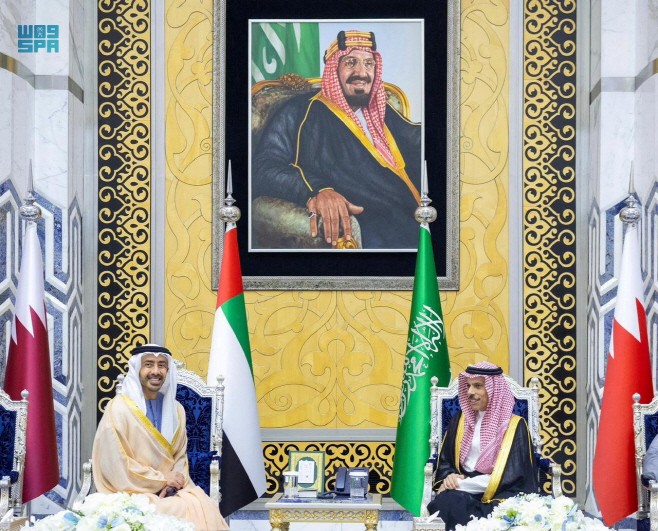 |
| Saudi Foreign Minister Faisal bin Farhan Al Saud (right) meets with UAE Deputy Prime Minister and Foreign Minister Abdullah bin Zayed Al Nahyan ahead of a special Gulf Cooperation Council meeting in Jeddah, Saudi Arabia, on April 28. / Reuters-Yonhap |
While the UAE cited geopolitical tensions as a factor, analysts point to a deeper, long-standing conflict with Saudi Arabia.
Saudi Arabia has led OPEC’s efforts to maintain high oil prices—around $100 per barrel—through production cuts. In contrast, the UAE has pursued aggressive capacity expansion to monetize its reserves early and invest in future industries.
This clash came to a head during the July 2021 OPEC+ meeting, when disagreements over production increases caused a temporary breakdown in negotiations.
The divergence has only intensified as global oil dynamics shifted following the U.S. shale boom, which significantly reduced OPEC’s market influence.
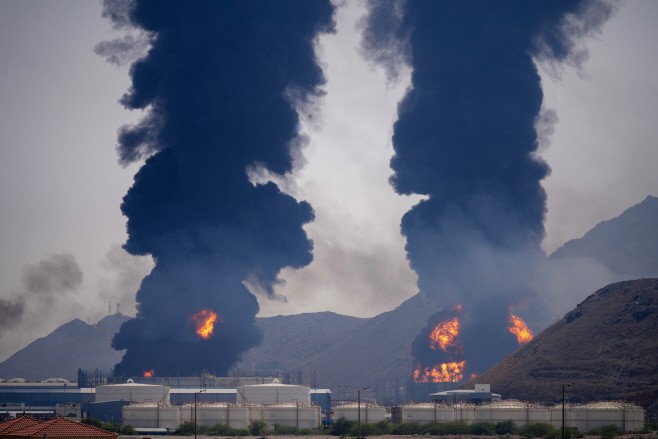 |
| Flames and smoke rise from an oil facility in Fujairah, United Arab Emirates, after debris from an intercepted Iranian drone struck the site on March 14. / AP-Yonhap |
The immediate catalyst for the UAE’s decision appears to be the ongoing conflict with Iran.
According to reports, Iran launched over 2,800 drones and missiles at Gulf states, with the UAE receiving the largest share of attacks. Frustration also grew over what UAE officials described as weak collective responses from the Gulf Cooperation Council.
Anwar Gargash, a senior advisor to the UAE president, criticized the bloc’s response as “the weakest in history” on the eve of the withdrawal.
 |
| The OPEC logo is seen on the organization’s headquarters building in Vienna, Austria, photographed on May 28, 2025. / AFP-Yonhap |
In the short term, the impact on oil prices may be limited due to existing supply disruptions. Brent crude has already surged above $110 per barrel following the Hormuz Strait closure.
However, analysts warn of significant long-term consequences. The UAE’s move could encourage other production-oriented countries to follow suit, potentially weakening OPEC’s influence further.
Some reports suggest that nations like Venezuela and Kazakhstan could consider similar steps.
Experts also warn of a possible oil price war between Saudi Arabia and the UAE once the Strait of Hormuz reopens—potentially more intense than the 2020 Saudi-Russia price conflict.
Jorge León of Rystad Energy noted that losing a major producer with nearly 4.8 million barrels per day in capacity represents a “critical turning point” for OPEC, adding that Saudi Arabia may now bear a heavier burden in stabilizing global oil markets.
The UAE’s departure marks a structural shift in the global energy system. As traditional alliances weaken and geopolitical tensions rise, the balance of power in oil markets is entering a new and uncertain phase.
With one of its core members pursuing an independent path, OPEC now faces growing questions about its future role in shaping global energy supply and prices.
#UAE #OPEC #Saudi Arabia #oil market #energy policy
Copyright by Asiatoday
Most Read
-
1
Trump shares map on social media labeling Strait o..

-
2
Kia Sportage outperforms Mazda CX-5 in German auto..

-
3
Houthis launch successive attacks on Saudi airport..

-
4
U.S. deploys carrier, 10,000 more troops to Middle..

-
5
Trump rejects Iran's offer to open Strait of Hormu..

-
6
N. Korea conducts first swarm attack drill with dr..

-
7
U.S.-China summit falls short on substance as Trum..

PEOPLE






HEADLINE NEWS
- Seoul dismisses Ukraine's claim of 'S. Korean support for Russia' as "inaccurate and inappropriate"
- S. Korea, Japan race to develop nuclear-powered submarines
- Henri Kagan, Kenso Soai win Nobel Prize in Chemistry for uncovering how mol..
- Vance says Alaska LNG cooperation will move forward with Seoul's current or..

-
Address : In-Young Bldg., 34, Uisadang-daero 1-gil, Yeongdeungpo-gu, Seoul
Copyright by ASIATODAY CO., LTD. All rights resereved