



Korea’s top film festivals seek survival strategies
Apr 28, 2026, 11:19 am


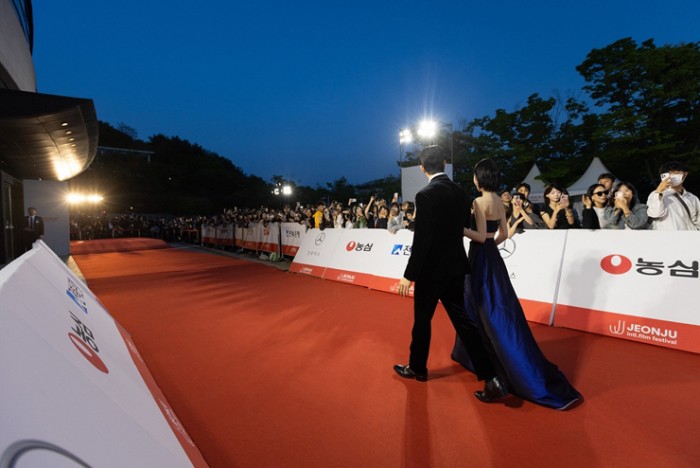 |
| As the “festival season” spanning more than six months kicks off this week with the opening of the 27th Jeonju International Film Festival on April 29, South Korea’s “Big 3” film festivals — including Jeonju — are undergoing transformation for survival. The photo shows the red carpet event at the opening ceremony of the 26th Jeonju International Film Festival held last year. /Courtesy of Jeonju International Film Festival |
South Korea’s major film festivals are undergoing sweeping changes as they confront declining audiences and shifting viewing habits in the era of streaming platforms.
The “festival season” kicks off this week with the 27th Jeonju International Film Festival, followed by a lineup of major events including the Bucheon International Fantastic Film Festival and the Busan International Film Festival.
Once numbering over 200 nationwide, only a handful of film festivals now maintain strong recognition among both domestic audiences and international industry figures. Among them, Jeonju, Bucheon, and Busan — often referred to as the “Big 3” — face a common challenge: survival.
Despite their maturity and established reputations, these festivals are grappling with the decline of theatrical cinema and the rapid rise of OTT platforms, which have reshaped audience behavior.
One major festival reportedly saw its attendance drop by half in 2024 compared to the previous year, underscoring the urgency for change.
As part of efforts to ensure survival, the Jeonju International Film Festival is expanding its Jeonju Cinema Project, which provides partial funding to emerging filmmakers, in a bid to strengthen its role in discovering new auteurs. The festival has drawn on successful cases such as Samsara by Lois Patiño and Direct Action by Ben Russell, both supported by the project and awarded Special Jury Prizes in the Encounters section at the Berlin International Film Festival in 2023 and 2024, respectively, helping elevate its global profile.
In parallel with building new infrastructure, Jeonju is also pursuing collaborations with internationally renowned filmmakers. The 11th installment of the “Walker” series by acclaimed director Tsai Ming-liang is being produced under the Jeonju Cinema Project. Filming is set to take place in Jeonju this year, with its premiere scheduled to coincide with the official opening of the Jeonju Independent Cinema House during next year’s festival.
Meanwhile, the Bucheon International Fantastic Film Festival is once again highlighting artificial intelligence (AI) as a central theme for the second consecutive year, positioning AI films alongside genre cinema as a key attraction. Starting this year, it also aims to become a hub for AI film production in Korea by partnering with institutions such as the Korean Film Council to train specialized talent.
The Busan International Film Festival, long known for its non-competitive format, has also undergone a major shift by introducing a competitive section and launching the “Busan Awards” last year.
 |
| The Bucheon International Fantastic Film Festival (BiFan) and the Busan International Film Festival (BIFF) are undergoing transformation through the introduction of AI films and competitive formats. The photo shows the official poster of the 30th BiFan opening in early July (left) and the cast and crew of No Choice walking the red carpet at the opening ceremony of the 30th BIFF last year. /Courtesy of BiFan·BIFF |
Budget constraints remain a persistent challenge. While local governments typically cover around 60% of festival funding, rising costs — such as increased airfare for international guests — strain already tight resources.
Film festivals must also carefully navigate relationships with local authorities and political stakeholders, particularly ahead of elections, to avoid potential budget cuts.
Government support has fluctuated in recent years. Funding was sharply reduced in 2024 before partially recovering, but still lags behind major international festivals such as Cannes and Berlin, which receive significantly higher public funding.
Industry experts warn against prioritizing scale over substance. Critics argue that some festivals have become overly focused on size and spectacle rather than their original mission.
Film critic Jeon Chan-il emphasized the need to return to fundamentals, urging festivals to serve as platforms that connect audiences with high-quality films rarely seen in mainstream theaters.
As Korea’s leading film festivals enter a new phase, their ability to balance innovation with identity will determine whether they can sustain relevance in a rapidly evolving media landscape.
#Jeonju International Film Festival #Bucheon International Fantastic Film Festival #Busan International Film Festival #Korean film festivals
Copyright by Asiatoday
Most Read
-
1
Alteogen secures European patent for Keytruda SC,..

-
2
Trump shares map on social media labeling Strait o..

-
3
Celltrion seeks rheumatoid arthritis indication ex..

-
4
Trump demands rates fall below 1% as Fed hikes for..

-
5
Chinese e-commerce giants AliExpress, Temu and She..

-
6
China expels No. 2 military official Zhang Youxia..

-
7
Houthi rebels release video claiming downing of Sa..

PEOPLE






HEADLINE NEWS
- UNC says N. Korea violated armistice agreement in DMZ landmine explosion
- U.S. 30-year Treasury yield hits 5.613% intraday, highest since 2002 as bon..
- Netanyahu faces political crisis ahead of election over allegations he igno..
- Chinese Foreign Minister Wang Yi demands retraction of Takaichi's remarks o..

-
Address : In-Young Bldg., 34, Uisadang-daero 1-gil, Yeongdeungpo-gu, Seoul
Copyright by ASIATODAY CO., LTD. All rights resereved